


Recovery and prognostic value of myocardial strain in ST-segment elevation myocardial infarction patients with a concurrent chronic total occlusion
- PMID: 31350585
- PMCID: PMC6890657
- DOI: 10.1007/s00330-019-06338-x
Recovery and prognostic value of myocardial strain in ST-segment elevation myocardial infarction patients with a concurrent chronic total occlusion
Abstract
Objectives: Global left ventricular (LV) function is routinely used to assess cardiac function; however, myocardial strain is able to identify more subtle dysfunction. We aimed to determine the recovery and prognostic value of featuring tracking (FT) cardiovascular magnetic resonance (CMR) strain in ST-segment elevation myocardial infarction (STEMI) patients with a concurrent chronic total occlusion (CTO).
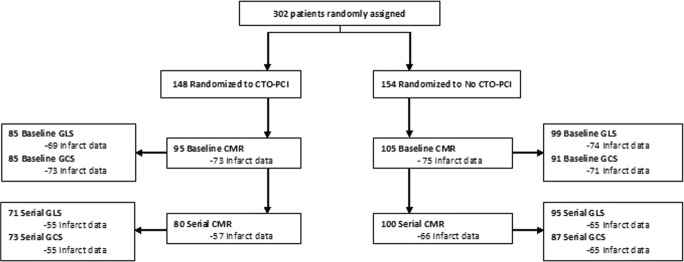
Methods: In the randomized EXPLORE trial, there was no significant difference in global LV function after percutaneous coronary intervention (PCI) of the CTO, compared with no-CTO PCI, post-STEMI. In the current study, we included 200 of the 302 EXPLORE patients with a baseline CMR, of which 180 also had 4-month follow-up (serial) CMR. Global longitudinal strain (GLS) was calculated from 3 long-axis views. Global circumferential strain (GCS) and segmental strain were calculated from 3 short-axis views (basal, mid, and apical).
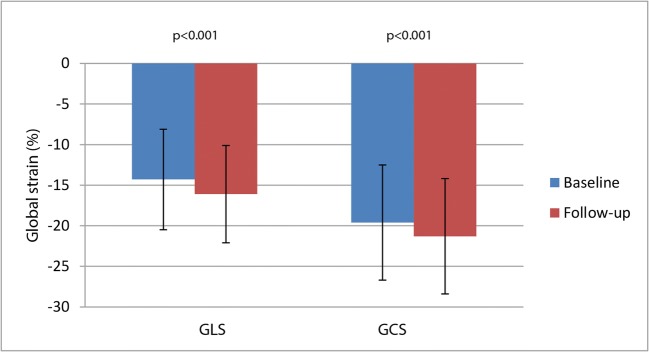
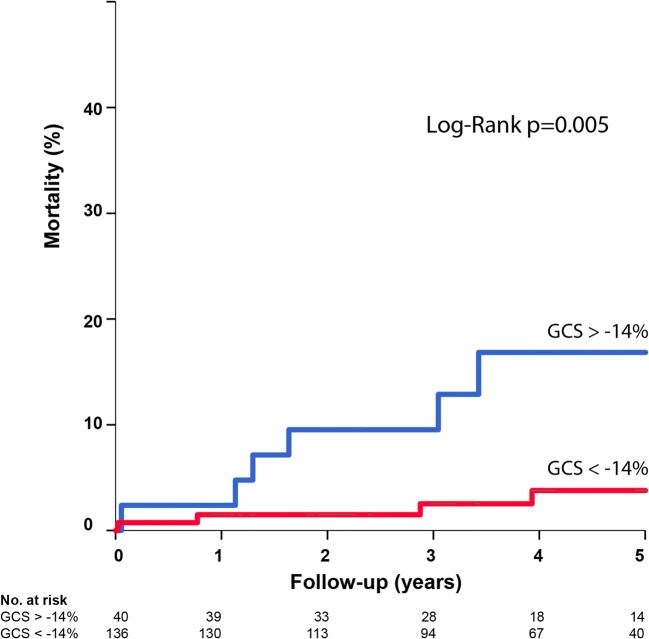
Results: Global strain significantly improved at 4 months (GLS ∆ - 1.8 ± 4.3%, p < 0.001; GCS ∆ - 1.7 ± 4.7%, p < 0.001); however, there was no treatment effect of CTO-PCI on strain recovery. GLS was a significant predictor for 4 months of LV ejection fraction (p = 0.006), incremental to other CMR parameters including infarct size. For mortality, infarct size remained the strongest predictor. On regional level, segmental strain independently predicted recovery in the dysfunctional segments (p < 0.001).
Conclusions: Global and segmental myocardial strains significantly improved over time, with no effect of CTO-PCI. Global strain was associated with outcome and segmental strain was an independent predictor for regional LV recovery in the dysfunctional CTO territory. Further research is needed to determine the additional prognostic value of strain beyond routine CMR parameters.
Key points: • In STEMI patients with a concurrent CTO, strain significantly improves over time, regardless of CTO-PCI. • Global strain is an independent predictor for functional recovery, incremental to infarct size, LVEF, and clinical parameters. • Segmental strain was able to predict the recovery of wall thickening, incremental to transmural extent of infarction.
Keywords: Coronary occlusion; Magnetic resonance imaging; Percutaneous coronary intervention; ST elevation myocardial infarction.
Conflict of interest statement
JPSH has received grants from Abbott Vascular during the conduct of the study and has received grants from B. Braun, Abiomed, and Biotronik outside the submitted work. RJvdS has received grants from Abbott Vascular, Biotronik, and Biosensors, has received personal fees from Biotronik and Boston Scientific, has been a consultant for Biotronik, and has received speaker fees from OrbusNeich, Boston Scientific, and Asahi Intecc outside the submitted work. TR has been a proctor for Boston Scientific.
Figures
References
-
- Khan JN, Singh A, Nazir SA, Kanagala P, Gershlick AH, McCann GP. Comparison of cardiovascular magnetic resonance feature tracking and tagging for the assessment of left ventricular systolic strain in acute myocardial infarction. Eur J Radiol. 2015;84(5):840–848. doi: 10.1016/j.ejrad.2015.02.002. - DOI - PubMed
-
- Shetye AM, Nazir SA, Razvi NA, et al. Comparison of global myocardial strain assessed by cardiovascular magnetic resonance tagging and feature tracking to infarct size at predicting remodelling following STEMI. BMC Cardiovasc Disord. 2017;17(1):7. doi: 10.1186/s12872-016-0461-6. - DOI - PMC - PubMed
Publication types
MeSH terms
Grants and funding
LinkOut - more resources
Full Text Sources
Medical
Miscellaneous
