


The prevalence, trends, and geographical distribution of human papillomavirus infection in China: The pooled analysis of 1.7 million women
- PMID: 31350872
- PMCID: PMC6718589
- DOI: 10.1002/cam4.2017
The prevalence, trends, and geographical distribution of human papillomavirus infection in China: The pooled analysis of 1.7 million women
Abstract
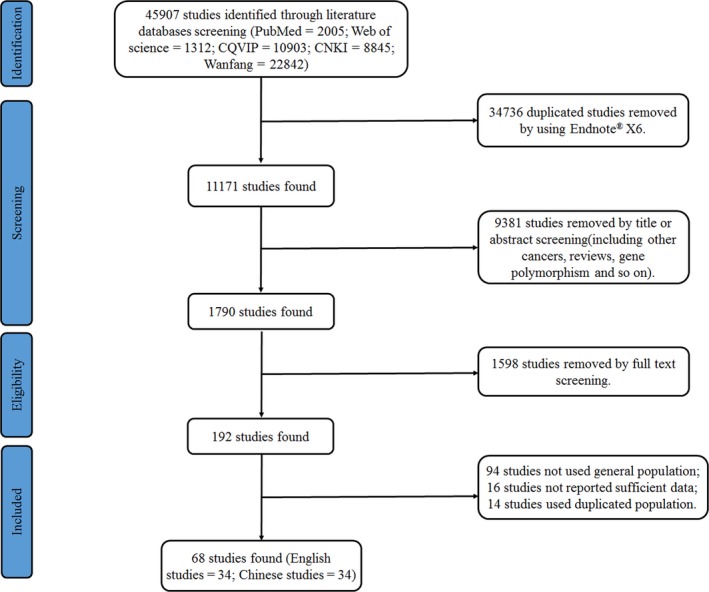
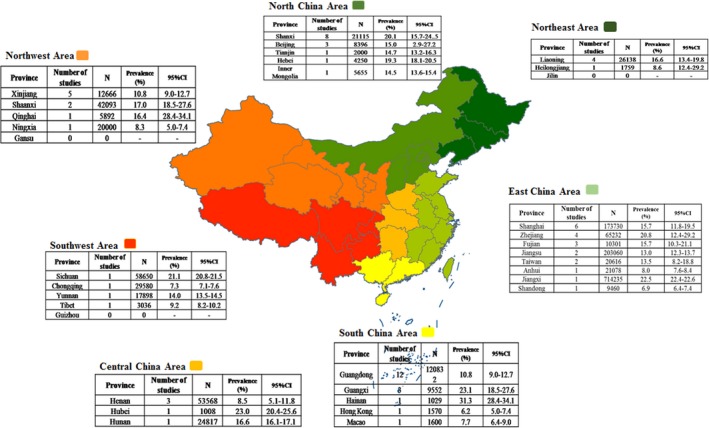
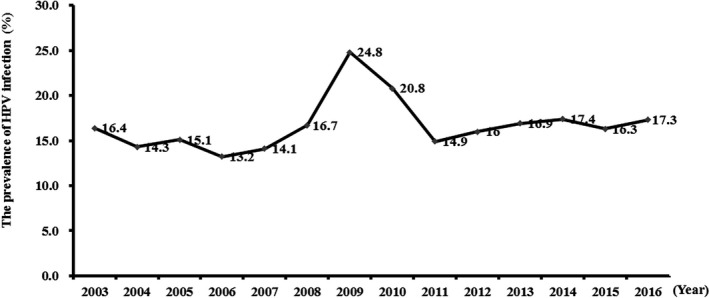
Human papillomavirus (HPV) infection which continues to be the most common sexually transmitted disease, has been identified as a major risk factor for cervical cancer. Therefore, it is very important to understand and grasp the distribution of HPV in Chinese population, and make the foundation for the development of cervical cancer vaccine in China. An extensive search strategy was conducted in multiple literature databases. All retrieved studies were screened by October 31, 2018. The prevalence of HPV infection was analyzed using random effects model. A total of 68 studies satisfied the inclusion criteria for our study. The national overall prevalence of HPV infection was 15.54% (95% CI: 13.83%-17.24%). we also performed subgroup analysis by age, geographic location, level of economic development, HPV assay method, and type of HPV infection. The top 5 common HPV types detected in general population, were HPV 16 (3.52%, 95% CI: 3.18%-3.86%), 52 (2.20%, 95% CI: 1.93%-2.46%), 58 (2.10%, 95% CI: 1.88%-2.32%), 18 (1.20%, 95% CI: 1.05%-1.35%), and 33 (1.02%, 95% CI: 0.89%-1.14%). Except for the higher prevalence of HPV infection in 2009 and 2010, the prevalence of HPV infection in other years changed little, ranged from 13.2% to 17.4%. HPV type in Chinese women was quite distinctive. HPV infection played a critical role in the occurrence of cervical cancer, understanding the distribution of HPV type and performing the HPV type testing had important clinical value for colposcopy referral and increasing the detection rate. Therefore, our findings could provide evidence for cervical cancer screening and vaccine, in order to reduce the burden of cervical cancer.
Keywords: China; HPV; distribution; general population.
© 2019 The Authors. Cancer Medicine published by John Wiley & Sons Ltd.
Conflict of interest statement
None declared.
Figures
References
-
- Torre LA, Bray F, Siegel RL, Ferlay J, Lortet‐Tieulent J, Jemal A. Global cancer statistics, 2012. CA Cancer J Clin. 2015;65(2):87‐108. - PubMed
-
- Chen WQ, Sun KX, Zheng RS, et al. Report of cancer incidence and morality in different areas of China, 2014. China Cancer. 2018;27:1‐14.
-
- Centers for Disease Control and Prevention (CDC) . Human papillomavirus‐associated cancers ‐ United States, 2004–2008. MMWR Morb Mortal Wkly Rep. 2012;61:258–261. - PubMed
-
- Cogliano V, Baan R, Straif K, Grosse Y, Secretan B, Ghissassi FE. Carcinogenicity of human papillomaviruses. Lancet Oncol. 2005;6:204. - PubMed
-
- Ronco G, Dillner J, Elfström KM, et al. Efficacy of HPV‐based screening for prevention of invasive cervical cancer: follow‐up of four European randomised controlled trials. Lancet (London, England). 2014;383:524–532. - PubMed
MeSH terms
Grants and funding
LinkOut - more resources
Full Text Sources
