Review
. 2019 Oct;42(10):2860-2870.
doi: 10.1111/pce.13632. Epub 2019 Aug 5.

Beneficial microbes going underground of root immunity

Affiliations
Review

Beneficial microbes going underground of root immunity

Ke Yu et al. Plant Cell Environ. 2019 Oct.

Abstract

Plant roots interact with an enormous diversity of commensal, mutualistic, and pathogenic microbes, which poses a big challenge to roots to distinguish beneficial microbes from harmful ones. Plants can effectively ward off pathogens following immune recognition of conserved microbe-associated molecular patterns (MAMPs). However, such immune elicitors are essentially not different from those of neutral and beneficial microbes that are abundantly present in the root microbiome. Recent studies indicate that the plant immune system plays an active role in influencing rhizosphere microbiome composition. Moreover, it has become increasingly clear that root-invading beneficial microbes, including rhizobia and arbuscular mycorrhiza, evade or suppress host immunity to establish a mutualistic relationship with their host. Evidence is accumulating that many free-living rhizosphere microbiota members can suppress root immune responses, highlighting root immune suppression as an important function of the root microbiome. Thus, the gate keeping functions of the plant immune system are not restricted to warding off root-invading pathogens but also extend to rhizosphere microbiota, likely to promote colonization by beneficial microbes and prevent growth-defense tradeoffs triggered by the MAMP-rich rhizosphere environment.

Keywords: host immune evasion; plant immunity; plant microbiome; rhizosphere; soil microbiology.


Figures

Figure 1
Figure 1
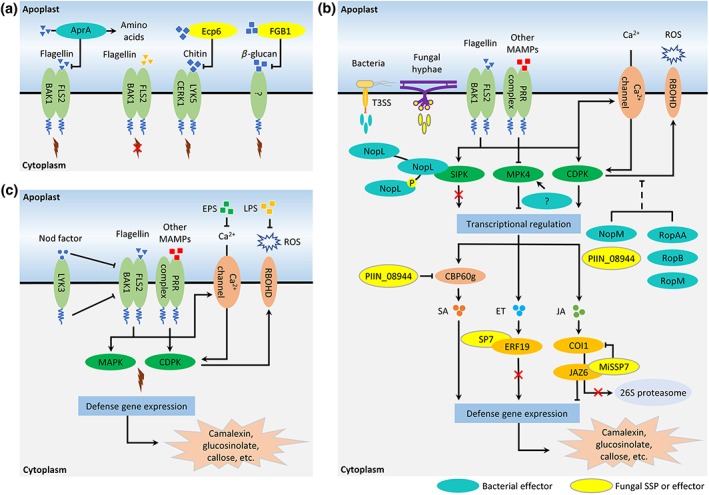
Schematic overview of beneficial microbes that evade or suppress root immune responses as described in the main text. (a) Beneficial microbes can evade PRR recognition by either evolving divergent MAMPs or masking the presence of excessive MAMPs. (b) Beneficial microbes can interfere with different host immune signalling components by secreting effectors. (c) Symbiosis‐related molecules produced by symbiotic microbes can suppress root immunity [Colour figure can be viewed at http://wileyonlinelibrary.com]
Figure 2
Figure 2
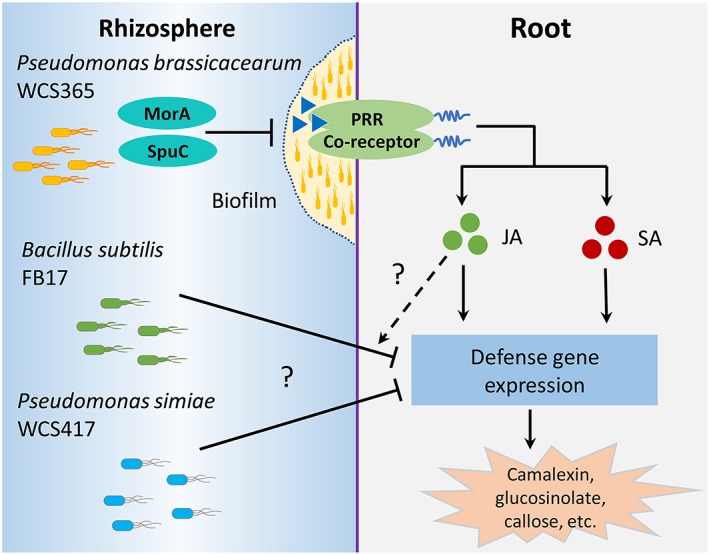
Schematic overview of root immune evasion and suppression mediated by non‐invasive beneficial microbes as described in the main text. Beneficial microbes living in rhizosphere can evade or suppress root immunity, suggesting that this is a useful trait for rhizosphere inhabitants [Colour figure can be viewed at http://wileyonlinelibrary.com]

References

    1. Akum, F. N. , Steinbrenner, J. , Biedenkopf, D. , Imani, J. , & Kogel, K. H. (2015). The Piriformospora indica effector PIIN_08944 promotes the mutualistic Sebacinalean symbiosis. Frontiers in Plant Science, 6, 906. - PMC - PubMed
    1. Almario, J. , Bruto, M. , Vacheron, J. , Prigent‐Combaret, C. , Moënne‐Loccoz, Y. , & Muller, D. (2017). Distribution of 2,4‐diacetylphloroglucinol biosynthetic genes among the Pseudomonas spp. reveals unexpected polyphyletism. Frontiers in Microbiology, 8, 1218. - PMC - PubMed
    1. Aslam, S. N. , Newman, M. A. , Erbs, G. , Morrissey, K. L. , Chinchilla, D. , Boller, T. , … Cooper, R. M. (2008). Bacterial polysaccharides suppress induced innate immunity by calcium chelation. Current Biology, 18, 1078–1083. 10.1016/j.cub.2008.06.061 - DOI - PubMed
    1. Bakker, P. A. H. M. , Berendsen, R. L. , Doornbos, R. F. , Wintermans, P. C. A. , & Pieterse, C. M. J. (2013). The rhizospere revisited: Root microbiomics. Frontiers in Plant Science, 4, 165. - PMC - PubMed
    1. Bakker, P. A. H. M. , Pieterse, C. M. J. , de Jonge, R. , & Berendsen, R. L. (2018). The soil‐borne legacy. Cell, 172, 1178–1180. 10.1016/j.cell.2018.02.024 - DOI - PubMed

Publication types

LinkOut - more resources