


High-intensity Focused Ultrasound Cycloplasty: Analysis of Pupil Dynamics
- PMID: 31354201
- PMCID: PMC6647825
- DOI: 10.5005/jp-journals-10028-1253
High-intensity Focused Ultrasound Cycloplasty: Analysis of Pupil Dynamics
Abstract
Aim: High-intensity focused ultrasound cystoplasty (UCP) aims to noninvasively and selectively target the ciliary body, thus lowering intraocular pressure (IOP). To be used on a large scale, the safety of the UCP procedure should be studied. Therefore, its effect on pupil behavior is important to better inform patients and to help physicians predict possible treatment side effects. This study aimed to evaluate to what extent UCP procedure (EyeOP-1®) affects pupil dynamics.
Materials and methods: Consecutive glaucoma patients with uncontrolled IOP despite optimal medication scheduled for UCP treatment were recruited and followed for 6 months. Pupillometry (PlusoptiX® S04) was performed at baseline, and 1, 3 and 6 months after UCP procedure at scotopic and mesopic conditions. The difference between pupil diameter (PD) in both lighting conditions was calculated at the three follow-up visits. Demographic, clinical characteristics and specific ocular parameters (anterior chamber depth and volume, white-to-white measurement, axial length, phakic status) were registered. Statistical analysis was performed using STATA 14.1.
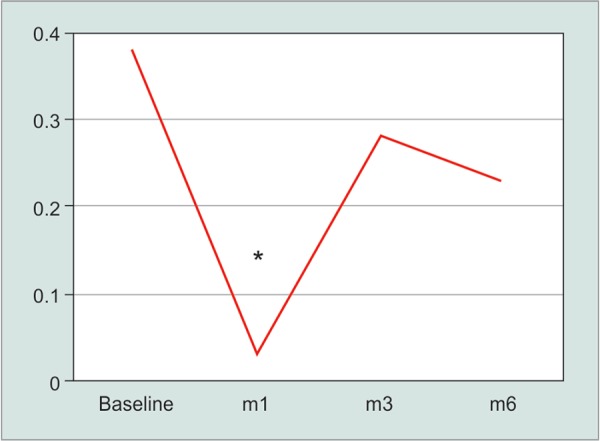
Results: Sixteen eyes of 16 patients with a mean age of 69 ± 11 years were included. Mean preoperative IOP and number of medications were 23.6 ± 3.0 mm Hg and 2.4 ± 1.3, respectively. Mean baseline scotopic and mesopic PD were 4.8 ± 0.8 mm and 4.4 ± 0.9 mm, respectively (difference = 0.38 ± 0.30 mm; range 0.1 to 1.2 mm). At month-1, the pupil diameter (PD) change between scotopic (4.6 ± 0.7 mm) and mesopic (4.5 ± 0.8 mm) conditions decreased to 0.03 ± 0.34 mm, p = 0.01. On the longer follow-up periods, however, the amplitude difference in PD compared to baseline was no longer significant (month-3: 0.28 ± 0.49 mm; month 6: 0.23 ± 0.41 mm; p >0.05). At the end of follow-up, mean scotopic and mesopic PD were 4.7 ± 1.0 mm and 4.4 ± 0.9 mm, respectively.
Conclusion and clinical significance: In the early postoperative period after UCP treatment, most patients present with a less light-reactive pupil, which seems to normalize with time.
How to cite this article: Sousa DC, Ferreira NP, Marques-Neves C, Somers A, Vandewalle E, Stalmans I, Pinto LA. High-intensity Focused Ultrasound Cycloplasty: Analysis of Pupil Dynamics. J Curr Glaucoma Pract 2018;12(3):102-106.
Keywords: Glaucoma; Intraocular pressure; Pupillometry; Ultrasound cystoplasty.
Conflict of interest statement
Source of support: Nil Conflict of interest: IS, LAP, DS–Consultant for Eye Tech Care.
Figures
References
-
- Tham Y-C,, Li X,, Wong TY,, et al. Global prevalence of glaucoma and projections of glaucoma burden through 2040: a systematic review and meta-analysis. Ophthalmology. 2014;;121((11):):2081-–2090.. - PubMed
-
- Burr JM,, Mowatt G,, Hernández R,, et al. The clinical effectiveness and cost-effectiveness of screening for open angle glaucoma: a systematic review and economic evaluation. Health Technol Assess. 2007;;11((41):):iii–iv, ix–x, 1–190.. - PubMed
-
- Coleman AL,, Miglior S. Risk Factors for Glaucoma Onset and Progression. Surv Ophthalmol. 2008;;53((6 SUPPL.).) - PubMed
-
- King A,, Azuara-Blanco A,, Tuulonen A. Glaucoma. BMJ. 2013;;346((jun11_1):):f3518.. - PubMed
LinkOut - more resources
Full Text Sources
Medical
Miscellaneous