


Effects of the Environment on Developmental Plasticity and Infection Success of Schistosoma Parasites - An Epigenetic Perspective
- PMID: 31354641
- PMCID: PMC6632547
- DOI: 10.3389/fmicb.2019.01475
Effects of the Environment on Developmental Plasticity and Infection Success of Schistosoma Parasites - An Epigenetic Perspective
Abstract
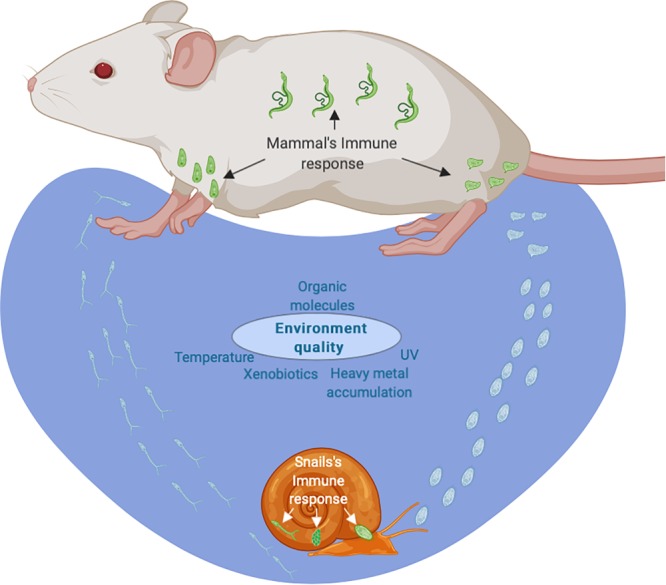
Evidence of how environmental cues affect the phenotypes of, and compatibility between Schistosoma mansoni and their hosts come from studies in environmental parasitology and research on host diet and chemotherapeutic treatment. Schistosomes deal with a multitude of signals from the water environment as well as cues that come from their hosts, particularly in response to molecules that serve to recognize and destroy them, i.e., those molecules that arise from their hosts' immune systems. These interactions shape, not only the parasite's morphology, metabolism and behavior in the short-term, but also their infection success and development into different stage-specific phenotypes later in their life cycle, through the modification of the parasite's inheritance system. Developmental phenotypic plasticity of S. mansoni is based on epigenetic mechanisms which are also sensitive to environmental cues, but are poorly understood. Here, we argue that specific cues from the environment could lead to changes in parasite development and infectivity, and consequently, environmental signals that come from environmental control measures could be used to influence S. mansoni dynamics and transmission. This approach poses a challenge since epigenetic modification can lead to unexpected and undesired outcomes. However, we suggest that a better understanding of how environmental cues are interpreted by epigenome during schistosome development and host interactions could potentially be applied to control parasite's virulence. We review evidence about the role of environmental cues on the phenotype of S. mansoni and the compatibility between this parasite and its intermediate and definitive hosts.
Keywords: environmental cues; host-para site interactions; imune response; inheritance systems; schistosomiasis.
Figures
References
-
- Augusto R. C., Friani G., Vasconcellos M. C., Rodrigues M. L. A., Mello-Silva C. C. (2015). Schistosoma mansoni: phytochemical effect on aquatic life cycle. Open J. Vet. Med. 5 127–132. 10.4236/ojvm.2015.56017 - DOI
-
- Augusto R. C., Tetreau G., Chan P., Walet-Balieu M. L., Mello-Silva C. C., Santos C. P., et al. (2017). Double impact: natural molluscicide for schistosomiasis vector control also impedes development of Schistosoma mansoni cercariae into adult parasites. PLoS Negl. Trop. Dis. 11:e0005789. 10.1371/journal.pntd.0005789 - DOI - PMC - PubMed
-
- Bakry F. A., El-Hommossany K., Abd El-Atti M., Ismail S. M. (2016). Alterations in the fatty acid profile, antioxidant enzymes and protein pattern of Biomphalaria Alexandrina snails exposed to the pesticides diazinon and profenfos. Toxicol. Ind. Health 32 666–676. 10.1177/0748233713506770 - DOI - PubMed
Publication types
Grants and funding
LinkOut - more resources
Full Text Sources
