


Integrating Morphological and Physiological Responses of Tomato Plants to Light Quality to the Crop Level by 3D Modeling
- PMID: 31354751
- PMCID: PMC6637845
- DOI: 10.3389/fpls.2019.00839
Integrating Morphological and Physiological Responses of Tomato Plants to Light Quality to the Crop Level by 3D Modeling
Abstract
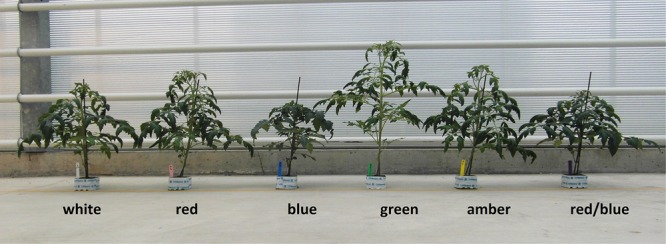
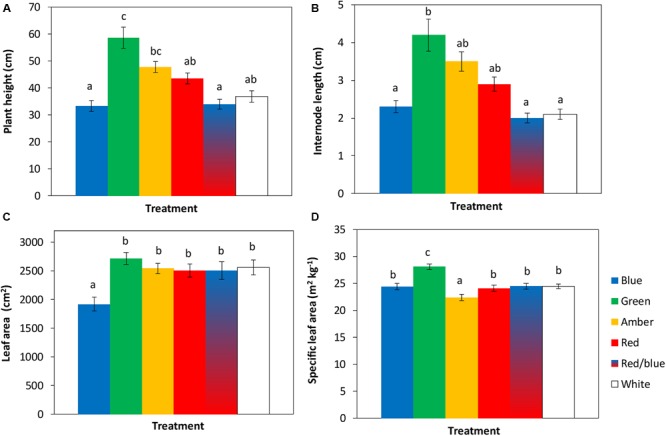
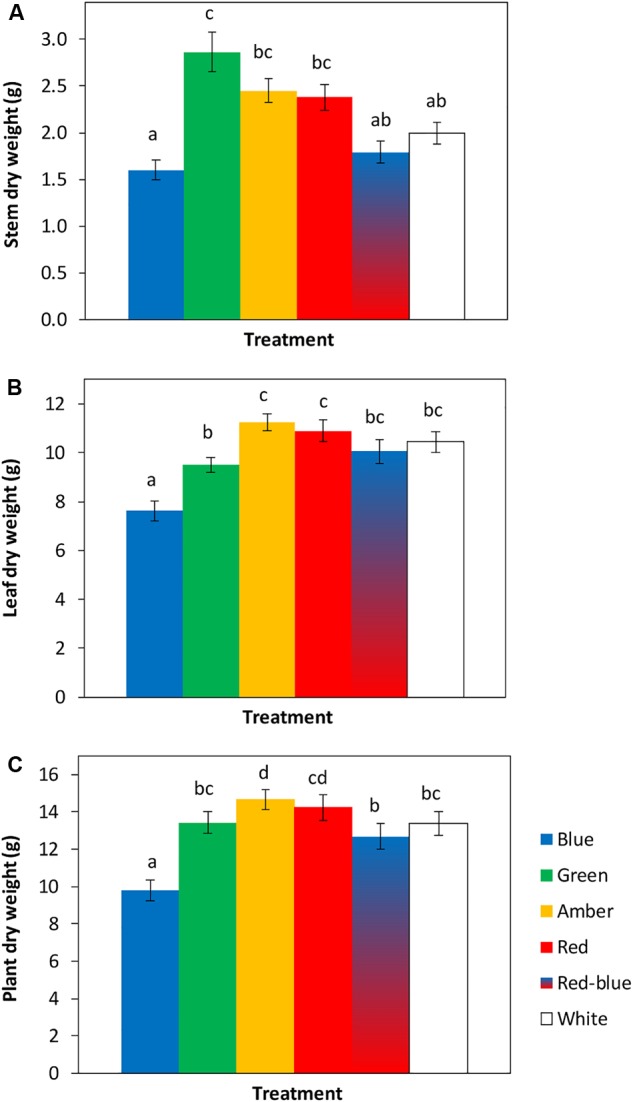
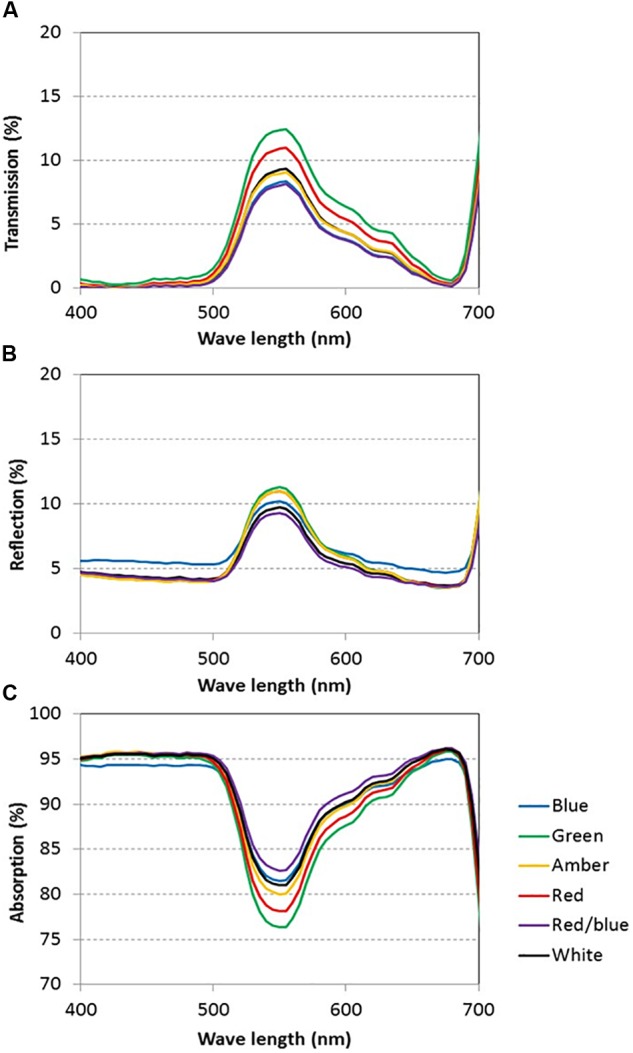
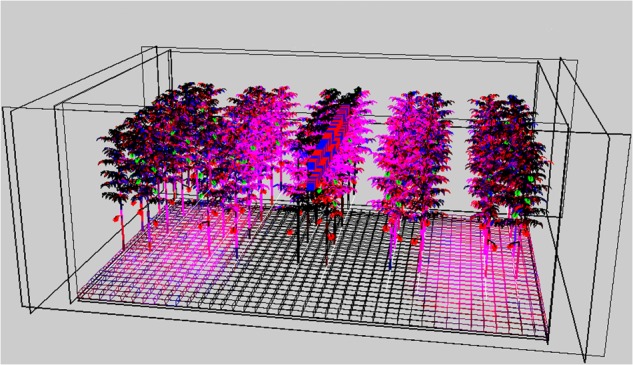
Next to its intensity, the spectral composition of light is one of the most important factors affecting plant growth and morphology. The introduction of light emitting diodes (LEDs) offers perspectives to design optimal light spectra for plant production systems. However, knowledge on the effects of light quality on physiological plant processes is still limited. The aim of this study is to determine the effects of six light qualities on growth and plant architecture of young tomato plants, and to upscale these effects to the crop level using a multispectral, functional-structural plant model. Young tomato plants were grown under 210 μmol m-2 s-1 blue, green, amber, red, white or red/blue (92%/8%) LED light with a low intensity of sunlight as background. Plants grown under blue light were shorter and developed smaller leaves which were obliquely oriented upward. Leaves grown under blue light contained the highest levels of light harvesting pigments, but when exposed to blue light only, they had the lowest rate of leaf photosynthesis. However, when exposed to white light these leaves had the highest rate of photosynthesis. Under green light, tomato plants were taller and leaves were nearly horizontally oriented, with a high specific leaf area. The open plant structure combined with a high light transmission and reflection at the leaf level allowed green light to penetrate deeper into the canopy. Plants grown under red, amber and white light were comparable with respect to height, leaf area and biomass production. The 3D model simulations indicated that the observed changes in plant architecture had a significant impact on light absorbance at the leaf and crop level. The combination of plant architecture and spectrum dependent photosynthesis was found to result in the highest rate of crop photosynthesis under red light in plants initially grown under green light. These results suggest that dynamic light spectra may offer perspectives to increase growth and production in high value production systems such as greenhouse horticulture and vertical farming.
Keywords: blue light; functional-structural plant model; green light; photomorphogenesis; red light; spectral composition of light.
Figures
References
-
- Atwell B. J., Kriedemann P. E., Turnbull C. G. (1999). Plants in Action: Adaptation in Nature, Performance in Cultivation. South Yarra, VIC: MacMillan Education Australia.
-
- Buck-Sorlin G. H., Hemmerling R., Vos J., De Visser P. H. B. (2009). “Modelling of spatial light distribution in the greenhouse: description of the model,” in Proceedings of the Third International Symposium on Plant Growth Modeling, Simulation, Visualization and Applications Beijing: 10.1109/PMA.2009.45 - DOI
-
- Bugbee B. (2016). Toward an optimal spectral quality for plant growth and development: the importance of radiation capture. Acta Hortic. 1134 1–12. 10.17660/ActaHortic.2016.1134.1 - DOI
LinkOut - more resources
Full Text Sources
