Review
. 2019 Jul 1:2019:1286054.
doi: 10.1155/2019/1286054. eCollection 2019.

Functional Skin Grafts: Where Biomaterials Meet Stem Cells

Affiliations
Review

Functional Skin Grafts: Where Biomaterials Meet Stem Cells

Amtoj Kaur et al. Stem Cells Int. .

Abstract

Skin tissue engineering has attained several clinical milestones making remarkable progress over the past decades. Skin is inhabited by a plethora of cells spatiotemporally arranged in a 3-dimensional (3D) matrix, creating a complex microenvironment of cell-matrix interactions. This complexity makes it difficult to mimic the native skin structure using conventional tissue engineering approaches. With the advent of newer fabrication strategies, the field is evolving rapidly. However, there is still a long way before an artificial skin substitute can fully mimic the functions and anatomical hierarchy of native human skin. The current focus of skin tissue engineers is primarily to develop a 3D construct that maintains the functionality of cultured cells in a guided manner over a period of time. While several natural and synthetic biopolymers have been translated, only partial clinical success is attained so far. Key challenges include the hierarchical complexity of skin anatomy; compositional mismatch in terms of material properties (stiffness, roughness, wettability) and degradation rate; biological complications like varied cell numbers, cell types, matrix gradients in each layer, varied immune responses, and varied methods of fabrication. In addition, with newer biomaterials being adopted for fabricating patient-specific skin substitutes, issues related to escalating processing costs, scalability, and stability of the constructs under in vivo conditions have raised some concerns. This review provides an overview of the field of skin regenerative medicine, existing clinical therapies, and limitations of the current techniques. We have further elaborated on the upcoming tissue engineering strategies that may serve as promising alternatives for generating functional skin substitutes, the pros and cons associated with each technique, and scope of their translational potential in the treatment of chronic skin ailments.


Figures
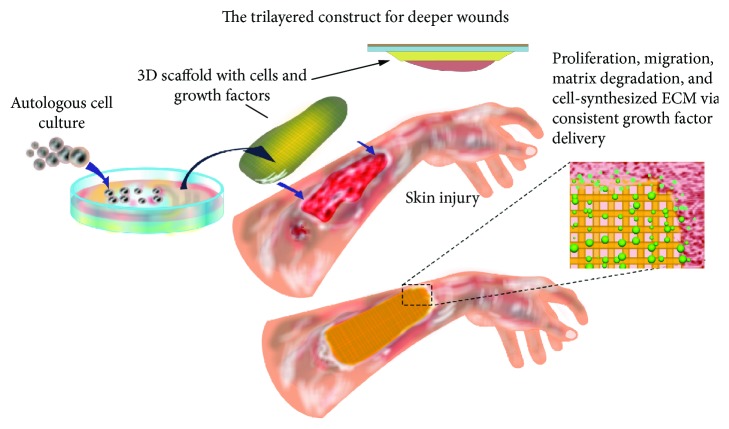
Figure 1
Figure 1
Schematic illustrating the stages of skin tissue engineering using biomaterials and stem cell technology. Briefly, autologous cells are isolated from skin biopsies of patients and expanded in vitro for up to 3 weeks. When optimal cell confluency is achieved, cells in combination with growth- and differentiation-inducing factors are seeded on biomimetic scaffolds (with structural resemblance to the skin anatomy) for implantation into the target site to facilitate repair and regeneration of the damaged skin tissue.
Figure 2
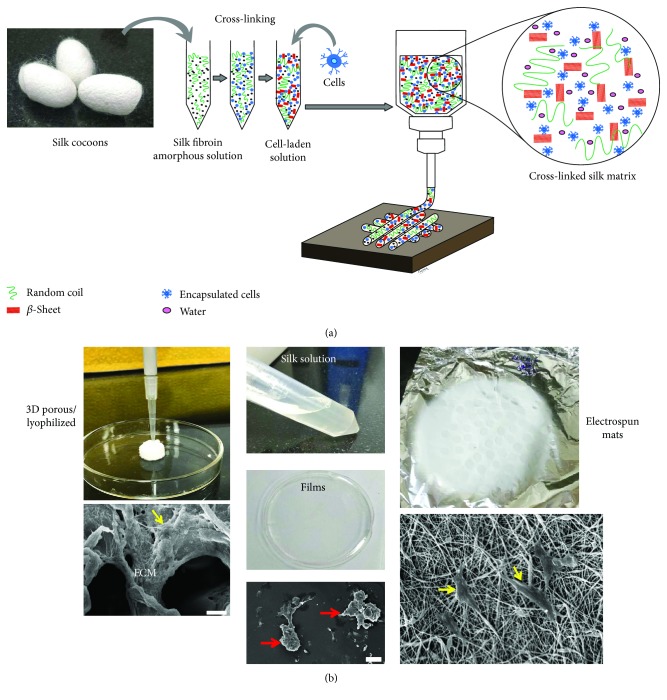
Figure 2
The panel illustrates the processing of silk fibroin solution into various scaffold morphologies by exploiting the physicochemical properties of silk fibroin. (a) Schematic showing the stages of 3D bioprinting: silk fibroin solution is isolated from Bombyx mori cocoons in the form of an aqueous solution. The sol to gel transition of this aqueous silk fibroin solution is induced using different cross-linking methods (chemical, physical). Once the rheology is optimized, the silk fibroin hydrogel is mixed with cells and 3D bioprinting is executed under applied pressure (pneumatic or mechanical). (b) Silk fibroin solution is processed in the form of 2D planar films, lyophilized scaffold with 3D porous morphology, and nanofibrous electrospun mats. Scanning electron micrographs demonstrate enhanced cell adhesion, characteristic fibroblastic morphology, and ECM deposition by cultured IHF on 3D scaffolds (lyophilized and electrospun; yellow arrows) as compared to distorted morphology on 2D films (red arrows). Scale bars = 20 μm. Abbreviations: IHF—immortalized human fibroblasts; ECM—extracellular matrix.
Figure 3
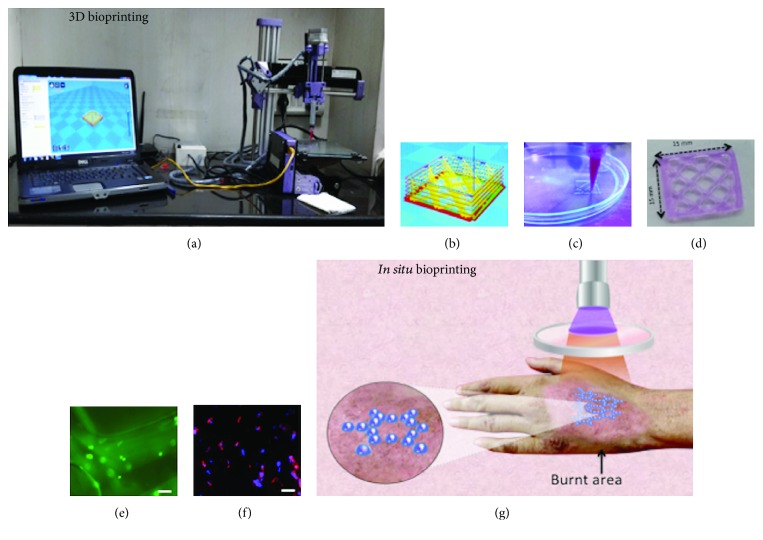
Figure 3
3D bioprinting to develop custom-made skin tissue constructs. (a) A customized printer used in our lab (by Alfatek Systems, Kolkata). (b) The CAD image prepared using the inbuilt software in a readable file format for bioprinting. (c) Following the CAD image, a pluronic-based bioink mixed with fibroblasts is loaded into the syringe fitted with a nozzle and the printing process is executed under applied pressure. (d) 3D bioprinted construct. (e) Fluorescence micrograph of GFP-tagged fibroblasts (green) showing cellular distribution inside the filaments of the construct immediately after printing. (f) Protein expression of skin-specific marker vimentin (red) in a 3D bioprinted pluronic-based construct 3 days postprinting by immunofluorescent staining. Nuclear staining was done by DAPI (blue). (g) In situ bioprinting strategy schematically depicted on the burnt skin of a patient demonstrating deposition of the bioink directly on the region of interest. Scale bars = 30 μm. Abbreviations: CAD—computer-aided design; IHF—immortalized human fibroblasts. Immortalized human fibroblasts (IHF) were used for 3D bioprinting.

References

    1. Zanger P. Staphylococcus aureus positive skin infections and international travel. Wiener klinische Wochenschrift. 2010;122(S1):31–33. doi: 10.1007/s00508-010-1333-1. - DOI - PubMed
    1. Bhardwaj N., Chouhan D., Mandal B. B. Functional 3D Tissue Engineering Scaffolds. Woodhead Publishing; 2018. 3D functional scaffolds for skin tissue engineering; pp. 345–365. - DOI
    1. Liu H., Wang C., Li C., et al. A functional chitosan-based hydrogel as a wound dressing and drug delivery system in the treatment of wound healing. RSC Advances. 2018;8(14):7533–7549. doi: 10.1039/c7ra13510f. - DOI - PMC - PubMed
    1. Brohem C. A., Da Silva Cardeal L. B., Tiago M., Soengas M. S., De Moraes Barros S. B., Maria-Engler S. S. Artificial skin in perspective: concepts and applications. Pigment Cell & Melanoma Research. 2011;24(1):35–50. doi: 10.1111/j.1755-148X.2010.00786.x. - DOI - PMC - PubMed
    1. Nemes Z., Steinert P. M. Bricks and mortar of the epidermal barrier. Experimental & Molecular Medicine. 1999;31(1):5–19. doi: 10.1038/emm.1999.2. - DOI - PubMed

LinkOut - more resources