Review
. 2019 Jul 27;11(8):1061.
doi: 10.3390/cancers11081061.

Molecular Characteristics of Uveal Melanoma: Insights from the Cancer Genome Atlas (TCGA) Project

Affiliations
Review

Molecular Characteristics of Uveal Melanoma: Insights from the Cancer Genome Atlas (TCGA) Project

Mathieu F Bakhoum et al. Cancers (Basel). .

Abstract

The Cancer Genome Atlas (TCGA) uveal melanoma project was a comprehensive multi-platform deep molecular investigation of 80 uveal melanoma primary tissue samples supported by the National Cancer Institute. In addition to identification of important mutations for the first time, it identified four different clusters (subgroups) of patients paralleling prognosis. The findings of the TCGA marker paper are summarized in this review manuscript and other investigations that have stemmed from the findings of the TCGA project are reviewed.

Keywords: RNA seq; TCGA; immune infiltrates; methylation; uveal melanoma; whole exome sequencing.


Conflict of interest statement

The authors declare no conflict of interest.

Figures
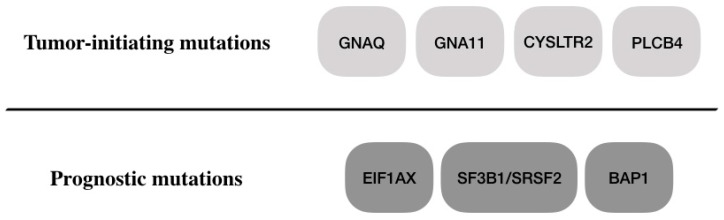
Figure 1
Figure 1
Two layers of mutations in uveal melanoma (UM). Mutations in genes involved in G-protein signaling are present in 98% of samples in a nearly mutually exclusive manner. They are also present in benign choroidal nevi and are therefore thought to occur in the earlier stages of tumor formation. A second layer of mutations occurs in EIF1AX, SF3B1, SRSF2, and BAP1. They are found in 66% of samples in a nearly mutually exclusive manner as well. These mutations confer different prognoses.
Figure 2
Figure 2
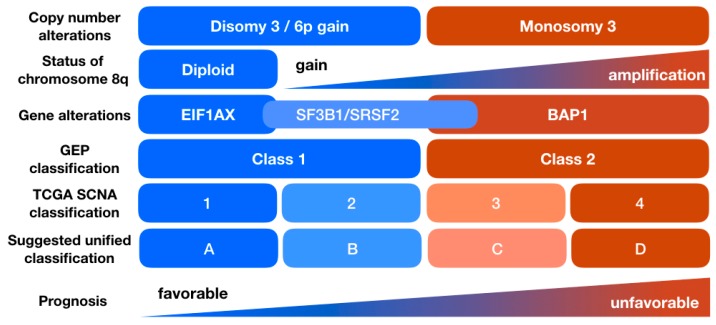
An overview of UM subtypes. Prognostic classes can be inferred from either somatic copy number alterations (SCNA), gene alterations, or gene expression. The A, B, C, and D classification was suggested to avoid confusion between the numerical classification used in both the Cancer Genome Atlas (TCGA) and the commercially available test (GEP classification).

References

    1. Kujala E., Mäkitie T., Kivelä T. Very long-term prognosis of patients with malignant uveal melanoma. Invest. Ophthalmol. Vis. Sci. 2003;44:4651–4659. doi: 10.1167/iovs.03-0538. - DOI - PubMed
    1. Diener-West M., Reynolds S.M., Agugliaro D.J., Caldwell R., Cumming K., Earle J.D., Hawkins B.S., Hayman J.A., Jaiyesimi I., Jampol L.M., et al. Collaborative ocular melanoma study group development of metastatic disease after enrollment in the COMS trials for treatment of choroidal melanoma: Collaborative ocular melanoma study group report No. 26. Arch. Ophthalmol. 2005;123:1639–1643. - PubMed
    1. Andreoli M.T., Mieler W.F., Leiderman Y.I. Epidemiological trends in uveal melanoma. Br. J. Ophthalmol. 2015;99:1550–1553. doi: 10.1136/bjophthalmol-2015-306810. - DOI - PubMed
    1. Collaborative Ocular Melanoma Study Group The COMS randomized trial of iodine 125 brachytherapy for choroidal melanoma: V. Twelve-year mortality rates and prognostic factors: COMS report No. 28. Arch. Ophthalmol. 2006;124:1684–1693. doi: 10.1001/archopht.124.12.1684. - DOI - PubMed
    1. Singh A.D., Turell M.E., Topham A.K. Uveal melanoma: Trends in incidence, treatment, and survival. Ophthalmology. 2011;118:1881–1885. doi: 10.1016/j.ophtha.2011.01.040. - DOI - PubMed

LinkOut - more resources