Review
. 2019 Jul 28;20(15):3694.
doi: 10.3390/ijms20153694.

The Role of Sodium Hydrogen Exchanger 1 in Dysregulation of Proton Dynamics and Reprogramming of Cancer Metabolism as a Sequela

Affiliations
Review

The Role of Sodium Hydrogen Exchanger 1 in Dysregulation of Proton Dynamics and Reprogramming of Cancer Metabolism as a Sequela

Rosa Angela Cardone et al. Int J Mol Sci. .

Abstract

Cancer cells have an unusual regulation of hydrogen ion dynamics that are driven by poor vascularity perfusion, regional hypoxia, and increased glycolysis. All these forces synergize/orchestrate together to create extracellular acidity and intracellular alkalinity. Precisely, they lead to extracellular pH (pHe) values as low as 6.2 and intracellular pH values as high as 8. This unique pH gradient (∆pHi to ∆pHe) across the cell membrane increases as the tumor progresses, and is markedly displaced from the electrochemical equilibrium of protons. These unusual pH dynamics influence cancer cell biology, including proliferation, metastasis, and metabolic adaptation. Warburg metabolism with increased glycolysis, even in the presence of Oxygen with the subsequent reduction in Krebs' cycle, is a common feature of most cancers. This metabolic reprogramming confers evolutionary advantages to cancer cells by enhancing their resistance to hypoxia, to chemotherapy or radiotherapy, allowing rapid production of biological building blocks that support cellular proliferation, and shielding against damaging mitochondrial free radicals. In this article, we highlight the interconnected roles of dysregulated pH dynamics in cancer initiation, progression, adaptation, and in determining the programming and re-programming of tumor cell metabolism.

Keywords: Na+/H+ exchanger; pH and Warburg metabolism; pH and cancer; proton transport in cancer; tumor metabolic microenvironment.


Conflict of interest statement

The authors declare no conflict of interest.

Figures
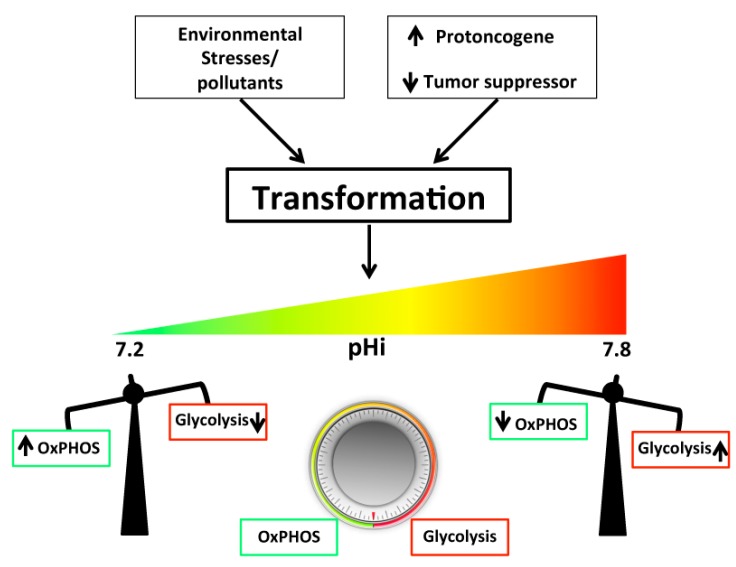
Figure 1
Figure 1
Among all the many allosteric factors controlling glycolysis, the cytosolic pH is in all probability the most significant factor regulating the metabolic balance. In the presence of adequate oxygen levels, the intracellular pH (pHi) plays a crucial role in determining the way cancer cells obtain energy: An alkaline pHi driving aerobic glycolysis, and a neutral pH driving oxidative phosphorylation with the cells pH transporters, ion channels, and enzymes, representing the core of this sophisticated and coordinated system (see text). An explanation for this phenomenon derives from the fact that both the processes of oxidative phosphorylation (OxPHOS) and glycolysis are exquisitely but oppositely pH-sensitive, and a rapid shift of metabolic cell patterns follows either acidification or alkalinization of the cytosol. On the basis of the studies discussed in this review, we can now see that the alkalinization of the cytosol occurs in the very first steps of oncogene-driven neoplastic transformation and is probably the fundamental physiological alteration utilized by the increased expression/activity of an oncogene or decreased expression/activity of a tumor suppressor to transform a normal cell. In this way, cytosolic pH would regulate the cells’ metabolic balance as a rheostat, as described in the general scheme imagined by DeBerardinis and Chandel [33], where instead of the usual on or off ‘switch’ between glycolysis and OxPHOS, they hypothesized the existence of a continuum between the two but did not have a physiological mechanism that could underlie this proposed rheostat-like mechanism.

References

    1. Alfarouk K.O., Shayoub M.E.A., Muddathir A.K., Elhassan G.O., Bashir A.H.H. Evolution of tumor metabolism might reflect carcinogenesis as a reverse evolution process (dismantling of multicellularity) Cancers. 2011;3:3002–3017. doi: 10.3390/cancers3033002. - DOI - PMC - PubMed
    1. Alfarouk K.O. Tumor metabolism, cancer cell transporters, and microenvironmental resistance. J. Enzym. Inhib. Med. Chem. 2016;31:859–866. doi: 10.3109/14756366.2016.1140753. - DOI - PubMed
    1. Huber V., De Milito A., Harguindey S., Reshkin S.J., Wahl M.L., Rauch C., Chiesi A., Pouysségur J., Gatenby R.A., Rivoltini L., et al. Proton dynamics in cancer. J. Transl. Med. 2010;8:57. doi: 10.1186/1479-5876-8-57. - DOI - PMC - PubMed
    1. Alfarouk K.O., Bashir A.H.H. Diabetes mellitus type 2 through oncology lens. Med. Hypotheses. 2011;76:761–762. doi: 10.1016/j.mehy.2011.01.031. - DOI - PubMed
    1. Alfarouk K.O., Verduzco D., Rauch C., Muddathir A.K., Bashir A.H.H., Elhassan G.O., Ibrahim M.E., Orozco P.J.D., Cardone R.A., Reshkin S.J., et al. Glycolysis, tumor metabolism, cancer growth and dissemination. A new pH-based etiopathogenic perspective and therapeutic approach to an old cancer question. Oncoscience. 2014;1:777–802. doi: 10.18632/oncoscience.109. - DOI - PMC - PubMed

MeSH terms

LinkOut - more resources
