


Bloodstream and catheter-related infections due to different clones of multidrug-resistant and biofilm producer Corynebacterium striatum
- PMID: 31357945
- PMCID: PMC6664767
- DOI: 10.1186/s12879-019-4294-7
Bloodstream and catheter-related infections due to different clones of multidrug-resistant and biofilm producer Corynebacterium striatum
Abstract
Background: Corynebacterium striatum is an emerging multidrug-resistant (MDR) pathogen associated with immunocompromised and chronically ill patients, as well as nosocomial outbreaks. In this study, we characterized 23 MDR C. striatum isolated of bloodstream and catheter-related infections from a hospital of Rio de Janeiro.
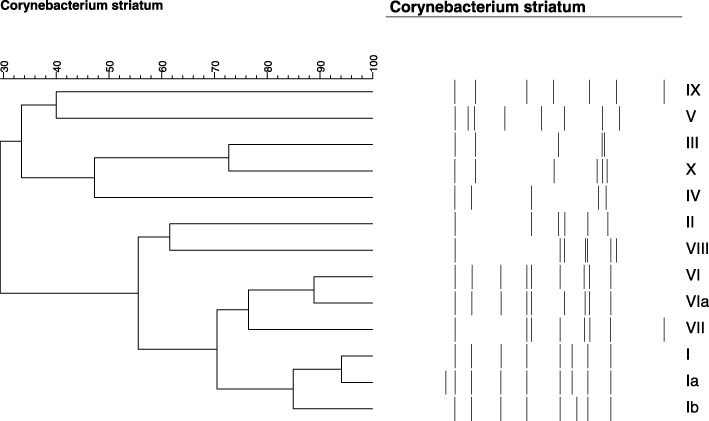
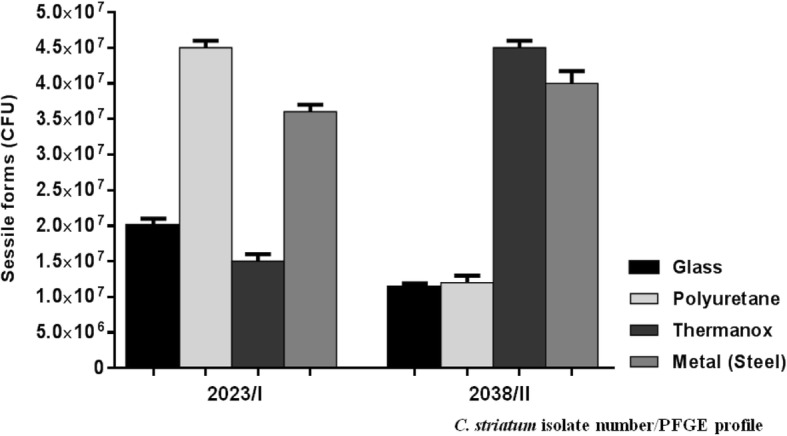
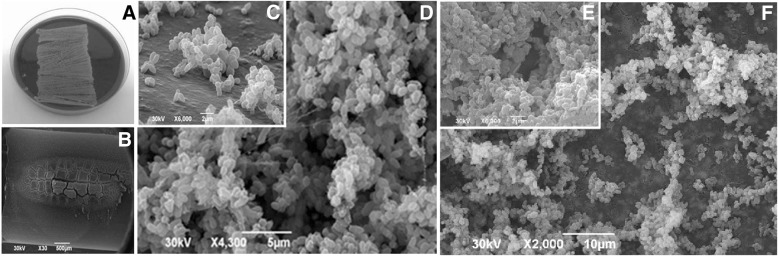
Methods: C. striatum isolates were identified by 16S rRNA and rpoB genes sequencing. The dissemination of these isolates was accomplished by pulsed-field gel electrophoresis (PFGE). All isolates were submitted to antimicrobial susceptibility testing by disk diffusion and by minimum inhibitory concentration using E-test strips methods. Antimicrobial resistance genes were detected by polymerase chain reaction. Quantitative tests were performed on four different abiotic surfaces and the ability to produce biofilm on the surface of polyurethane and silicone catheter was also demonstrated by scanning electron microscopy.
Results: Eleven PFGE profiles were found. The PFGE profile I was the most frequently observed among isolates. Five different MDR profiles were found and all PFGE profile I isolates presented susceptibility only to tetracycline, vancomycin, linezolid and daptomycin. Only the multidrug-susceptible isolate did not show mutations in the quinolone-resistance determinant region (QRDR) of the gyrA gene and was negative in the search of genes encoding antibiotic resistance. The other 22 isolates were positive to resistance genes to aminoglycoside, macrolides/lincosamides and chloramphenicol and showed mutations in the QRDR of the gyrA gene. Scanning electron microscopy illustrated the ability of MDR blood isolate partaker of the epidemic clone (PFGE profile I) to produce mature biofilm on the surface of polyurethane and silicone catheter.
Conclusions: Genotyping analysis by PFGE revealed the permanence of the MDR PFGE profile I in the nosocomial environment. Other new PFGE profiles emerged as etiologic agents of invasive infections. However, the MDR PFGE profile I was also found predominant among patients with hematogenic infections. The high level of multidrug resistance associated with biofilm formation capacity observed in MDR C. striatum is a case of concern.
Keywords: Antimicrobial multiresistance; Bacteremia; Biofilm; C. striatum; Catheter-related infection; Nosocomial outbreak.
Conflict of interest statement
The authors declare that they have no competing interests.
Figures
References
-
- Collada M, Rico Nieto A. Diaz de Bustamante Ussia M, balsa Criado a.Septic arthritis in a native knee due to Corynebacterium striatum. Reumatol Clin. 2017;17:30033–30035. - PubMed
MeSH terms
Substances
LinkOut - more resources
Full Text Sources
Molecular Biology Databases
