. 2019 Oct 15;25(20):6089-6097.
doi: 10.1158/1078-0432.CCR-19-0208. Epub 2019 Jul 29.

Circulating Tumor Cell Clusters in Patients with Metastatic Breast Cancer: a SWOG S0500 Translational Medicine Study

Affiliations

Circulating Tumor Cell Clusters in Patients with Metastatic Breast Cancer: a SWOG S0500 Translational Medicine Study

Costanza Paoletti et al. Clin Cancer Res. .

Abstract

Purpose: Metastasis requires malignant cell circulation from the primary to a distant tissue. Elevated levels of circulating tumor cells (CTC) portend a poor prognosis in breast and other cancers. Recent studies have suggested that CTC clusters may be a factor in the metastatic process. We conducted a prospective retrospective study of the SWOG0500 clinical trial to test whether CTC clusters are associated with poorer prognosis.

Experimental design: CTC CellSearch galleries from SWOG0500 trial were reread using prespecified criteria for CTC clusters, doublets, and enumeration. Survival analysis methods include Kaplan-Meier plots and log-rank tests.

Results: Patients were classified into three prognostic subgroups based on baseline CTC/7.5 mL whole blood (WB): Arm A: <5CTC; Arm B/C: ≥5CTC and then B (<5CTC) and C (≥5CTC)/7.5 mL WB at first follow-up. At baseline, 19% of patients had CTC doublets or clusters, which were more likely in Arm B/C versus Arm A (38% vs. 1.4%; P < 0.0001). Furthermore, doublets or clusters were significantly more common in patients who were ultimately assigned to Arm C versus B (54% vs. 25%; P < 0.0001). In Arm C, doublets and clusters were associated with worse overall survival than only doublets, clusters, or no doublets nor clusters at baseline (P = 0.008) and first follow-up (P = 0.010). When compared with enumeration alone, doublets, clusters, or both were not prognostic in patients who had 5-19 or ≥20 CTC/7.5 mL WB.

Conclusions: In patients with metastatic breast cancer starting first-line chemotherapy, mortality is independent of the presence of CTC clusters, but rather depends on the number of CTC/7.5 mL WB.


Figures

Fig. 1.
Fig. 1.
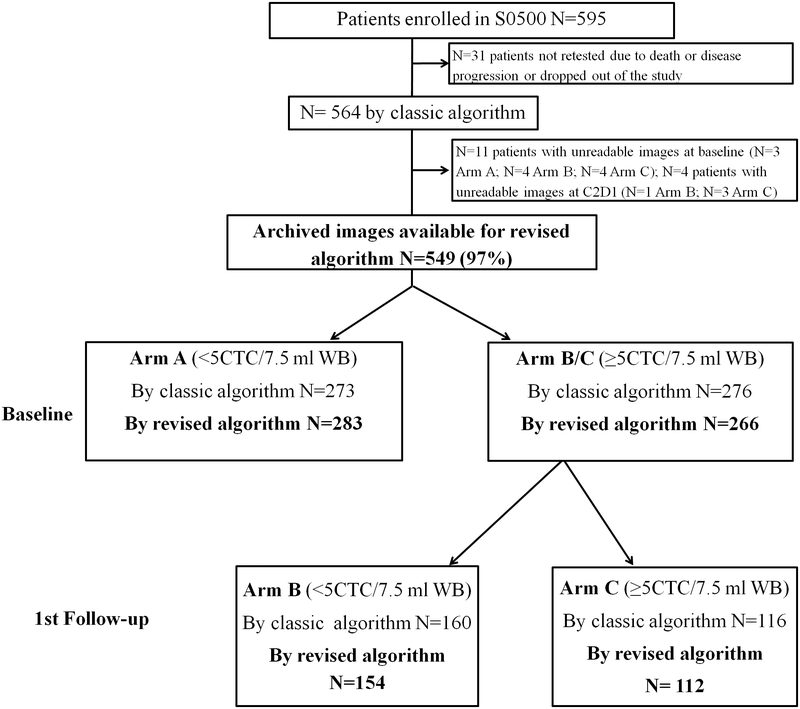
REMARK diagram for doublet/clusters analysis of S0500. Of the 564 patients originally eligible for S0500, 549 had images stored and readable for analysis for doublets and clusters. When the CellSearch galleries were re-read, 10 patients originally assigned to Arms B/C were reassigned to Arm A due to revised total CTC <5 due to inter-laboratory variability, and likewise, 4 patients originally assigned to Arm C were assigned to Arm B due to revised total CTC <5 at 1st follow-up. Two patients originally assigned to Arm A were revised to ≥5 CTC/7.5 ml WB, but they could not be reassigned to Arm B or C due to the lack of assessments at first follow up and therefore, they were still assigned to Arm A (N=1 due to interlaboratory variability; N=1 due revised algorithm)(see text for details).
Fig. 2.
Fig. 2.
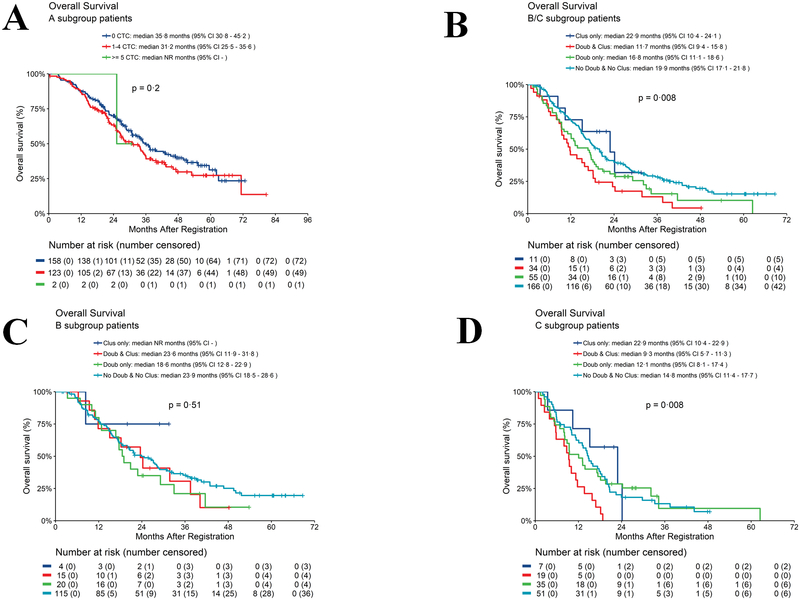
Overall survival according to CTC enumeration or doublets and clusters at baseline. 2A. Arm A: OS for patients with 0 vs 1–4 CTC/7.5 ml WB using revised algorithm. 2B. Arm B/C: OS according to presence or absence of clusters. 2C. Arm B: OS according to presence or absence of clusters. 2D. Arm C: OS according to presence or absence of clusters (See text for definition of Arm A, B, and C).
Fig. 3.
Fig. 3.
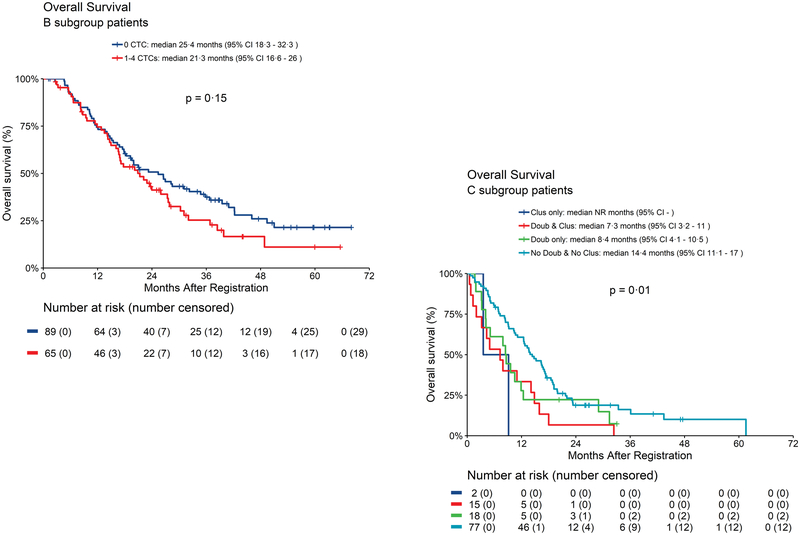
Overall survival according to CTC enumeration or doublets and clusters at first follow-up. 3A. Arm B: OS for patients with 0 vs 1–4 CTC/7.5 ml WB using revised algorithm. 3B. Arm C: OS according to presence or absence of clusters (See text for definition of Arm A, B, and C).
Fig. 4.
Fig. 4.
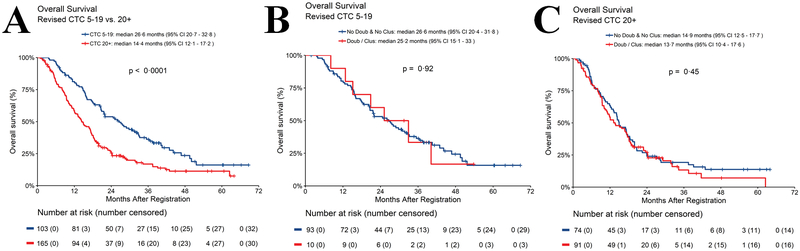
Overall survival according to CTC enumeration in patients with 5–19 vs ≥20 CTC/7.5 ml WB at baseline using the revised algorithm. 4A. OS for patients with 5–19 vs. ≥20 CTC/7.5 ml WB; 4B. OS of patients with 5–19 CTC/7.5 ml WB divided by doublets or clusters vs. no doublets or clusters; 4C. OS of patients with ≥20 CTC/7.5 ml WB divided by doublets or clusters vs no doublets or cluster.

References

    1. Hanahan D, Weinberg RA. Hallmarks of cancer: the next generation. Cell. 2011;144:646–74. - PubMed
    1. Aceto N, Bardia A, Miyamoto DT, Donaldson MC, Wittner BS, Spencer JA, et al. Circulating tumor cell clusters are oligoclonal precursors of breast cancer metastasis. Cell. 2014;158:1110–22. - PMC - PubMed
    1. Duda DG, Duyverman AM, Kohno M, Snuderl M, Steller EJ, Fukumura D, et al. Malignant cells facilitate lung metastasis by bringing their own soil. Proc Natl Acad Sci U S A. 2010;107:21677–82. - PMC - PubMed
    1. Szczerba BM, Castro-Giner F, Vetter M, Krol I, Gkountela S, Landin J, et al. Neutrophils escort circulating tumour cells to enable cell cycle progression. Nature. 2019;566:553–7. - PubMed
    1. Gkountela S, Castro-Giner F, Szczerba BM, Vetter M, Landin J, Scherrer R, et al. Circulating Tumor Cell Clustering Shapes DNA Methylation to Enable Metastasis Seeding. Cell. 2019;176:98–112 e14. - PMC - PubMed

Publication types

Substances