Comparison of Platelet Rich Plasma and Prolotherapy in the Management of Osteochondral Lesions of the Talus: A Retrospective Cohort Study
- PMID: 31358724
- PMCID: PMC6685325
- DOI: 10.12659/MSM.914111
Comparison of Platelet Rich Plasma and Prolotherapy in the Management of Osteochondral Lesions of the Talus: A Retrospective Cohort Study
Abstract
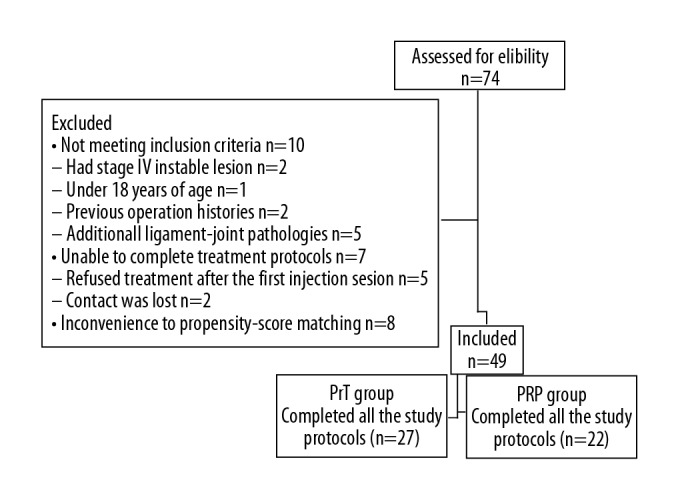
BACKGROUND Osteochondral lesions of talus (OLT) are among the most common ankle problems. Platelet-rich plasma (PRP) and prolotherapy (PrT) are 2 successful injection-based techniques for treatment of chronic musculoskeletal problems. The aim of the present study was to compare PRP and PrT injections for the management of OLT. MATERIAL AND METHODS This was a retrospective cohort study of 49 patients with OLT symptoms of more than 6 months who had been refractory to 3 months of treatment using conservative methods. The patients were divided into 2 groups: PrT injections (PrT group, n=27) or PRP injections (PRP group, n=22). The patients were given 3 injections of 4 mL solution into periarticular and intra-articular ankle joint spaces. After treatment, patients were evaluated via Visual Analogue Scale (VAS), American Orthopedic Foot and Ankle Society Score (AOFAS), and Ankle Osteoarthritis Scale (AOS) at baseline and 21-, 90-, 180-, and 360-day follow-up periods. RESULTS Both PRP and PrT treatments resulted in greater improvement in pain and ankle functions at follow-up periods extending to 1 year (P<0.001) and there was no difference between the groups for the outcomes at follow-up periods (P>0.05). Excellent or good outcomes were reported by 88.8% of the patients in PrT group and 90.9% of the patients in PRP group. CONCLUSIONS Both PRP and PrT are efficient and safe methods in treatment of OLT. PrT offers advantages of less cost and minimal invasiveness.
Conflict of interest statement
None.
Figures
References
-
- Roach R, Mcbride DJ, Maffulli N. Osteochondral lesions of the talus. Minerva Ortop Traumatol. 2002;53(3):157–63.
-
- Shearer C, Loomer R, Clement D. Nonoperatively managed stage 5 osteochondral talar lesions. Foot Ankle Int. 2002;23(7):651–54. - PubMed
-
- Haene R, Qamirani E, Story RA, et al. Intermediate outcomes of fresh talar osteochondral allografts for treatment of large osteochondral lesions of the talus. J Bone Joint Surg Am. 2012;94(12):1105–10. - PubMed
-
- Elias I, Jung JW, Raikin SM, et al. Osteochondral lesions of the talus: Change in MRI findings over time in talar lesions without operative intervention and implications for staging systems. Foot Ankle Int. 2006;27(3):157–66. - PubMed
-
- McGahan PJ, Pinney SJ. Current concept review: Osteochondral lesions of the talus. Foot Ankle Int. 2010;31(1):90–101. - PubMed
MeSH terms
LinkOut - more resources
Full Text Sources
Medical
Research Materials