. 2019 Nov;13(11):2856-2867.
doi: 10.1038/s41396-019-0478-9. Epub 2019 Jul 29.

Viruses as key reservoirs of antibiotic resistance genes in the environment

Affiliations

Viruses as key reservoirs of antibiotic resistance genes in the environment

Didier Debroas et al. ISME J. 2019 Nov.

Abstract

Antibiotic resistance is a rapidly growing health care problem globally and causes many illnesses and deaths. Bacteria can acquire antibiotic resistance genes (ARGs) by horizontal transfer mediated by mobile genetic elements, where the role of phages in their dissemination in natural environments has not yet been clearly resolved. From metagenomic studies, we showed that the mean proportion of predicted ARGs found in prophages (0-0.0028%) was lower than those present in the free viruses (0.001-0.1%). Beta-lactamase, from viruses in the swine gut, represented 0.10 % of the predicted genes. Overall, in the environment, the ARG distribution associated with viruses was strongly linked to human activity, and the low dN/dS ratio observed advocated for a negative selection of the ARGs harbored by the viruses. Our network approach showed that viruses were linked to putative pathogens (Enterobacterales and vibrionaceae) and were considered key vehicles in ARG transfer, similar to plasmids. Therefore, these ARGs could then be disseminated at larger temporal and spatial scales than those included in the bacterial genomes, allowing for time-delayed genetic exchanges.


Figures

Fig. 1
Fig. 1
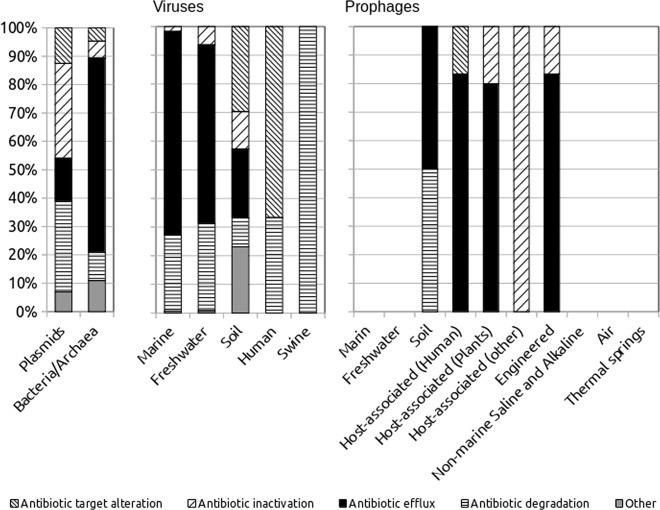
Antibiotic Resistance Genes predicted in the viromes (i.e., viruses) and microbiomes (i.e., prophages) expressed in percentage of the genes predicted
Fig. 2
Fig. 2
Mechanisms of the resistance to the antibiotics detected in the environments for the viruses (free and prophages) and the prophages
Fig. 3
Fig. 3
a Molecular network built with the best vehicles of the ARGs inferred from the gene phylogenies (patristic distances). b Main network topological indices computed from the network
Fig. 4
Fig. 4
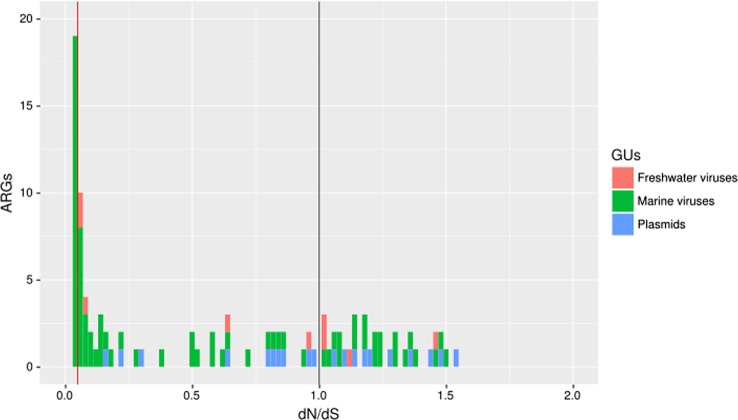
Selective pressure acting on the ARGs included in the second network (Fig. 3) evaluated by the dN/dS ratio
Fig. 5
Fig. 5
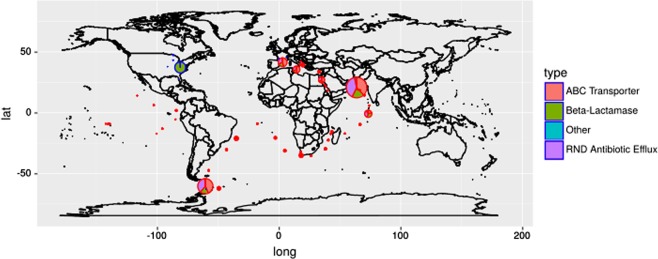
Relative importance of the ARGs and the main resistance mechanisms in the aquatic ecosystems in the earth. The pie size is proportional to the reads mapped on the viral contigs for each environment: oceans and lakes
Fig. 6
Fig. 6
Taxonomies of the vehicles of the ARGs, bacteria (a) and viruses (b), present in the second network displayed in Fig. 3

References

    1. Colavecchio A, Cadieux B, Lo A, Goodridge LD. Bacteriophages contribute to the spread of antibiotic resistance genes among foodborne pathogens of the enterobacteriaceae family? A Review. Front Microbiol. 2017;8. 10.3389/fmicb.2017.01108. - PMC - PubMed
    1. Davies J, Davies D. Origins and evolution of antibiotic resistance. Microbiol Mol Biol Rev. 2010;74:417–33. doi: 10.1128/MMBR.00016-10. - DOI - PMC - PubMed
    1. Brown-Jaque M, Calero-Cáceres W, Muniesa M. Transfer of antibiotic-resistance genes via phage-related mobile elements. Plasmid. 2015;79:1–7. doi: 10.1016/j.plasmid.2015.01.001. - DOI - PubMed
    1. Lossouarn J, Dupont S, Gorlas A, Mercier C, Bienvenu N, Marguet E, et al. An abyssal mobilome: viruses, plasmids and vesicles from deep-sea hydrothermal vents. Res Microbiol. 2015;166:742–52. doi: 10.1016/j.resmic.2015.04.001. - DOI - PubMed
    1. Fuhrman JA. Marine viruses and their biogeochemical and ecological effects. Nature. 1999;399:541–8. doi: 10.1038/21119. - DOI - PubMed

Substances