


Predictors and moderators of recurring self-harm in adolescents participating in a comparative treatment trial of psychological interventions
- PMID: 31359435
- PMCID: PMC6849475
- DOI: 10.1111/jcpp.13099
Predictors and moderators of recurring self-harm in adolescents participating in a comparative treatment trial of psychological interventions
Abstract
Background: In primary analyses, dialectical behavior therapy (DBT) was associated with greater reduction in self-harm during treatment than individual/group supportive therapy (IGST). The objective of this paper was to examine predictors and moderators of treatment outcomes for suicidal adolescents who participated in a randomized controlled trial evaluating DBT and IGST.
Methods: Adolescents (N = 173) were included in the intent-to-treat sample and randomized to receive 6 months of DBT or IGST. Potential baseline predictors and moderators were identified within four categories: demographics, severity markers, parental psychopathology, and psychosocial variables. Primary outcomes were suicide attempts (SA) and nonsuicidal self-injury evaluated at baseline, midtreatment (3 months), and end of treatment (6 months) via the Suicide Attempt and Self-Injury Interview (Psychological Assessment, 18, 2006, 303). For each moderator or predictor, a generalized linear mixed model was conducted to examine main and interactive effects of treatment and the candidate variable on outcomes.
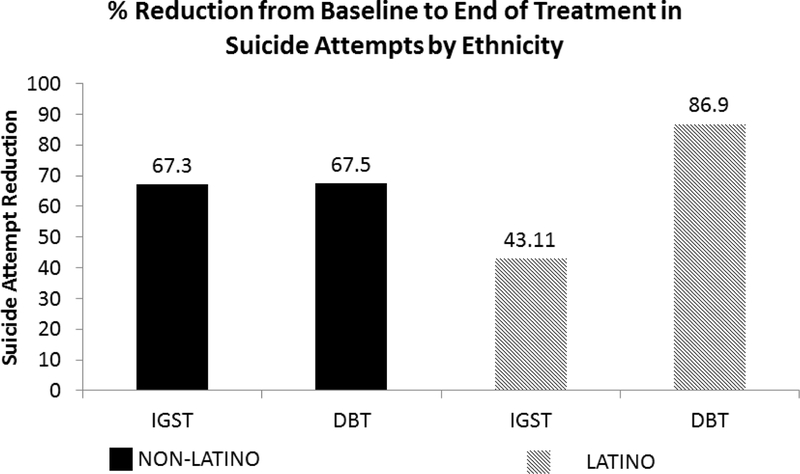
Results: Adolescents with higher family conflict, more extensive self-harm histories, and more externalizing problems produced on average more reduction on SH frequency from baseline to post-treatment. Adolescents meeting BPD diagnosis were more likely to have high SH frequency at post-treatment. Analyses indicated significant moderation effects for emotion dysregulation on NSSI and SH. DBT was associated with better rates of improvement compared to IGST for adolescents with higher baseline emotion dysregulation and those whose parents reported greater psychopathology and emotion dysregulation. A significant moderation effect for ethnicity on SA over the treatment period was observed, where DBT produced better rate of improvement compared to IGST for Hispanic/Latino individuals.
Conclusions: These findings may help to inform salient treatment targets and guide treatment planning. Adolescents that have high levels of family conflict, externalizing problems, and increased level of severity markers demonstrated the most change in self-harm behaviors over the course of treatment and benefitted from both treatment interventions. Those with higher levels of emotion dysregulation and parent psychopathology may benefit more from the DBT.
Keywords: Moderators; dialectical behavior therapy; predictors; treatment response.
© 2019 Association for Child and Adolescent Mental Health.
Conflict of interest statement
The authors have declared that they have no competing or potential conflicts of interest.
Figures
References
-
- Achenbach TM, & Rescorla LA (2001). ASEBA School-age Forms & Profiles: An Integrated System of Multi-informant Assessment. ASEBA.
-
- Agresti A (1990). Categorical data analysis. New York, NY: John Wiley & Sons Inc.
-
- Althouse AD (2016). Adjust for multiple testing?: It is not that simple. The Annals of Thoracic Surgery. 101, 1644–1645 - PubMed
-
- Brent D, Greenhill L, Compton S, Emslie G, Wells K, Walkup J, … Turner JB (2009). The Treatment of Adolescent Suicide Attempters (TASA) Study: Predictors of Suicidal Events in an Open Treatment Trial. Journal of the American Academy of Child and Adolescent Psychiatry, 48(10), 987–996. 10.1097/CHI.0b013e3181b5dbe4 - DOI - PMC - PubMed
Publication types
MeSH terms
Grants and funding
LinkOut - more resources
Full Text Sources
Medical
