


Nonalcoholic fatty liver disease increases risk of incident advanced chronic kidney disease: a propensity-matched cohort study
- PMID: 31359543
- PMCID: PMC6851415
- DOI: 10.1111/joim.12964
Nonalcoholic fatty liver disease increases risk of incident advanced chronic kidney disease: a propensity-matched cohort study
Abstract
Background: As the prevalence of nonalcoholic fatty liver disease (NAFLD) escalates, understanding its potential impact on the development of chronic kidney disease (CKD) is needed.
Objective: To determine the longitudinal association of NAFLD with the development of advanced CKD in the United States.
Methods: A retrospective cohort analysis of the Truven Health MarketScan Database (2006-2015) was conducted. We used Cox proportional hazards models to compare the risk of developing CKD stages 3-5 in patients with NAFLD versus non-NAFLD, identified by ICD-9 codes, after 1:3 propensity score (PS) matching.
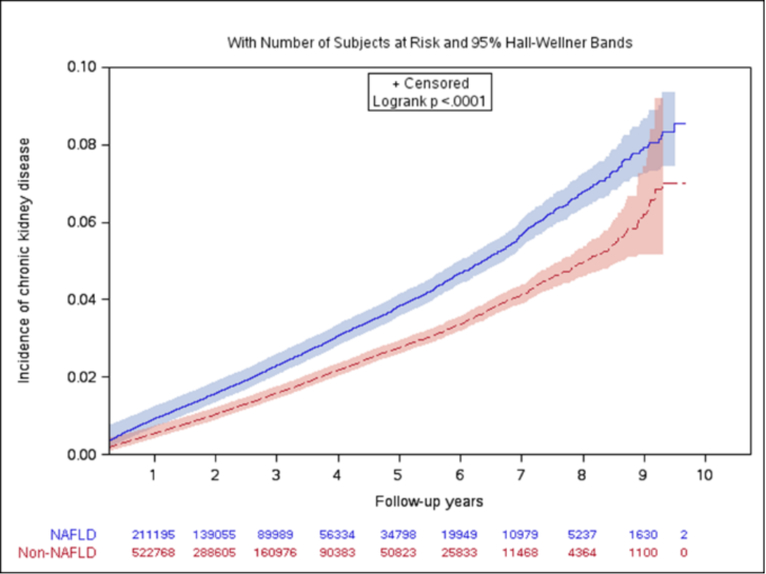
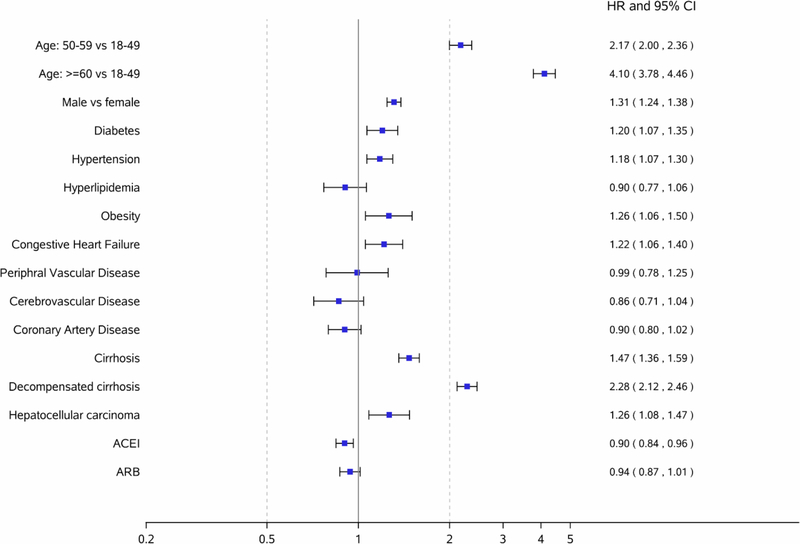
Results: In a cohort of 262 619 newly diagnosed patients with NAFLD and 769 878 PS (1:3)-matched non-NAFLD patients, we identified 5766 and 8655 new advanced (stage 3-5) CKD cases, respectively. The crude CKD incidence rate was 8.2 and 5.5 per 1000 person-years in NAFLD and non-NAFLD groups, respectively. In multivariable Cox model, patients with NAFLD had a 41% increased risk of developing advanced CKD compared with non-NAFLD patients [adjusted hazard ratio (aHR), 1.41; 95% confidence interval (CI), 1.36-1.46]. In the sensitivity analysis adjusting for time-varying covariates after NAFLD diagnosis, NAFLD persisted as a significant CKD risk factor (aHR, 1.58; 95% CI, 1.52-1.66) and the association remained significant when stratified by age, gender and pre-existing comorbidities. The risk of CKD increased in NAFLD with compensated cirrhosis (aHR, 1.47; 95% CI, 1.36-1.59) and decompensated cirrhosis (aHR, 2.28; 95% CI, 2.12-2.46).
Conclusion: Nonalcoholic fatty liver disease was independently associated with an increased risk of advanced CKD development suggesting renal function screening and regular monitoring are needed in this population.
Keywords: chronic kidney disease; cirrhosis; cohort; nonalcoholic fatty liver disease.
© 2019 The Association for the Publication of the Journal of Internal Medicine.
Conflict of interest statement
Conflict of Interest
Others declare no conflicts of interest that pertain to this study.
Figures
References
-
- Chalasani N, Younossi Z, Lavine JE, Charlton M, Cusi K, Rinella M, Harrison SA, et al. The diagnosis and management of nonalcoholic fatty liver disease: Practice guidance from the American Association for the Study of Liver Diseases. Hepatology 2018;67:328–357. - PubMed
-
- Singal AK, Hasanin M, Kaif M, Wiesner R, Kuo YF. Nonalcoholic Steatohepatitis is the Most Rapidly Growing Indication for Simultaneous Liver Kidney Transplantation in the United States. Transplantation 2016;100:607–612. - PubMed
-
- Anstee QM, Targher G, Day CP. Progression of NAFLD to diabetes mellitus, cardiovascular disease or cirrhosis. Nat Rev Gastroenterol Hepatol 2013;10:330–344. - PubMed
-
- Armstrong MJ, Adams LA, Canbay A, Syn WK. Extrahepatic complications of nonalcoholic fatty liver disease. Hepatology 2014;59:1174–1197. - PubMed
-
- Targher G, Day CP, Bonora E. Risk of cardiovascular disease in patients with nonalcoholic fatty liver disease. N Engl J Med 2010;363:1341–1350. - PubMed
Publication types
MeSH terms
Grants and funding
LinkOut - more resources
Full Text Sources
Medical
Research Materials
