


Salmonellosis detection and evidence of antibiotic resistance in an urban raccoon population in a highly populated area, Costa Rica
- PMID: 31359623
- PMCID: PMC6852039
- DOI: 10.1111/zph.12635
Salmonellosis detection and evidence of antibiotic resistance in an urban raccoon population in a highly populated area, Costa Rica
Abstract
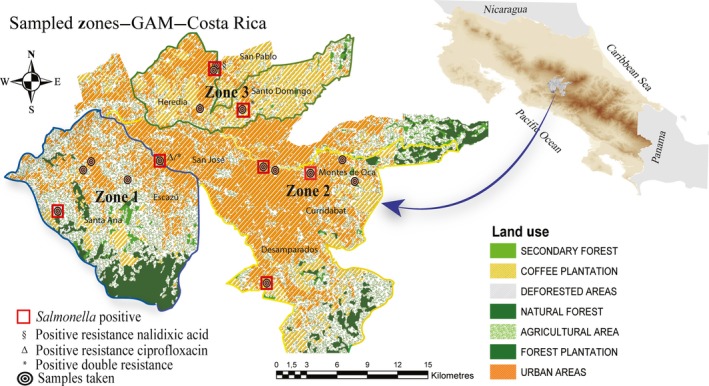
Wild animals are involved in zoonotic disease transmission cycles. These are generally complex and poorly understood, especially among animals adapted to life in human ecosystems. Raccoons are reservoirs and effective carriers for infectious agents such as Salmonella throughout different environments and contribute to the transference of resistance genes. This study examined the presence of circulating Salmonella sp. in a population of raccoons in a tropical urban environment and evaluated resistance to antibiotics commonly used to treat salmonellosis. A total of 97 raccoons of different ages and sex were included in this study. 49% (38-60 CI) of the faecal samples were positive for Salmonella spp. The study identified 15 circulating serovars with the most prevalent being S. Hartford (7/15), S. Typhimurium (4/15) and S. Bovismorbificans (4/15). These serovars correspond to the serovars detected in humans with clinical symptoms in Costa Rica. 9.5% of the Salmonella strains recovered demonstrated ciprofloxacin resistance, and 7.1% showed resistance to nalidixic acid. This study provides evidence of multiple Salmonella serovars circulating in a population of urban raccoons in Costa Rica. Furthermore, the study confirms the existence of antimicrobial resistance to two antibiotics used to treat human salmonellosis. The findings emphasize the role of the raccoon as a reservoir of Salmonella in the Greater Metropolitan Area of Costa Rica (GAM) and stress the need for active monitoring of the presence and possible spread in antibiotic resistance due to this peri-domestic carnivore.
Keywords: Procyon lotor; Salmonella sp; antibiotic resistance; public health; zoonosis.
© 2019 The Authors. Zoonoses and Public Health published by Blackwell Verlag GmbH.
Conflict of interest statement
The authors have no conflict of interests.
Figures
References
-
- Adams, C. E. , & Lindsey, K. J. (2010). Urban wildlife management (2nd ed.). London, UK: CRC; Taylor & Francis [distributor]: Boca Raton, FL.
-
- Al‐Gallas, N. , Abbassi, M. S. , Gharbi, B. , Manai, M. , Ben Fayala, M. N. , Bichihi, R. , … Ben Aissa, R. (2013). Occurrence of plasmid‐mediated quinolone resistance determinants and rmtB gene in Salmonella enterica serovar enteritidis and Typhimurium isolated from food‐animal products in Tunisia. Foodborne Pathogens and Disease, 10(9), 813–819. 10.1089/fpd.2012.1466 - DOI - PubMed
-
- Allen, S. E. , Boerlin, P. , Janecko, N. , Lumsden, J. S. , Barker, I. K. , Pearl, D. L. , … Jardine, C. (2011). Antimicrobial resistance in generic Escherichia coli isolates from wild small mammals living in swine farm, residential, landfill, and natural environments in southern Ontario, Canada. Applied and Environmental Microbiology, 77(3), 882–888. 10.1128/AEM.01111-10 - DOI - PMC - PubMed
-
- American Society of Microbiology (2016). Clinical microbiology procedures handbook (4th ed.). Washington, DC: ASM Press.
Publication types
MeSH terms
Substances
LinkOut - more resources
Full Text Sources
Medical
Miscellaneous
