Review
. 2019 Jul 8:2019:1957360.
doi: 10.1155/2019/1957360. eCollection 2019.

Advanced Lipid Technologies® (ALT®): A Proven Formulation Platform to Enhance the Bioavailability of Lipophilic Compounds

Affiliations
Review

Advanced Lipid Technologies® (ALT®): A Proven Formulation Platform to Enhance the Bioavailability of Lipophilic Compounds

Miguel A Lopez-Toledano et al. J Drug Deliv. .

Abstract

Despite recent advances, the drug development process continues to face significant challenges to efficiently improve the poor solubility of active pharmaceutical ingredients (API) in aqueous media or to improve the bioavailability of lipid-based formulations. The inherent high intra- and interindividual variability of absorption of oral lipophilic drug leads to inconsistent and unpredictable bioavailability and magnitude of the therapeutic effect. For this reason, the development of lipid-based drugs remains a challenging endeavour with a high risk of failure. Therefore, effective strategies to assure a predictable, consistent, and reproducible bioavailability and therapeutic effect for lipid-based medications are needed. Different solutions to address this problem have been broadly studied, including the approaches of particle size reduction, prodrugs, salt forms, cocrystals, solid amorphous forms, cyclodextrin clathrates, and lipid-based drug delivery systems such as self-emulsifying systems and liposomes. Here, we provide a brief description of the current strategies commonly employed to increase the bioavailability of lipophilic drugs and present Advanced Lipid Technologies® (ALT®), a combination of different surfactants that has been demonstrated to improve the absorption of omega-3 fatty acids under various physiological and pathological states.


Figures
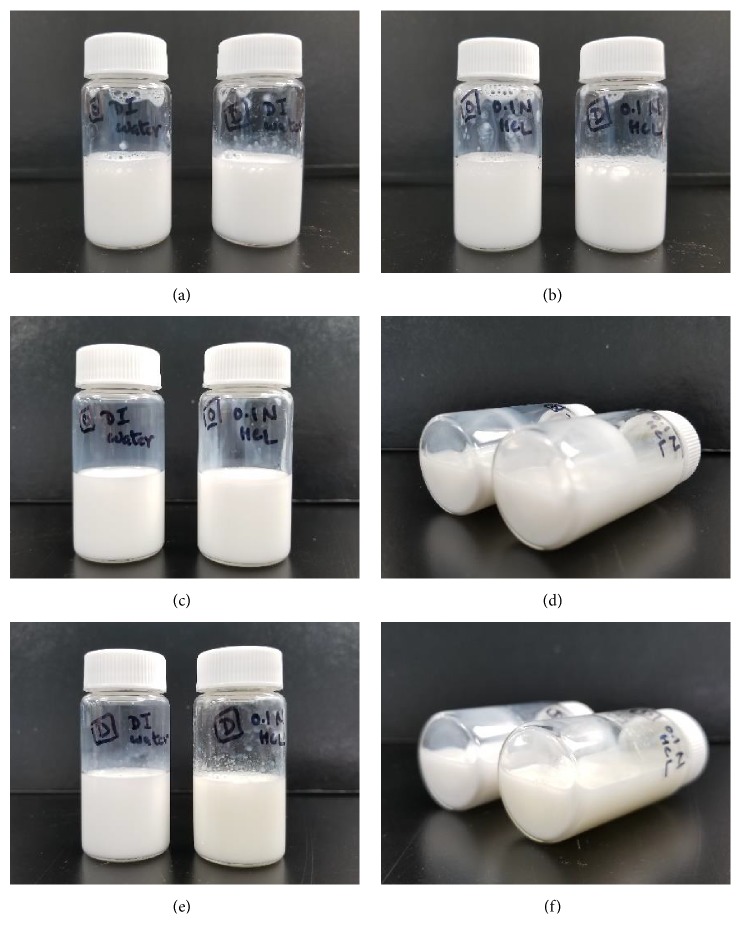
Figure 1
Figure 1
Physical Stability of formulations of SC401 and SC411/SC403 dispersed in purified water and 0.1 N HCl. (a) SC401 (left) and SC411/SC403 (right) formulations forming micelles in a 1:20 dilution in purified water at time 0, (b) SC401 (left) and SC411/SC403 (right) formulations forming micelles in a 1:20 dilution in 0.1 N HCl at time 0, (c) SC401 formulation forming micelles in a 1:20 dilution in purified water (left) and 0.1 N HCl (right) 7 days after dilution, (d) SC401 formulation forming micelles in a 1:20 dilution in purified water (left) and 0.1 N HCl (right) 7 days after dilution in a horizontal position, showing no precipitates of the two-phase formation, (e) SC411/SC403 formulation forming micelles in a 1:20 dilution in purified water (left) and 0.1 N HCl (right) 7 days after dilution, and (f) SC411/SC403 formulation forming micelles in a 1:20 dilution in purified water (left) and 0.1 N HCl (right) 7 days after dilution in a horizontal position, showing no precipitates of the two-phase formation.
Figure 2
Figure 2
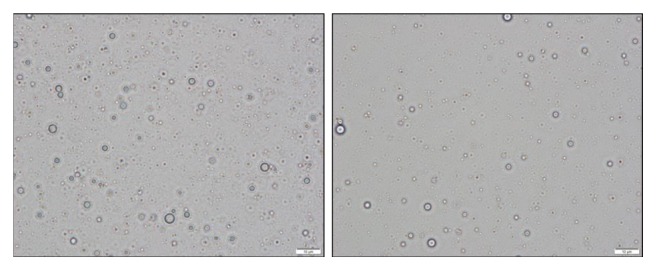
Micrographs illustrating dispersions of SC401 (left) and SC411 (right) at a 1:20 dilution in purified water. Taken with a BX43 Olympus Light Microscope using cellSens software for image capture and particle size measurement (1000X magnification).
Figure 3
Figure 3
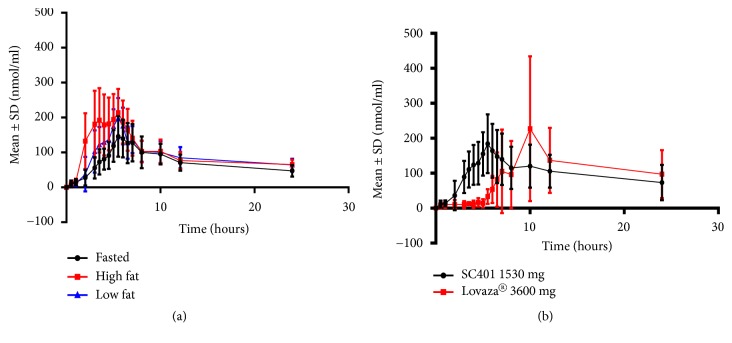
Advanced Lipid Technologies® (ALT®) significantly improves omega-3 fatty acid absorption. (a) Phase I, Single-Dose, Open-Label, Randomized, Three-Way Crossover Study of Food Effect on the Pharmacokinetics of Omega-3-Acid Ethyl Esters in Healthy Subjects was performed to quantify the BA of EPA + DHA after treatment with 1530 mg EPA EE+ DHA EE in fasted and high or low fat feeding conditions. Mean ± standard error of the total EPA + DHA concentration-time profiles after a single oral dose of SC401 (1530 mg of DHA EE + EPA EE with ALT®) in fasted, low fat or high fat diet conditions. (b) Phase I, Single-Dose, Open-Label, Randomized, Two-Way Crossover Study, the Relative Bioavailability of 1530 mg of EPA EE + DHA EE with ALT® vs. 3600 mg of EPA EE + DHA EE, was compared under low fat fed conditions. Mean ± standard deviation of total lipid EPA + DHA concentration-time profiles after a single oral dose of SC401 (1530 mg of DHA-EE + EPA EE) or Lovaza® (3600 mg of DHA EE + EPA EE) in low-fat feeding conditions (N = 23). DHA = docosahexaenoic acid; EPA = eicosapentaenoic acid.
Figure 4
Figure 4
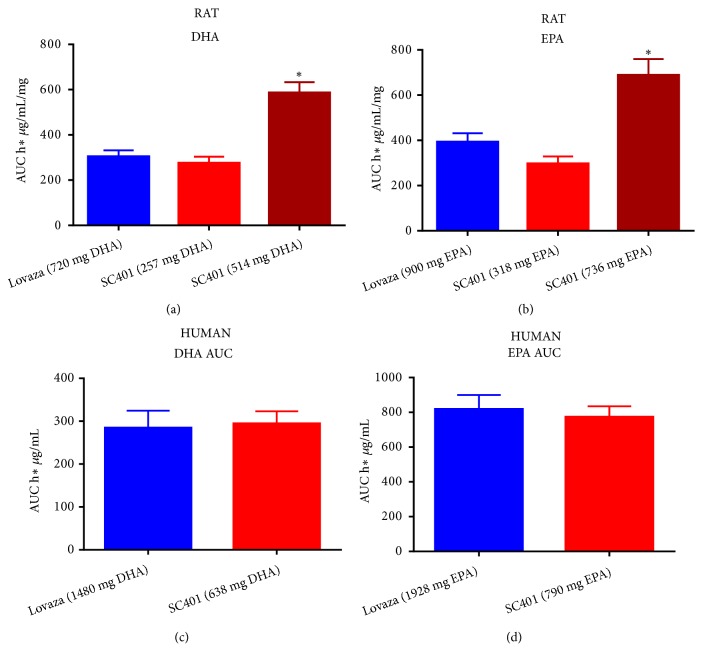
SC401 significantly increases DHA and EPA bioavailability in both rats (a, b) and humans (c, d) compared with Lovaza®. (a) Comparison of the area under the curve (AUC) of DHA at time 0 after treating adult rats with 2000 mg/kg of Lovaza® (720 mg DHA EE, blue), 1000 mg/kg of SC401 (257 mg DHA EE, red), or 2000 mg/kg of SC401 (514 mg DHA EE, dark red). (b) Comparison of the area under the curve (AUC) of EPA at time 0 after treating adult rats with 2000 mg/kg of Lovaza® (900 mg EPA EE, blue), 1000 mg/kg of SC401 (318 mg EPA EE, red), or 2000 mg/kg of SC401 (736 mg EPA EE, dark red). (c) Comparison of the AUC of DHA at time 0 after treating with Lovaza® (1480 mg of DHA EE, blue) or SC401 (638 mg DHA EE, red), in healthy humans. (d) Comparison of the AUC of EPA at time 0 after treating with Lovaza® (1928 mg EPA EE, blue) or SC401 (790 mg EPA EE, red), in healthy humans. p<0.001 vs Lovaza® and higher dose of SC401.
Figure 5
Figure 5
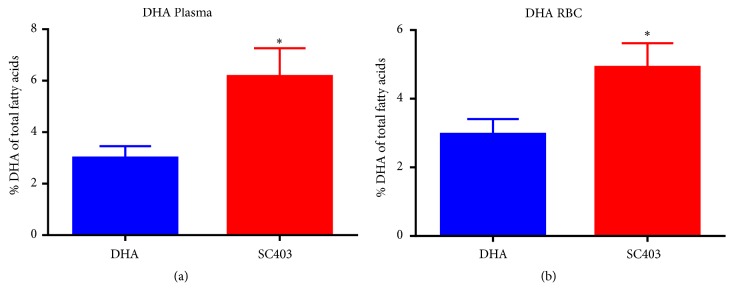
SC403 significantly increases DHA levels in both plasma and red blood cells (RBC) membrane in a piglet model of Short Bowel Syndrome (SBS). After a 70% mid-jejune-ileal resection, neonatal piglets were fed with 1 g/kg/day of DHA EE or 1 g/kg/day of DHA EE + ALT® (SC403) and the percentage of DHA was measured in blood. The comparison of DHA plasma levels in DHA (blue) vs. SC403 (red) treated SBS piglets reveals a statistically significant increase in DHA in SC403-treated piglets, both in plasma (a) and red blood cells membranes (b) 8 days after intervention (SEM ± SE) as compared with the piglets treated with DHA alone. : p<0.005.
Figure 6
Figure 6
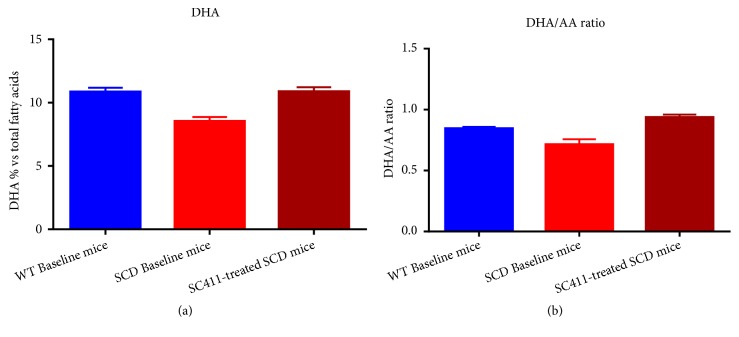
SC411 significantly increases DHA levels in red blood cell (RBC) membranes in a model of Sickle Cell Disease (SCD). Wild type (WT) and Townes, a recognized animal model of SCD, mice with a deficiency in DHA were treated with SC411 (50 mg DHA/Kg/day + ALT®) for 42 days before measuring the RBC membrane levels of DHA. (a) The SCD mice (red) have significantly lower levels of DHA as compared with WT (blue) at baseline. SC411-treated SCD mice (dark red) restore the RBC membrane DHA levels to WT levels. (b) Similarly, the DHA/AA ratio in RBC membranes is also low in SCD mice (red) as compared with WT (blue) at baseline and SC411-treated SCD mice (dark red) significantly increase DHA/AA ratio in RBC membranes.
Figure 7
Figure 7
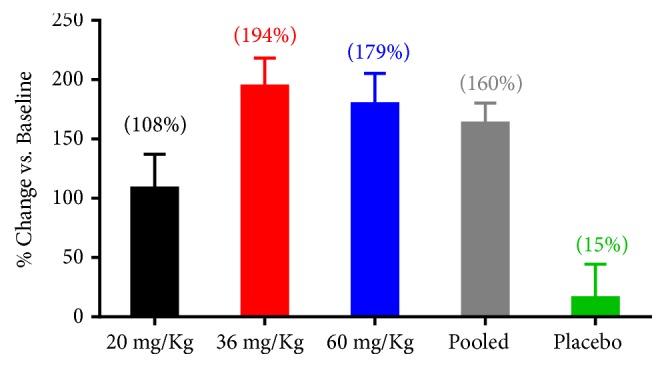
Percent change of DHA + EPA blood cell membrane levels from baseline at week 4: after four weeks of treatment (A), blood cell membrane DHA and EPA levels were significantly increased in all SC411 doses (p<0.001) vs. baseline. 36 mg/Kg, 60 mg/Kg, and pooled treatments were also significantly increased vs. placebo (p<0.01).

References

    1. Solaesa Á. G., Sanz M. T., Falkeborg M., Beltrán S., Guo Z. Production and concentration of monoacylglycerols rich in omega-3 polyunsaturated fatty acids by enzymatic glycerolysis and molecular distillation. Food Chemistry. 2016;190:960–967. doi: 10.1016/j.foodchem.2015.06.061. - DOI - PubMed
    1. Delmonte P., Kia A.-R. F., Qing H., Rader J. I. Review of methods for preparation and gas chromatographic separation of trans and cis reference fatty acids. Journal of AOAC International. 2009;92(5):1310–1326. - PubMed
    1. Yamamoto K., Kinoshita A., Shibahara A. Gas chromatographic separation of fatty acid methyl esters on weakly polar capillary columns. Journal of Chromatography A. 2008;1182(1):132–135. doi: 10.1016/j.chroma.2007.12.071. - DOI - PubMed
    1. Armand M. Lipases and lipolysis in the human digestive tract: where do we stand? Current Opinion in Clinical Nutrition & Metabolic Care. 2007;10(2):156–164. doi: 10.1097/MCO.0b013e3280177687. - DOI - PubMed
    1. N’Goma J. B., Amara S., Dridi K., Jannin V., Carrière F. Understanding the lipid-digestion processes in the GI tract before designing lipid-based drug-delivery systems. Therapeutic Delivery. 2012;3(1):105–124. doi: 10.4155/tde.11.138. - DOI - PubMed

LinkOut - more resources