


Public Prevention Plans to Manage Climate Change and Respiratory Allergic Diseases. Innovative Models Used in Campania Region (Italy): The Twinning Aria Implementation and the Allergy Safe Tree Decalogue
- PMID: 31360673
- PMCID: PMC6581484
Public Prevention Plans to Manage Climate Change and Respiratory Allergic Diseases. Innovative Models Used in Campania Region (Italy): The Twinning Aria Implementation and the Allergy Safe Tree Decalogue
Abstract
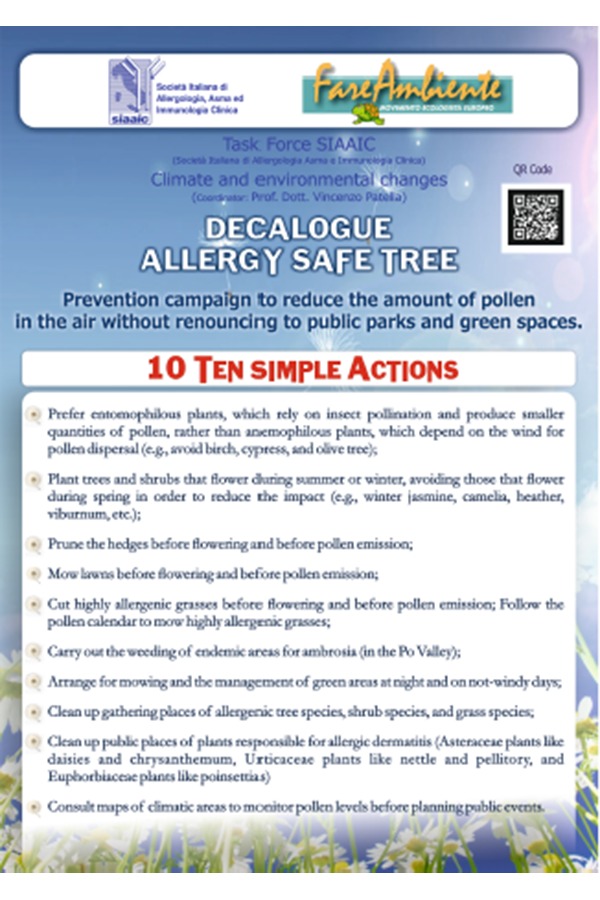
In recent years, climate change has been influenced by air pollution, and this destructive combination has justifiably sounded an alarm for nations and many institutional bodies worldwide. Official reports state that the emission of greenhouse gases produced by human activity are growing, and consequently also the average temperature. The World Health Organization (WHO) believes that health effects expected in the future due to climate change will be dramatic, and has invited international groups to investigate potential remedies. A task force has been established by the Italian Society of Allergology, Asthma and Clinical Immunology (SIAAIC), with the aim to actively work on correlation between pollution and climate change. The Task Force provided prevention tools to suggest city leaders how to improve the health conditions of allergic people in public urban parks. The "Allergy Safe Tree Decalogue" suggests the preparation and maintenance of public low allergy-impact greenery. Through the Twinning ARIA project, the Division for the Promotion and Enhancement of Health Innovation Programs of Campania Region (Italy), sought to promote the implementation of the project in the regional Health System. The main objective will be to investigate the current use and usefulness of mobile phone Apps in the management of allergic respiratory disease, through Mobile Airways Sentinel networK (MASK), the Phase 3 of the ARIA initiative, based on the freely available MASK App (the Allergy Diary, Android and iOS platforms). The effects of these prevention activities will be registered and compared with monitoring efforts thanks to the Aerobiology Units, located throughout the Campania area. A joint effort between researchers and public administrations for the implementation of prevention plans coherently with the two models proposed in a specific area, i.e. the Decalogue for public administrations and the MASK Allergy Diary app for individual patients suffering from allergy, will be implemented as a pilot.
Keywords: Air pollution; Allergic Rhinitis; Asthma; Climate Change; Health Innovation Programs; Public Health.
Figures
References
-
- D’Amato G, Holgate ST, Pawankar R, Ledford DK, et al. Meteorological conditions, climate change, new emerging factors, and asthma and related allergic disorders. A statement of the World Allergy Organization. World Allergy Organ J. 2015;8(1):25. doi: 10.1186/s40413-015-0073-0. eCollection 2015. - DOI - PMC - PubMed
-
- Patella V, Florio G, Magliacane D, Giuliano A, Crivellaro MA, Di Bartolomeo D, Genovese A, Palmieri M, Postiglione A, Ridolo E, Scaletti C, Ventura MT, Zollo A. Urban air pollution and climate change: “The Decalogue: Allergy Safe Tree” for allergic and respiratory diseases care. Clin Mol Allergy. 2018;16:20. doi: 10.1186/s12948-018-0098-3. - DOI - PMC - PubMed
-
- IPCC. Climate Change 2014: Synthesis Report. Contribution of Working Groups I, II and III to the Fifth Assessment Report of the Intergovernmental Panel on Climate Change. 2014:80. 4.2 M, About PDF.
-
- Jacob DJ, Winner DA. Effect of climate change on air quality. Atmos Environ. 2009;43:51–63.
LinkOut - more resources
Full Text Sources