. 2019 Jul 9:2019:8051270.
doi: 10.1155/2019/8051270. eCollection 2019.

Growth Media for Mixed Multispecies Oropharyngeal Biofilm Compositions on Silicone

Affiliations

Growth Media for Mixed Multispecies Oropharyngeal Biofilm Compositions on Silicone

Matthias Leonhard et al. Biomed Res Int. .

Abstract

Aims: Microbial colonization of silicone voice prostheses by bacteria and Candida species limits the device lifetime of modern voice prostheses in laryngectomized patients. Thus, research focuses on biofilm inhibitive properties of novel materials, coatings, and surface enhancements. Goal of this in vitro study was the evaluation of seven commonly used growth media to simulate growth of mixed oropharyngeal species as mesoscale biofilms on prosthetic silicone for future research purposes.

Methods and results: Yeast Peptone Dextrose medium (YPD), Yeast Nitrogen Base medium (YNB), M199 medium, Spider medium, RPMI 1640 medium, Tryptic Soy Broth (TSB), and Fetal Bovine Serum (FBS) were used to culture combined mixed Candida strains and mixed bacterial-fungal compositions on silicone over the period of 22 days. The biofilm surface spread and the microscopic growth showed variations from in vivo biofilms depending on the microbial composition and growth medium.

Conclusion: YPD and FBS prove to support continuous in vitro growth of mixed bacterial-fungal oropharyngeal biofilms deposits over weeks as needed for longterm in vitro testing with oropharyngeal biofilm compositions.

Significance and impact of study: The study provides data on culture conditions for mixed multispecies biofilm compositions that can be used for future prosthesis designs.


Figures
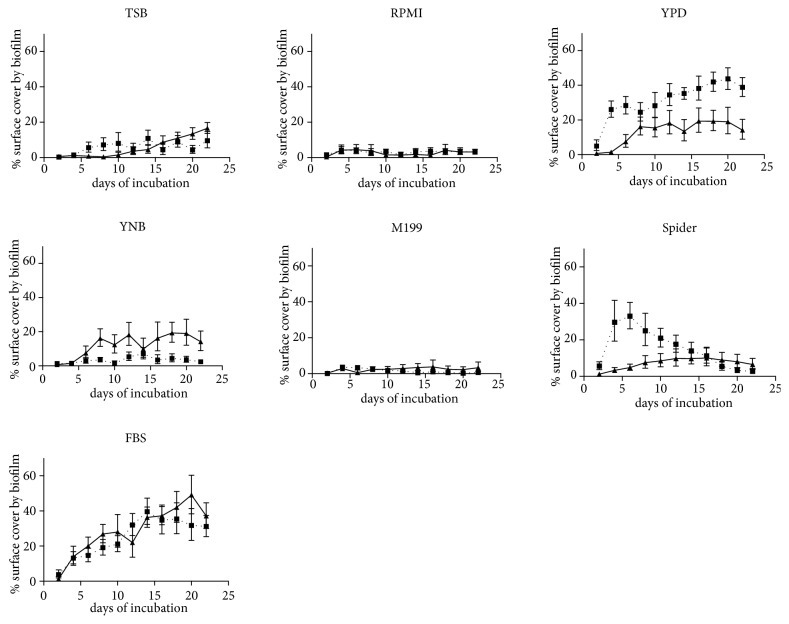
Figure 1
Figure 1
Growth of biofilm deposits on silicone, generated by the tested growth media with two microbial compositions: dotted line: Candida albicans, Candida tropicalis, and Candida krusei. Solid line: Candida albicans, Escherichia coli, Streptococcus salivarius, and Staphylococcus aureus. Abbreviations: TSB: Tryptic Soy Broth, YPD: Yeast Peptone Dextrose, YNB: Yeast Nitrogen Base, FBS: Fetal Bovine Serum, and SPIDER: Spider Medium. Error bars show standard deviations of mean values.
Figure 2
Figure 2
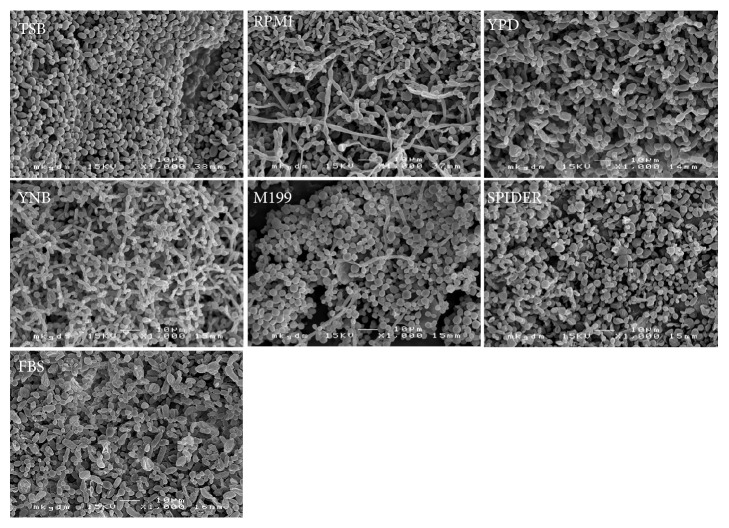
Scanning electron micrographies of biofilm structures of a mixed trispecies biofilm composition of Candida albicans, Candida tropicalis, and Candida krusei grown in Tryptic Soy Broth (TSB), RPMI 1640 medium (RPMI), Yeast Peptone Dextrose medium (YPD), Yeast Nitrogen Base medium (YNB), M199 medium (M199), Spider medium (SPIDER), and Fetal Bovine Serum (FBS) after 22 days of incubation.
Figure 3
Figure 3
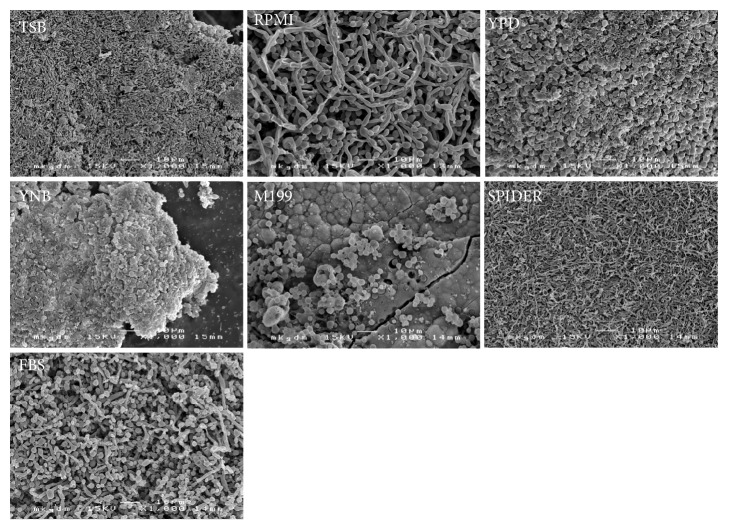
Scanning electron micrographies of biofilm structures of a mixed multispecies biofilm composition of Candida albicans, Escherichia coli, Streptococcus salivarius, and Staphylococcus aureus grown in Tryptic Soy Broth (TSB), RPMI 1640 medium (RPMI), Yeast Peptone Dextrose medium (YPD), Yeast Nitrogen Base medium (YNB), M199 medium (M199), Spider medium (SPIDER), and Fetal Bovine Serum (FBS) after 22 days of incubation.

References

    1. Leonhard M., Schneider-Stickler B. Advances in Experimental Medicine and Biology. chapter 8. Vol. 830. Cham: Springer International Publishing; 2015. Voice prostheses, microbial colonization and biofilm formation; pp. 123–136. - PubMed
    1. Ackerstaff A. H., Hilgers F. J., Meeuwis C. A., et al. Multi-institutional assessment of the provox 2 voice prosthesis. Archives of Otolaryngology–Head & Neck Surgery. 1999;125(2):167–173. doi: 10.1001/archotol.125.2.167. - DOI - PubMed
    1. Schuldt T., Ovari A., Dommerich S. The costs for different voice prostheses depending on the lifetime. Laryngo-Rhino-Otologie. 2013;92(6):389–393. doi: 10.1055/s-0033-1337951. - DOI - PubMed
    1. Tićac B., Tićac R., Rukavina T., et al. Microbial colonization of tracheoesophageal voice prostheses (Provox2) following total laryngectomy. European Archives of Oto-Rhino-Laryngology. 2010;267(10):1579–1586. doi: 10.1007/s00405-010-1253-8. - DOI - PubMed
    1. Leonhard M., Reumüller A., Moser D., Bigenzahn W., Schneider-Stickler B. Examination of biofilm related material deterioration on 20 PROVOX®2 voice prostheses by scanning electron microscopy. Laryngo-Rhino-Otologie. 2009;88(6):392–397. doi: 10.1055/s-0028-1119409. - DOI - PubMed