


Resident Clinical Experience in the Emergency Department: Patient Encounters by Postgraduate Year
- PMID: 31360817
- PMCID: PMC6637008
- DOI: 10.1002/aet2.10326
Resident Clinical Experience in the Emergency Department: Patient Encounters by Postgraduate Year
Abstract
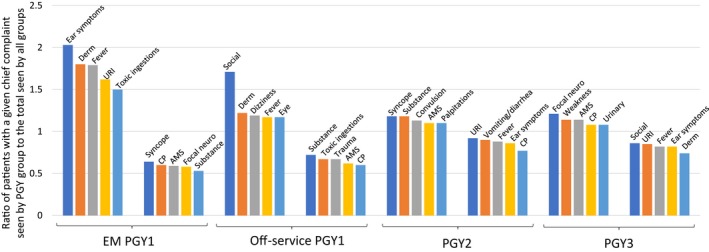
Background: During emergency medicine (EM) training, residents are exposed to a wide spectrum of patient complaints. We sought to determine how resident clinical experience changes based on training level in relation to the patient acuity levels, chief complaints, and dispositions.
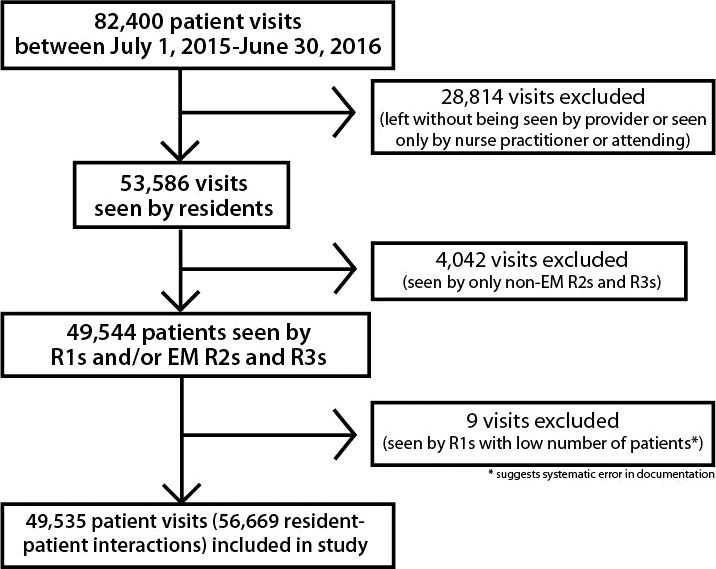
Methods: We performed a retrospective chart review of patients seen at a safety-net, academic hospital in Los Angeles from July 1, 2015, to June 30, 2016. Resident postgraduate year (PGY) level and specialty, patient acuity (based on the Emergency Severity Index), chief complaint (based on one of 30 categories), and disposition were abstracted. Our primary objective was to examine the progression of EM resident experience throughout the course of training. As a secondary objective, we compared the cases seen by EM and off-service PGY-1s.
Results: A total of 49,535 visits were examined, and of these, 32,870 (66.4%) were in the adult ED (AED) and 16,665 (33.6%) were in the pediatric ED (PED). The median acuity level was 3, and 27.4% of AED patients and 7.3% of PED patients were admitted. Data from 126 residents were analyzed. This included 94 PGY-1 residents (16 EM and 78 off-service), 16 PGY-2 EM, and 16 PGY-3 EM residents. Residents of different training levels evaluated different types of patients. Senior EM residents were more likely to care for higher-acuity patients than junior EM residents. EM PGY-3s saw higher percentages of acuity level 1 and 2 patients (2.3 and 37.8%, respectively, of their total patients) than EM PGY-1s (0.3 and 18.7%, respectively). Conversely, EM PGY-1s saw higher percentages of acuity level 4 and 5 patients (27.9 and 1.6%, respectively) compared to EM PGY-3s (10.7 and 0.7%, respectively). There was a significant linear trend for increasing acuity with training year among EM residents (p < 0.001). EM PGY-1s saw more patients than off-service PGY-1s with slightly higher acuities and admission rates.
Conclusion: The clinical experience of EM residents varies based on their level of training. EM residents show a progression throughout residency and are more likely to encounter higher volumes of patients with higher acuity as they progress in their training. When designing EM residency curriculums, this is a model of an EM residency program.
Figures
References
-
- DeBehnke D, O'Brien S, Leschke R. Emergency medicine resident work productivity in an academic emergency department. Acad Emerg Med 2000;7:90–2. - PubMed
-
- Deveau J, Lorenz J, Hughs M, et al. Emergency medicine work productivity and procedural accomplishment. J Am Osteopath Assoc 2003;103:291–6. - PubMed
-
- Langdorf M, Strange G, Macneil P. Computerized tracking of emergency medicine resident clinical experience. Ann Emerg Med 1990;19:764–73. - PubMed
-
- Brennan DF, Silvestri S, Sun JY, Papa L. Progression of emergency medicine resident productivity. Acad Emerg Med 2007;14:790–4. - PubMed
-
- Jeanmonod R, Jeanmonod D, Ngiam R. Resident productivity: does shift length matter? Am J Emerg Med 2008;26:789–91. - PubMed
LinkOut - more resources
Full Text Sources
Research Materials
