


Germline Pathogenic Variants in Homologous Recombination and DNA Repair Genes in an Asian Cohort of Young-Onset Colorectal Cancer
- PMID: 31360874
- PMCID: PMC6649855
- DOI: 10.1093/jncics/pky054
Germline Pathogenic Variants in Homologous Recombination and DNA Repair Genes in an Asian Cohort of Young-Onset Colorectal Cancer
Abstract
Background: Growing evidence suggests a role for cancer susceptibility genes such as BRCA2 and PALB2 in young-onset colorectal cancers. Using a cohort of young colorectal cancer patients, we sought to identify and provide functional evidence for germline pathogenic variants of DNA repair genes not typically associated with colorectal cancer.
Methods: We recruited 88 patients with young-onset colorectal cancers seen at a general oncology center. Whole-exome sequencing was performed to identify variants in DNA repair and colorectal cancer predisposition genes. Pathogenic BRCA2 and PALB2 variants were analyzed using immunoblot and immunofluorescence on patient-derived lymphoblastoid cells.
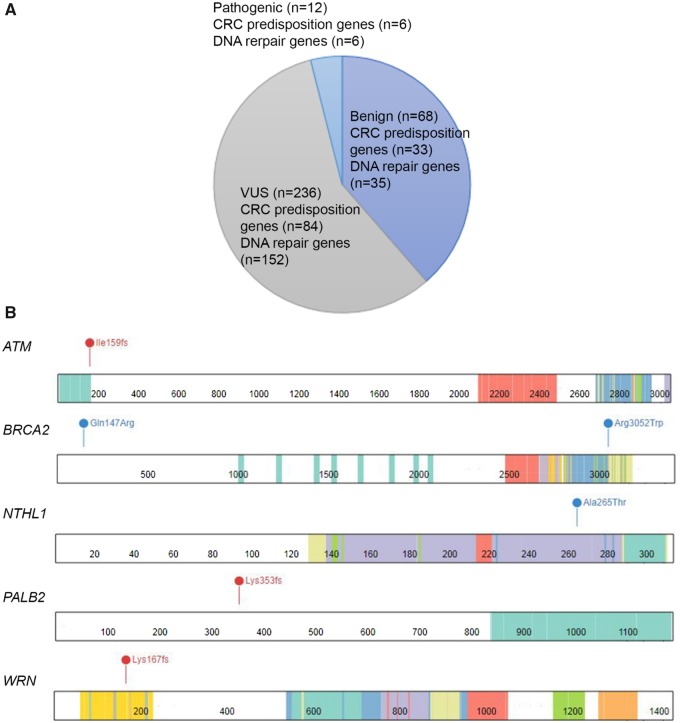
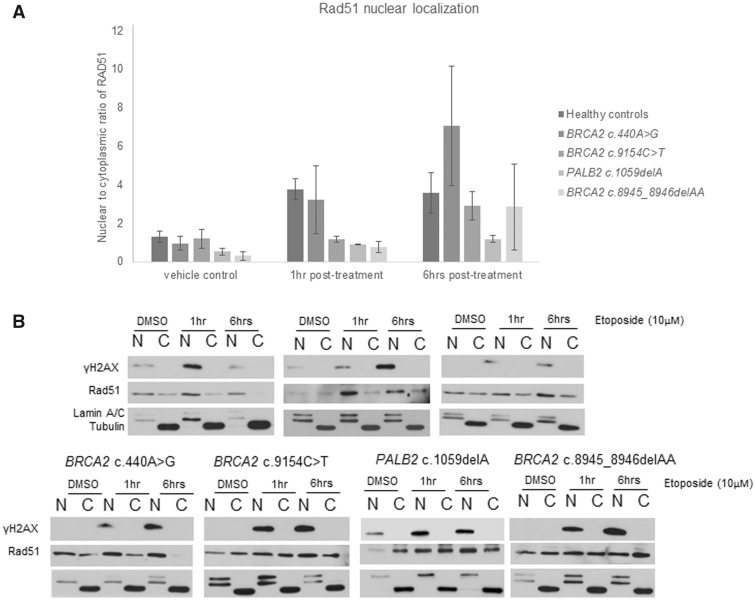
Results: In general, our cohort displayed characteristic features of young-onset colorectal cancers. Most patients had left-sided tumors and were diagnosed at late stages. Four patients had familial adenomatous polyposis, as well as pathogenic APC variants. We identified 12 pathogenic variants evenly distributed between DNA repair and colorectal cancer predisposition genes. Six patients had pathogenic variants in colorectal cancer genes: APC (n = 4) and MUTYH monoallelic (n = 2). Another six had pathogenic variants in DNA repair genes: ATM (n = 1), BRCA2 (n = 1), PALB2 (n = 1), NTHL1 (n = 1), and WRN (n = 2). Pathogenic variants BRCA2 c.9154C>T and PALB2 c.1059delA showed deficient homologous recombination repair, evident from the impaired RAD51 nuclear localization and foci formation.
Conclusion: A substantial portion of pathogenic variants in young-onset colorectal cancer was found in DNA repair genes not previously associated with colorectal cancer. This may have implications for the management of patients. Further studies are needed to ascertain the enrichment of pathogenic DNA repair gene variants in colorectal cancers.
Figures

References
-
- National Registry of Diseases Office. Singapore Cancer Registry Annual Registry Report 2015 2017. https://www.nrdo.gov.sg/docs/librariesprovider3/Publications-Cancer/canc.... Accessed May 4, 2018.
-
- Rho YS, Gilabert M, Polom K, et al. Comparing clinical characteristics and outcomes of young-onset and late-onset colorectal cancer: an international collaborative study. Clin Colorectal Cancer. 2017;16(4):334–342. - PubMed
-
- Koblinski J, Jandova J, Nfonsam V.. Disparities in incidence of early- and late-onset colorectal cancer between Hispanics and Whites: a 10-year SEER database study. Am J Surg. 2018;215(4):581–585. - PubMed
LinkOut - more resources
Full Text Sources
Molecular Biology Databases
Research Materials
Miscellaneous