Methionine-Homocysteine Pathway in African-American Prostate Cancer

Jie H Gohlke et al. JNCI Cancer Spectr. .

Abstract

African American (AA) men have a 60% higher incidence and two times greater risk of dying of prostate cancer (PCa) than European American men, yet there is limited insight into the molecular mechanisms driving this difference. To our knowledge, metabolic alterations, a cancer-associated hallmark, have not been reported in AA PCa, despite their importance in tumor biology. Therefore, we measured 190 metabolites across ancestry-verified AA PCa/benign adjacent tissue pairs (n = 33 each) and identified alterations in the methionine-homocysteine pathway utilizing two-sided statistical tests for all comparisons. Consistent with this finding, methionine and homocysteine were elevated in plasma from AA PCa patients using case-control (AA PCa vs AA control, methionine: P = .0007 and homocysteine: P < .0001), biopsy cohorts (AA biopsy positive vs AA biopsy negative, methionine: P = .0002 and homocysteine: P < .0001), and race assignments based on either self-report (AA PCa vs European American PCa, methionine: P = .001, homocysteine: P < .0001) or West African ancestry (upper tertile vs middle tertile, homocysteine: P < .0001; upper tertile vs low tertile, homocysteine: P = .002). These findings demonstrate reprogrammed metabolism in AA PCa patients and provide a potential biological basis for PCa disparities.


Figures
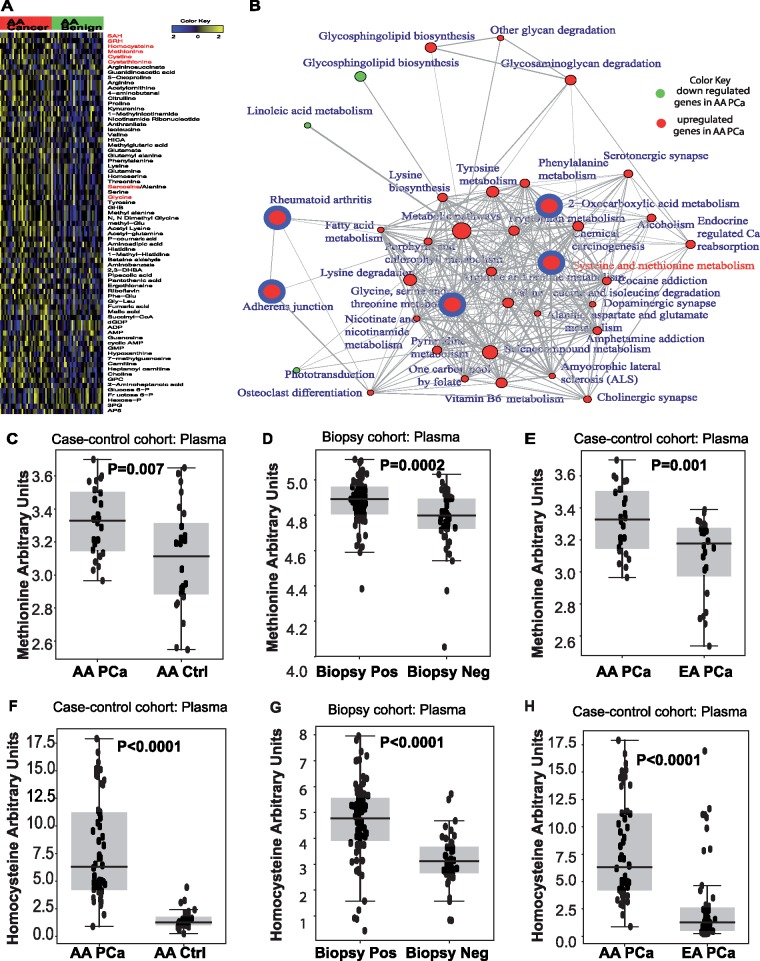
Figure 1.
Figure 1.
Methionine-homocysteine levels in African American (AA) prostate cancer (PCa). (A) Heat map showing altered metabolites in localized PCa (n = 33) and matched adjacent benign tissue in ancestry-verified AA patients. Shades of yellow and blue represent an increase or decrease of a metabolite relative to median metabolite levels (false discovery rate [FDR] = 0.3), respectively (refer to color key). Metabolites marked in red belong to the methionine-homocysteine pathway. (B) Network-based Gene Set Analysis map showing differential metabolic pathways between AA PCa and adjacent benign tissue. Pathways enriched at FDR-corrected P value less than .001 are shown in solid circles. The circumference of the circle is correlated to the pathway connectivity. Red and green circles indicate enriched pathways that are up- and downregulated in AA PCa, respectively. Red circles with blue borders indicate the most enriched pathways (P < 10−5). Association between enriched pathways are delineated by the bridges. Components of the methionine-homocysteine pathway are indicated in red font. Boxplots comparing the plasma methionine levels between (C) AA PCa and control subjects (n = 24 each), (D) AA biopsy-positive (n = 78) samples and biopsy-negative control subjects (n = 43), and (E) AA and EA PCa (n = 24 each). Boxplots comparing the plasma homocysteine levels between (F) AA PCa (n = 52) and control subjects (n = 25), (G) AA biopsy positive (n = 80) and biopsy negative (n = 43), and (H) AA PCa (n = 52) and EA PCa (n = 51). Two-sided P values for all the comparisons were calculated using Wilcoxon rank sum test.
Figure 2.
Figure 2.
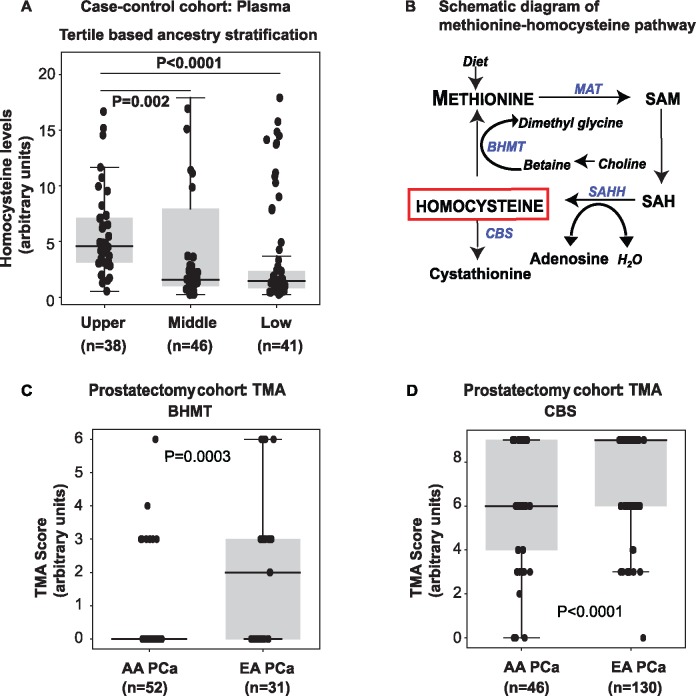
West African ancestry and plasma homocysteine, and the expression of homocysteine metabolizing enzymes, in African American (AA) prostate cancer (PCa). (A) Comparison of plasma homocysteine in case-control samples stratified into tertiles based on their West African ancestry. (B) Schematic diagram of methionine-homocysteine pathway. Homocysteine can be metabolized to cystathionine by cystathionine beta synthase (CBS) or remethylated back to methionine by Betaine-Homocysteine S-Methyltransferase (BHMT). (C) Tissue microarray analysis (TMA) for BHMT in AA PCa (n = 52) and EA PCa (n = 31). (D) Same as in C, but for CBS (AA PCa: n = 46 vs EA PCa: n = 130). Two-sided P values for all the panels were calculated using Wilcoxon rank sum test. MAT = Methionine adenosyltransferase; SAM = S-adenosylmethionine; SAH: S-adenosylhomocysteine; SAHH: S-adenosyl-L-homocysteine hydrolase.

References

    1. Tsivian M, Banez LL, Keto CJ, et al. African-American men with low-grade prostate cancer have higher tumor burdens: results from the Duke Prostate Center. Prostate Cancer Prostatic Dis. 2013;16(1):91–94. - PubMed
    1. Ritch CR, Morrison BF, Hruby G, et al. Pathological outcome and biochemical recurrence-free survival after radical prostatectomy in African-American, Afro-Caribbean (Jamaican) and Caucasian-American men: an international comparison. BJU Int. 2013;111(4b):E186–E190. - PubMed
    1. Yamoah K, Walker A, Spangler E, et al. African-American race is a predictor of seminal vesicle invasion after radical prostatectomy. Clin Genitourin Cancer. 2015;13(2):e65–e72. - PMC - PubMed
    1. Smith CJ, Dorsey TH, Tang W, et al. Aspirin use reduces the risk of aggressive prostate cancer and disease recurrence in African-American Men. Cancer Epidemiol Biomarkers Prev. 2017;26(6):845–853. - PMC - PubMed
    1. Shojaie A, Michailidis G.. Analysis of gene sets based on the underlying regulatory network. J Comput Biol. 2009;16(3):407–426. - PMC - PubMed

LinkOut - more resources