


Functional study of a KCNH2 mutant: Novel insights on the pathogenesis of the LQT2 syndrome
- PMID: 31361068
- PMCID: PMC6714209
- DOI: 10.1111/jcmm.14521
Functional study of a KCNH2 mutant: Novel insights on the pathogenesis of the LQT2 syndrome
Abstract
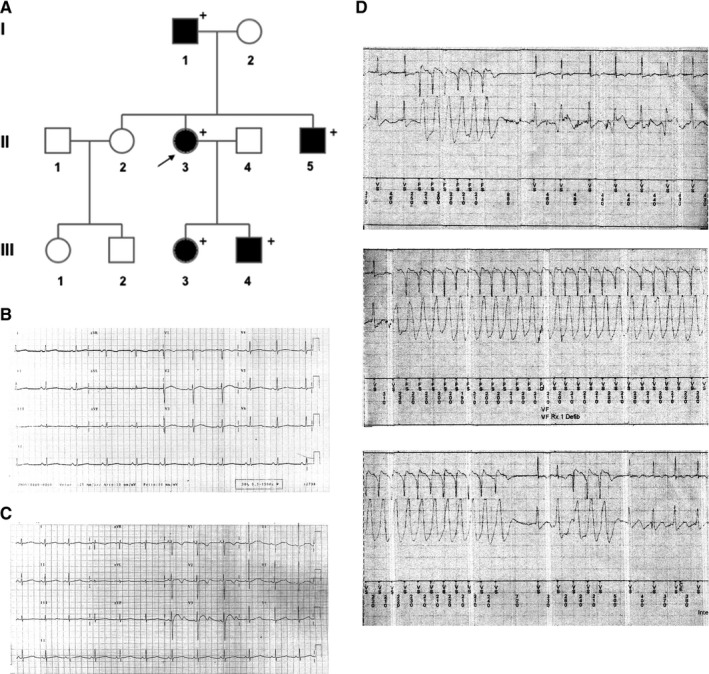
The K+ voltage-gated channel subfamily H member 2 (KCNH2) transports the rapid component of the cardiac delayed rectifying K+ current. The aim of this study was to characterize the biophysical properties of a C-terminus-truncated KCNH2 channel, G1006fs/49 causing long QT syndrome type II in heterozygous members of an Italian family. Mutant carriers underwent clinical workup, including 12-lead electrocardiogram, transthoracic echocardiography and 24-hour ECG recording. Electrophysiological experiments compared the biophysical properties of G1006fs/49 with those of KCNH2 both expressed either as homotetramers or as heterotetramers in HEK293 cells. Major findings of this work are as follows: (a) G1006fs/49 is functional at the plasma membrane even when co-expressed with KCNH2, (b) G1006fs/49 exerts a dominant-negative effect on KCNH2 conferring specific biophysical properties to the heterotetrameric channel such as a significant delay in the voltage-sensitive transition to the open state, faster kinetics of both inactivation and recovery from the inactivation and (c) the activation kinetics of the G1006fs/49 heterotetrameric channels is partially restored by a specific KCNH2 activator. The functional characterization of G1006fs/49 homo/heterotetramers provided crucial findings about the pathogenesis of LQTS type II in the mutant carriers, thus providing a new and potential pharmacological strategy.
Keywords: arrhythmia; cardiac pathophysiology; channelopathy; electrophysiology; long QT syndrome.
© 2019 The Authors. Journal of Cellular and Molecular Medicine published by John Wiley & Sons Ltd and Foundation for Cellular and Molecular Medicine.
Conflict of interest statement
The authors confirm that there are no conflicts of interest.
Figures


References
-
- Vandenberg JI, Perry MD, Perrin MJ, Mann SA, Ke Y, Hill AP. hERG K(+) channels: structure, function, and clinical significance. Physiol Rev. 2012;92:1393‐1478. - PubMed
-
- Piper DR, Hinz WA, Tallurri CK, Sanguinetti MC, Tristani‐Firouzi M. Regional specificity of human ether‐a'‐go‐go‐related gene channel activation and inactivation gating. J Biol Chem. 2005;280:7206‐7217. - PubMed
-
- Smith PL, Baukrowitz T, Yellen G. The inward rectification mechanism of the HERG cardiac potassium channel. Nature. 1996;379:833‐836. - PubMed
Publication types
MeSH terms
Substances
LinkOut - more resources
Full Text Sources
