


Reproductive and genetic consequences of extreme isolation in Salix herbacea L. at the rear edge of its distribution
- PMID: 31361802
- PMCID: PMC6868362
- DOI: 10.1093/aob/mcz129
Reproductive and genetic consequences of extreme isolation in Salix herbacea L. at the rear edge of its distribution
Abstract
Background and aims: At the rear edge of the distribution of species, extreme isolation and small population size influence the genetic diversity and differentiation of plant populations. This may be particularly true for Arctic-alpine species in mid-latitude mountains, but exactly how peripherality has shaped their genetic and reproductive characteristics is poorly investigated. The present study, focused on Salix herbacea, aims at providing new insights into the causes behind ongoing demographic dynamics and their consequences for peripheral populations of Arctic-alpine species.
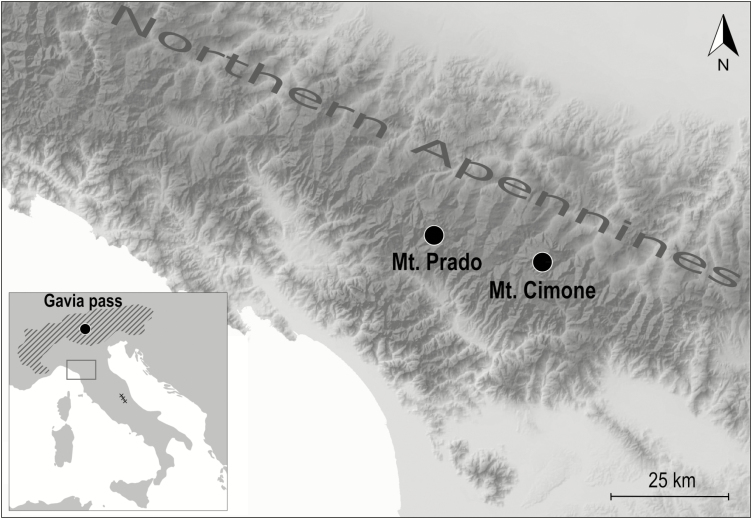
Methods: We performed a whole-population, highly detailed sampling of the only two S. herbacea populations in the northern Apennines, comparing their clonal and genetic diversity, sex ratio and spatial genetic structure with a reference population from the Alps. After inspecting ~1800 grid intersections in the three populations, 563 ramets were genotyped at 11 nuclear microsatellite markers (nSSRs). Past demography and mating patterns of Apennine populations were investigated to elucidate the possible causes of altered reproductive dynamics.
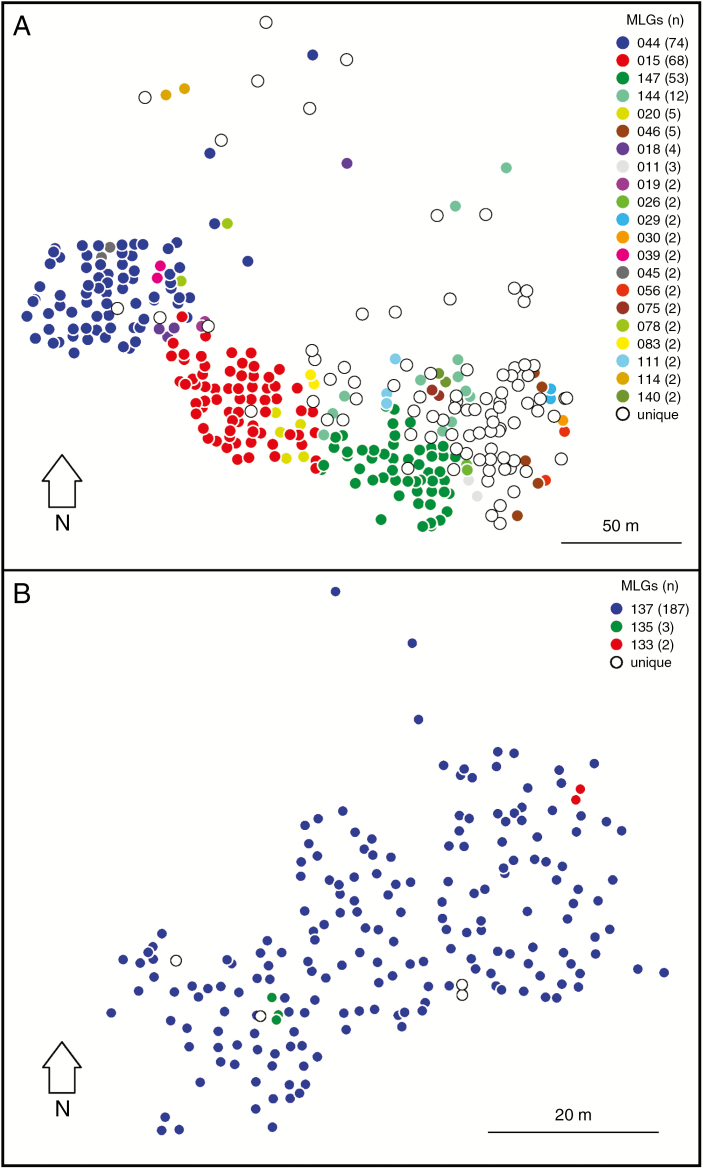
Key results: Apennine populations, which experienced a Holocene bottleneck and are highly differentiated (FST = 0.15), had lower clonal and genetic diversity compared with the alpine population (RMLG = 1 and HE = 0.71), with the smaller population exhibiting the lowest diversity (RMLG = 0.03 and HE = 0.24). An unbalanced sex ratio was found in the larger (63 F:37 M) and the smaller (99 F:1 M) Apennine population. Both were characterized by the presence of extremely large clones (up to 2500 m2), which, however, did not play a dominant role in local reproductive dynamics.
Conclusions: Under conditions of extreme isolation and progressive size reduction, S. herbacea has experienced an alteration of genetic characteristics produced by the prevalence of clonal growth over sexual reproduction. However, our results showed that the larger Apennine population has maintained levels of sexual reproduction enough to counteract a dramatic loss of genetic and clonal diversity.
Keywords: Salix herbacea; Fragmentation; clonal growth; gene flow; genetic diversity; isolation; marginality; microsatellite markers; peripherality; sex ratio; snowbed; spatial genetic structure.
© The Author(s) 2019. Published by Oxford University Press on behalf of the Annals of Botany Company. All rights reserved. For permissions, please e-mail: journals.permissions@oup.com.
Figures

References
-
- Abeli T, Vamosi JC, Orsenigo S. 2018. The importance of marginal population hotspots of cold-adapted species for research on climate change and conservation. Journal of Biogeography 45: 977–985.
-
- Aleksić JM, Piotti A, Geburek T, Vendramin GG. 2017. Exploring and conserving a “microcosm”: whole-population genetic characterization within a refugial area of the endemic, relict conifer Picea omorika. Conservation Genetics 18: 777–788.
-
- Alsos IG, Alm T, Normand S, Brochmann C. 2009. Past and future range shifts and loss of diversity in dwarf willow (Salix herbacea L.) inferred from genetics, fossils and modelling. Global Ecology and Biogeography 18: 223–239.
-
- Alvarez N, Manel S, Schmitt T, the IntraBioDiv Consortium. 2012. Contrasting diffusion of Quaternary gene pools across Europe: the case of the arctic–alpine Gentiana nivalis L. (Gentianaceae). Flora 207: 408–413.
-
- Ansell SW, Grunmann M, Russel SJ, Schneider H, Vogel JC. 2008. Genetic discontinuity, breeding-system change and population history of Arabis alpina in the Italian Peninsula and adjacent Alps. Molecular Ecology 17: 2245–2257. - PubMed
Publication types
MeSH terms
LinkOut - more resources
Full Text Sources
Miscellaneous
