. 2019 Oct;12(10):1364-1374.
doi: 10.1016/j.tranon.2019.07.003. Epub 2019 Jul 27.

UAB30, A Novel Rexinoid Agonist, Decreases Stemness In Group 3 Medulloblastoma Human Cell Line Xenografts

Affiliations

UAB30, A Novel Rexinoid Agonist, Decreases Stemness In Group 3 Medulloblastoma Human Cell Line Xenografts

Adele P Williams et al. Transl Oncol. 2019 Oct.

Abstract

Purpose: In spite of advances in therapy for some subtypes, group 3 medulloblastoma continues to portend a poor prognosis. A subpopulation of medulloblastoma cells expressing the cell surface marker CD133 have been posited as possible stem cell like cancer cells (SCLCC), a potential source of drug resistance and relapse. Retinoids have been shown to affect SCLCC in other brain tumors. Based on these findings, we hypothesized that the CD133-enriched cell population group 3 medulloblastoma cells would be sensitive to the novel rexinoid, UAB30.

Methods: Human medulloblastoma cell lines were studied. Cell sorting based on CD133 expression was performed. Both in vitro and in vivo extreme limiting dilution assays were completed to establish CD133 as a SCLCC marker in these cell lines. Cells were treated with either retinoic acid (RA) or UAB30 and sphere forming capacity and CD133 expression were assessed. Immunoblotting was used to assess changes in stem cell markers. Finally, mice injected with CD133-enriched or CD133-depleted cells were treated with UAB30.

Results: CD133-enriched cells more readily formed tumorspheres in vitro at lower cell concentrations and formed tumors in vivo at low cell numbers. Treatment with RA or UAB30 decreased CD133 expression, decreased tumorsphere formation, and decreased expression of cancer stem cell markers. In vivo studies demonstrated that tumors from both CD133-enriched and CD133-depleted cells were sensitive to treatment with UAB30.

Conclusions: CD133 is a marker for medulloblastoma SCLCCs. Both CD133-enriched and CD133-depleted medulloblastoma cell populations demonstrated sensitivity to UAB30, indicating its potential as a therapeutic option for group 3 medulloblastoma.


Figures

Figure 1
Figure 1
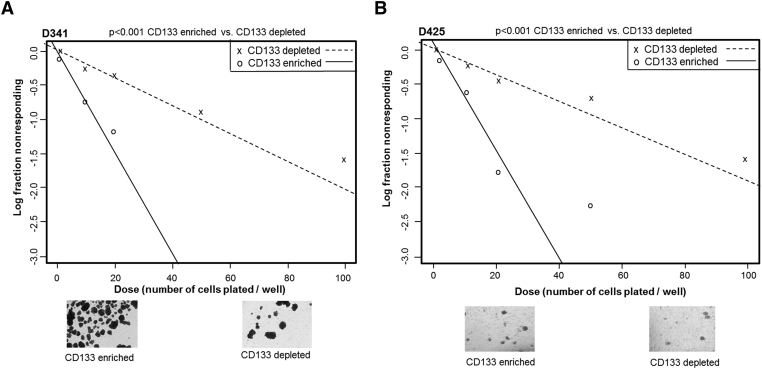
CD133-enriched cells more readily formed tumorspheres. A, D341 cells were magnetically sorted into CD133-enriched and CD133-depleted populations. Cells were plated for an extreme limiting dilution assay (ELDA) with 5000, 1000, 100, 50, 20, 10, and 1 cell per well. CD133-enriched cells formed spheres at significantly lower cell concentrations than the CD133-depleted cells. Representative photomicrographs showing decreased number of tumorspheres in the CD133 enriched versus CD133 depleted populations. B, D425 cells were similarly sorted and plated for ELDA with 5000, 1000, 100, 50, 20, 10, and 1 cell per well. CD133-enriched cells formed spheres at significantly lower cell concentrations than the CD133-depleted cells. Representative photomicrographs showing decreased number of tumorspheres in the CD133-enriched versus CD133-depleted populations.
Figure 2
Figure 2
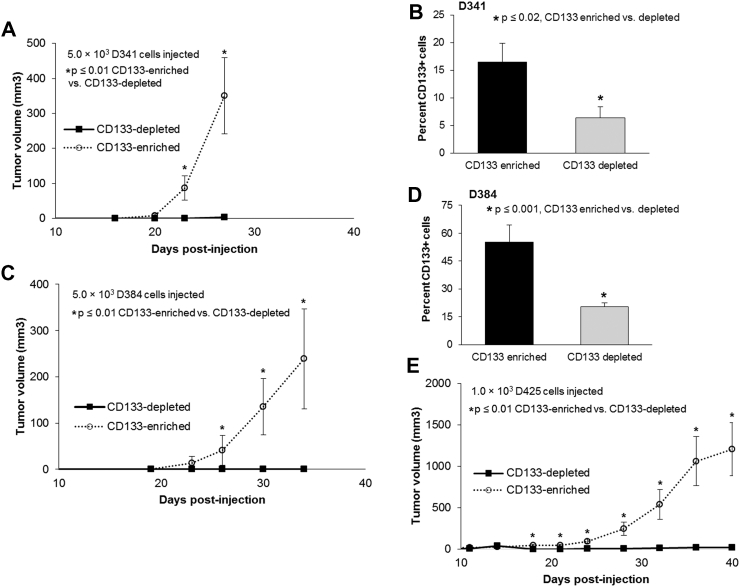
CD133-enriched D341, D384 and D425 cells demonstrated increased tumor growth in vivo. A, D341 cells were magnetically sorted into CD133-enriched and depleted populations. Within each group, 5 × 103 (n = 5 / group) cells were injected into the right flank of athymic nude mice. Tumor volume measurements were taken every 3–4 days. After 23 days, the CD133-enriched cells formed tumors in 5 of 5 mice compared to only 0 of 5 mice in the CD133-depleted group. The CD133-enriched population grew significantly larger tumors than the CD-133 depleted cell population. B, Tumors from the 5 × 103 groups were harvested and dissociated into single cell suspension. Flow cytometry was utilized to detect CD133 expression. CD133 levels remained significantly greater in the CD133-enriched tumors compared to tumors from the CD133-depleted cell population. C, D384 cells were magnetically sorted into CD133-enriched and depleted populations. Within each group 5 × 103 (n = 5 / group) cells were injected into the right flank of athymic nude mice. After 30 days, 4 of 5 mice injected with CD133-enriched cells had tumors compared to none of the mice that were injected with CD133-depleted cells. Tumor volume measurements were taken every 3–4 days and the CD133-enriched population grew significantly larger tumors than the CD133-depleted tumors. D, Tumors from the 1 × 105 groups were harvested and dissociated into single cell suspension to have enough tumor cells for analysis. Flow cytometry was utilized to detect CD133 expression. CD133 levels remained significantly greater in the CD133-enriched tumors. E, D425 cells were magnetically sorted into CD133-enriched and depleted populations. Within each group 1.0 × 103 (n = 10 / group) cells were injected into the right flank of athymic nude mice. By 20 days, all 10 mice in the CD133-enriched group developed tumors compared to only 2 of 10 in the CD133-depleted group. Tumor volume measurements were taken every 3–4 days and the CD133-enriched population grew significantly larger tumors than the CD133-depleted group.
Figure 3
Figure 3
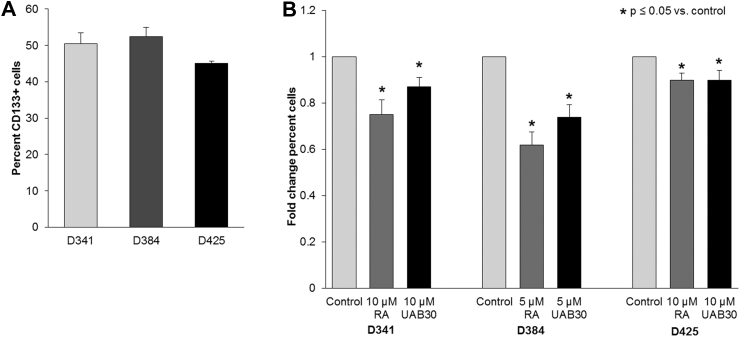
CD133 expression was decreased after RA and UAB30. A, Flow cytometry was used to determine the baseline CD133 expression in untreated D341, D384, and D425 cells. B, D341 and D425 cells were treated with vehicle (control) or RA or UAB30 (10 μM) and D384 cells were treated with vehicle (control) or RA or UAB30 (5 μM) for 48 hours. Cells were fixed, stained with CD133 antibody, and analyzed using flow cytometry. There was a significant decrease in CD133 expression in all three MB cell lines following RA and UAB30 treatment compared to untreated control cells. Data were reported as fold change percent cells ± SEM expressing CD133.
Figure 4
Figure 4
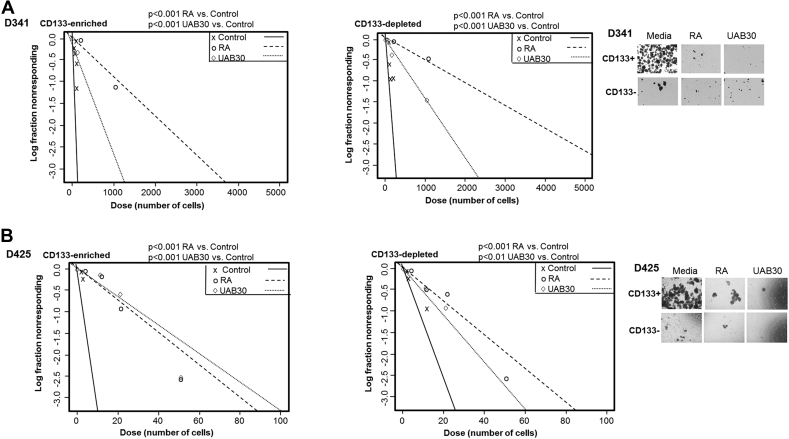
RA and UAB30 decreased tumorsphere formation. A, D341 and B, D425 cells were magnetically sorted and plated in 96 well plates with decreasing number of cells per well. The cells were treated with conditioned neurobasal media with vehicle or conditioned neurobasal media with RA or UAB30 (10 μM). The number of wells with sphere formation were counted and analyzed as an ELDA. There was significantly less tumorsphere formation in those cells treated with RA or UAB30 than the control in both the CD133-enriched and depleted population in both cell lines. Representative photomicrographs showing decreased number of tumorspheres following treatment with RA or UAB30.
Figure 5
Figure 5
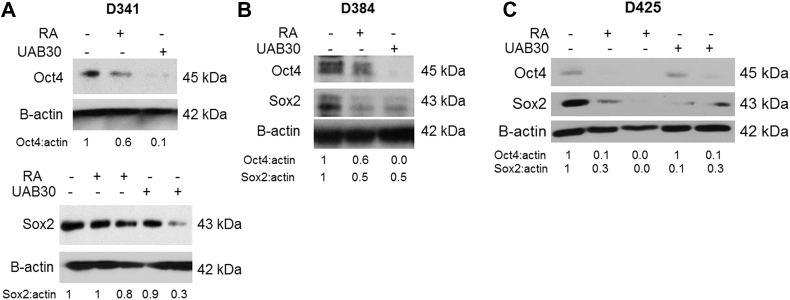
Treatment with RA and UAB30 decreased stemness markers in MB cells. Cells were treated with RA or UAB30 and whole cell lysates underwent immunoblotting for stemness markers. A D341 cells were treated with RA or UAB30 (0, 10 μM) for 48 hours. Immunoblotting for Oct4 showed decreased expression after treatment with RA or UAB30 (top panel). Cells were treated with RA or UAB30 (0, 10, 30 μM) for 5 days and lysates examined for Sox2. Sox2 expression was decreased with RA or UAB30 treatment (bottom panel). B D384 cells were treated with RA or UAB30 (0, 10 μM) for 72 hours, and immunoblotting performed for Oct4 (top panel) and Sox2 (bottom panel). Both proteins were decreased with RA or UAB30 treatment. C D425 cells were treated with RA or UAB30 (0, 10, 30 μM) for 72 hours. Immunoblotting for Oct4 and Sox2 revealed decreased expression of these proteins following RA or UAB30 treatment. Densitometry was utilized to evaluate the bands, providing confirmatory evidence that RA and UAB30 decreased expression of stemness markers.
Figure 6
Figure 6
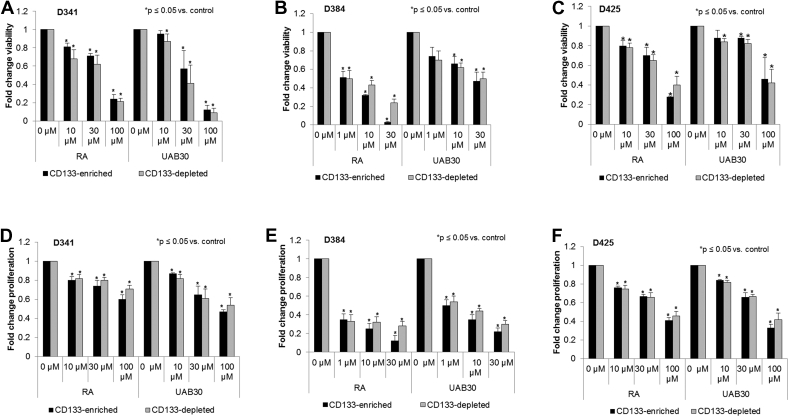
Treatment with RA and UAB30 decreased viability and proliferation in CD133-enriched and depleted cells. A-C D341, D384, and D425 were magnetically sorted, cells were plated on 96 well plates and treated with vehicle or increasing doses of RA and UAB30 (0, 10, 30, 100 μM for D341 and D425; 0, 1, 10, 30 μM for D384). Viability was measured after 5 days of treatment using alamarBlue® assay. In all three cell lines, treatment with RA and UAB30 significantly decreased viability. Results were similar for both the CD133-enriched and depleted populations. D-F Proliferation was measured with CellTiter 96® assay after 5 days of treatment. Similar to viability, proliferation was significantly decreased following RA or UAB30 treatment in all three cell lines, and the CD133-enriched populations were as sensitive to treatment as the CD133-depleted populations.
Figure 7
Figure 7
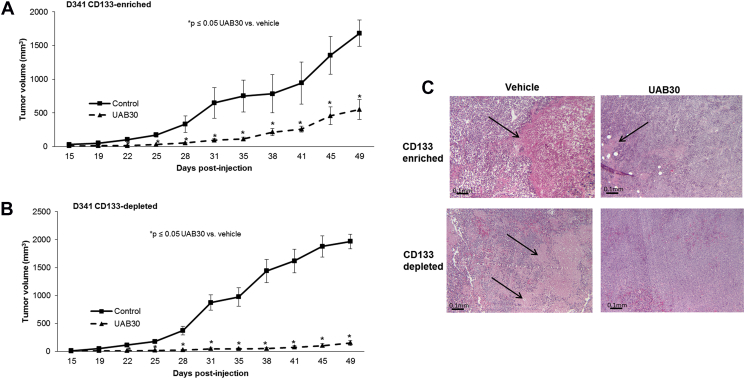
UAB30 decreased tumor growth in vivo in both CD133-enriched and depleted cells. D341 cells were magnetically sorted. CD133-enriched cells (5 × 103 in 25% Matrigel™) were injected in the right flank of athymic nude mice (n = 5) and the same was done with CD133-depleted cells (1 × 105 cells in 25% Matrigel™) (n = 5). Mice were randomized to receive either vehicle-treated chow or UAB-treated chow (100 mg/kg/day). Tumors were measured twice per week and mice were euthanized when tumors met IACUC parameters. A In the CD133-enriched population there was a significant difference in tumor volume as early as 22 days, with significantly smaller volume tumors in the UAB30-treated cohort. B In the CD133-deleted population there was also a significant difference in tumor volume as early as 22 days, with significantly smaller volume tumors in the UAB30-treated cohort. C Histology on the tumors revealed that the vehicle treated tumors tended to have larger areas of necrosis (open arrows) than the UAB30-treated tumors. This finding held true for both the CD133-enriched and CD133-depleted tumors.
Supplementary data Figure 1
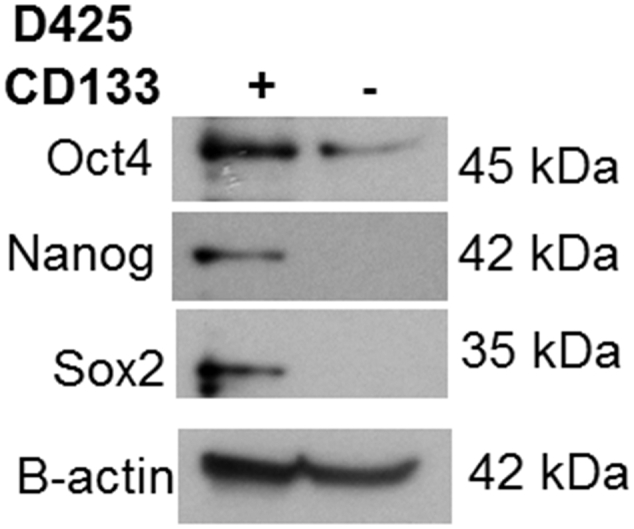
Stemness markers were more abundant in CD133-enriched versus CD133-depleted D425 cell populations. D425 MB tumors were dissociated and separated by magnetic bead sorting into CD133-enriched and CD133-depleted populations. Immunoblotting of whole cell lysates for stemness markers Oct4, Nanog and Sox2 was performed. All proteins were more prominent in the CD133-enriched versus CD133-depleted cells. β-actin served as internal loading control.
Supplementary data Figure 2
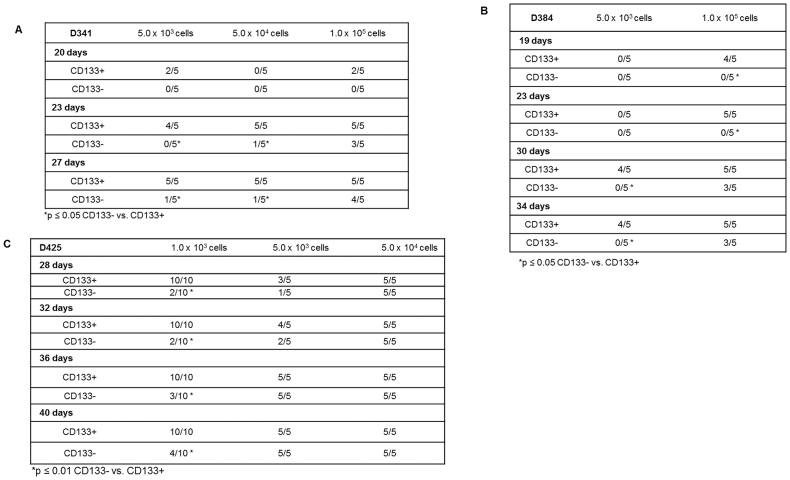
CD133-enriched D341, D384 and D425 cells demonstrated increased tumor growth in vivo. A D341 cells were magnetically sorted into CD133-enriched and depleted populations. Within each group, either 5 × 103 (n = 5), 5 × 104 (n = 5), or 1.0 × 105 (n = 5) cells were injected into the right flank of athymic nude mice. After 27 days, the CD133-enriched cells formed tumors in 5 of 5 mice in the lowest concentration groups compared to only 1 of 5 mice injected with the CD133-depleted cells. CD133-enriched tumors also began growing earlier (20 days vs. 27 days). B D384 cells were magnetically sorted into CD133-enriched and depleted populations. Within each group, either 5 × 103 (n = 5) or 1 × 105 (n = 5) cells were injected into the right flank of athymic nude mice. After 34 days, 4 of 5 mice injected with the smallest concentration of CD133-enriched cells had tumors compared to none of the mice that were injected with CD133-depleted cells. In addition, even at the higher cell number, the CD133-enriched tumors began growing earlier (19 days versus 30 days) than the CD133-depleted tumors. C D425 cells were magnetically sorted into CD133-enriched and depleted populations. Within each group, either 1.0 × 103 (n = 10), 5.0 × 103 (n = 5), or 5.0 × 104 (n = 5) cells were injected into the right flank of athymic nude mice. In the cohort with the least amount of cells, by 28 days, all 10 mice in the CD133-enriched group developed tumors compared to only 2 of 10 in the CD133-depleted group.
Supplementary data Figure 3
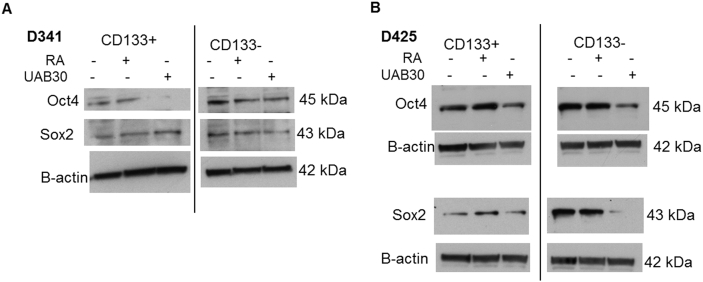
Treatment with RA and UAB30 decreased stemness markers in sorted MB cells. Cells were sorted into CD133-enriched and CD133-depleted populations. Cells were treated for treated with RA or UAB30 and whole cell lysates underwent immunoblotting for stemness markers. A D341 CD133-enriched (left panel) or CD133-depleted (right panel) cells were treated with RA or UAB30 (0, 10 µM) for 48 hours. Immunoblotting for Oct4 showed decreased expression after treatment with RA or UAB30. Sox2 expression was slightly decreased with UAB30 treatment in the CD133-depleted population B D425 CD133-enriched (left panel) or CD133-depleted (right panel) cells were treated with RA or UAB30 (0, 10 µM) for 72 hours. Immunoblotting for Oct4 (upper panels) and Sox2 (lower panels) revealed decreased expression of these proteins following UAB30 treatment.

References

    1. Northcott PA, Korshunov A, Witt H, Hielscher T, Eberhart CG, Mack S, Bouffet E, Clifford SC, Hawkins CE, French P. Medulloblastoma comprises four distinct molecular variants. J Clin Oncol. 2011;29(11):1408–1414. - PMC - PubMed
    1. Kool M, Korshunov A, Remke M, Jones DT, Schlanstein M, Northcott PA, Cho YJ, Koster J, Schouten-van Meeteren A, van Vuurden D. Molecular subgroups of medulloblastoma: an international meta-analysis of transcriptome, genetic aberrations, and clinical data of WNT, SHH, Group 3, and Group 4 medulloblastomas. Acta Neuropathol. 2012;123(4):473–484. - PMC - PubMed
    1. Cho YJ, Tsherniak A, Tamayo P, Santagata S, Ligon A, Greulich H, Berhoukim R, Amani V, Goumnerova L, Eberhart CG. Integrative genomic analysis of medulloblastoma identifies a molecular subgroup that drives poor clinical outcome. J Clin Oncol. 2011;29(11):1424–1430. - PMC - PubMed
    1. Eberhart CG. Three down and one to go: modeling medulloblastoma subgroups. Cancer Cell. 2012;21(2):137–138. - PMC - PubMed
    1. Palmer SL, Reddick WE, Gajjar A. Understanding the cognitive impact on children who are treated for medulloblastoma. J Pediatr Psychol. 2007;32(9):1040–1049. - PubMed