


An upper bound for the background rate of human extinction
- PMID: 31363134
- PMCID: PMC6667434
- DOI: 10.1038/s41598-019-47540-7
An upper bound for the background rate of human extinction
Erratum in
-
Author Correction: An upper bound for the background rate of human extinction.Sci Rep. 2019 Dec 11;9(1):19222. doi: 10.1038/s41598-019-55816-1. Sci Rep. 2019. PMID: 31822773 Free PMC article.
Abstract
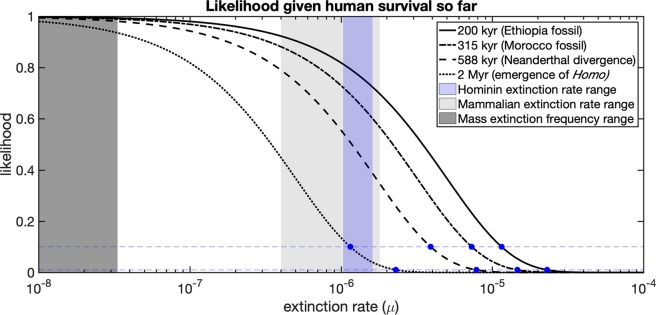
We evaluate the total probability of human extinction from naturally occurring processes. Such processes include risks that are well characterized such as asteroid impacts and supervolcanic eruptions, as well as risks that remain unknown. Using only the information that Homo sapiens has existed at least 200,000 years, we conclude that the probability that humanity goes extinct from natural causes in any given year is almost guaranteed to be less than one in 14,000, and likely to be less than one in 87,000. Using the longer track record of survival for our entire genus Homo produces even tighter bounds, with an annual probability of natural extinction likely below one in 870,000. These bounds are unlikely to be affected by possible survivorship bias in the data, and are consistent with mammalian extinction rates, typical hominin species lifespans, the frequency of well-characterized risks, and the frequency of mass extinctions. No similar guarantee can be made for risks that our ancestors did not face, such as anthropogenic climate change or nuclear/biological warfare.
Conflict of interest statement
The authors declare no competing interests.
Figures
References
-
- Raup, D. M. Extinction: bad genes or bad luck? (WW Norton & Company, 1992).
-
- Barnosky AD, et al. Has the Earth’s sixth mass extinction already arrived? Nat. 2011;471:51. - PubMed
-
- Smith JM. The causes of extinction. Phil. Trans. R. Soc. Lond. B. 1989;325:241–252. - PubMed
-
- Benton MJ. The Red Queen and the Court Jester: species diversity and the role of biotic and abiotic factors through time. Sci. 2009;323:728–732. - PubMed
-
- Schulte P, et al. The Chicxulub asteroid impact and mass extinction at the Cretaceous-Paleogene boundary. Sci. 2010;327:1214–1218. - PubMed
Publication types
MeSH terms
LinkOut - more resources
Full Text Sources
Medical
