


Retinopathy of prematurity in Rwanda: a prospective multi-centre study following introduction of screening and treatment services
- PMID: 31363176
- PMCID: PMC7182562
- DOI: 10.1038/s41433-019-0529-5
Retinopathy of prematurity in Rwanda: a prospective multi-centre study following introduction of screening and treatment services
Erratum in
-
Correction: Retinopathy of prematurity in Rwanda: a prospective multi-centre study following introduction of screening and treatment services.Eye (Lond). 2020 May;34(5):992. doi: 10.1038/s41433-019-0561-5. Eye (Lond). 2020. PMID: 31485037 Free PMC article.
Abstract
Objectives: To investigate risk factors for retinopathy of prematurity (ROP) in a newly established ROP screening and management programme in Rwanda, Africa.
Methods: In this multi-centre prospective study 795/2222 (36%) babies fulfilled the inclusion criteria (gestational age (GA) < 35 weeks or birth weight (BW) < 1800 g or unstable clinical course), 424 (53%) of whom were screened for ROP. 270 died before the first screening. ROP and treatment-warranted ROP were classified using the revised International Classification of ROP (2005). Data on maternal and perinatal risk factors were collected from daily neonatal notes.
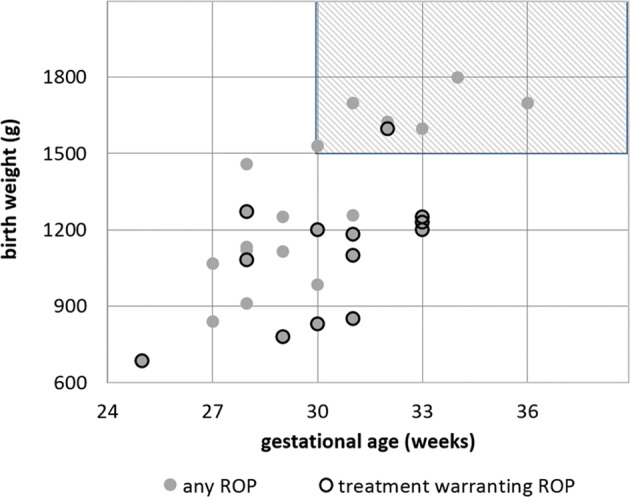
Results: 31 babies (7.3%, CI 5.0-10.2) developed any ROP, 13 of whom (41.9%, CI 24.5-60.9) required treatment. ROP was seen in six neonates with GA > 30 weeks and BW > 1500 g, one of whom required treatment. In univariate analysis the following were associated with any ROP: increasing number of days on supplemental oxygen (OR 2.1, CI 1.5-3.0, P < 0.001), low GA (OR 3.4, CI 1.8-6.4, P < 0.001), low BW (OR 2.3, CI 1.5-3.4, P < 0.001), at least one episode of hyperglycaemia ≥ 150 mg/dl (OR 6.6, CI 2.0-21.5, P < 0.001), blood transfusion (OR 3.5, CI 1.6-7.4, P < 0.001) or sepsis (OR 3.2, CI 1.2-8.6, P = 0.01). In multivariate analysis longer exposure to supplemental oxygen (OR 2.1, CI 1.2-3.6, P = 0.01) and hyperglycaemia (OR 3.5, CI 1.0-12.4, P = 0.05) remained significant.
Conclusions: ROP has become an emerging health problem in Rwanda, requiring programmes for screening and treatment. ROP screening is indicated beyond the 2013 American Academy guidelines. Improved quality of neonatal care, particularly oxygen delivery and monitoring is needed.
Conflict of interest statement
The authors declare that they have no conflict of interest.
Figures
References
-
- Quinn G, Gilbert C, Darlow B, Zin A. Retinopathy of prematurity: an epidemic in the making. Chin Med J. 2010;123:2929–37. - PubMed
-
- Gilbert C, Fielder A, Gordillo L, Guinn G, Semiglia R, Zin A, et al. Characteristics of infants with severe retinopathy of prematurity in countries with low, moderate and high levels of development: implications for screening programs. Pediatrics. 2005;115:e518–e25. doi: 10.1542/peds.2004-1180. - DOI - PubMed
Publication types
MeSH terms
LinkOut - more resources
Full Text Sources
