The Role of the Hand Surgeon in Microsurgery in Brazil
- PMID: 31363286
- PMCID: PMC6597419
- DOI: 10.1055/s-0039-1692433
The Role of the Hand Surgeon in Microsurgery in Brazil
Abstract
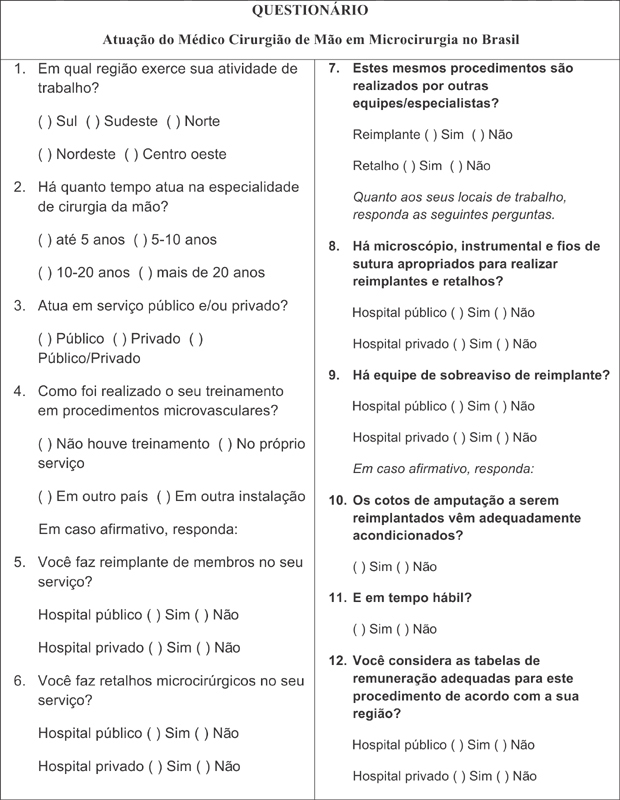
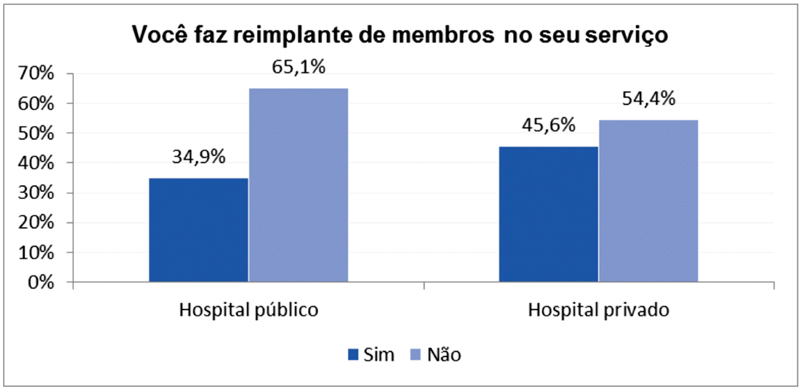
Objective This study evaluates the conditions for microvascular procedures found by hand surgeons in Brazilian clinical practices. Methodology A prospective, observational, and analytical primary clinical research conducted during the 37 th Brazilian Congress of Hand Surgery, from March 30 th to April 1 st , 2017, in Belo Horizonte, in which physicians answered 12 closed, objective, multiple-choice questions regarding their geographic region, type of institution (public or private), microsurgical training, time of experience, technical conditions, the availability of a standby team for emergencies and compensation. Results The study analyzed 143 hand surgeons; among them, 65.7% participants were based at the Southeast region, 13.3% in the Northeast region, 11.9% in the South region, 6.3% in the Central-West region and 2.8% in the North region. Regarding the time of experience, 43.4% of the hand surgeons had less than 5 years, 16.8% had 5 to 10 years, 23.8% 10 to 20 years, and 23% had more than 20 years of practice in microvascular surgery. Seven percent of the surgeons had no training in microvascular surgery; for 63.6%, training occurred during medical residency, whereas 30.8% were trained in another institution, and 7.7% in another country. Among these surgeons, 76.9% worked at both private and public hospitals, 14.7% at private hospitals and 5.6% at public hospitals. Regarding compensation, 1.8% of the surgeons considered it adequate, and 98.2%, inadequate in public hospitals, whereas 5.0% considered it adequate, and 95.0%, inadequate in private hospitals. Conclusion This research shows that most surgeons were trained in microsurgery, had never performed reattachments, and considered that compensation is inadequate; moreover, standby teams were not available. There are few, unevenly distributed hand surgeons with microsurgical ability in emergency settings, and their compensation is low.
Keywords: hands/surgery; microsurgical procedures; replantation; socioeconomic factors.
Conflict of interest statement
Figures

References
-
- Hing E, Hall M J, Ashman J J, Xu J. National Hospital Ambulatory Medical Care Survey: 2007 outpatient department summary. Natl Health Stat Rep. 2010;23(28):1–32. - PubMed
-
- Trybus M, Lorkowski J, Brongel L, Hladki W. Causes and consequences of hand injuries. Am J Surg. 2006;192(01):52–57. - PubMed
-
- de Putter C E, Selles R W, Polinder S, Panneman M J, Hovius S E, van Beeck E F. Economic impact of hand and wrist injuries: health-care costs and productivity costs in a population-based study. J Bone Joint Surg Am. 2012;94(09):e56. - PubMed
-
- del Piñal F. Severe mutilating injuries to the hand: guidelines for organizing the chaos. J Plast Reconstr Aesthet Surg. 2007;60(07):816–827. - PubMed
-
- Pomerance J, Truppa K, Bilos Z J, Vender M I, Ruder J R, Sagerman S D. Replantation and revascularization of the digits in a community microsurgical practice. J Reconstr Microsurg. 1997;13(03):163–170. - PubMed
LinkOut - more resources
Full Text Sources
Miscellaneous