


Correcting versus resolving respiratory motion in free-breathing whole-heart MRA: a comparison in patients with thoracic aortic disease
- PMID: 31363865
- PMCID: PMC6667582
- DOI: 10.1186/s41747-019-0107-4
Correcting versus resolving respiratory motion in free-breathing whole-heart MRA: a comparison in patients with thoracic aortic disease
Abstract
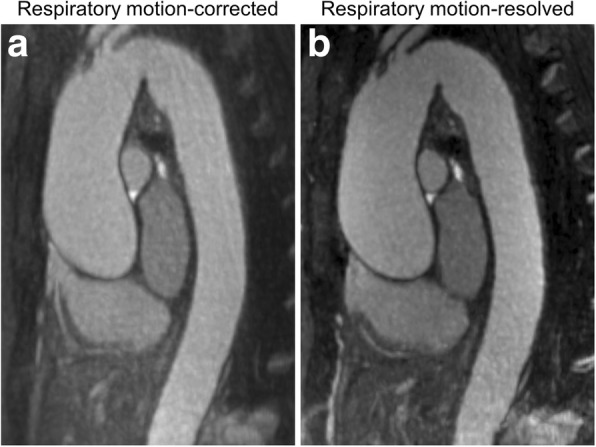
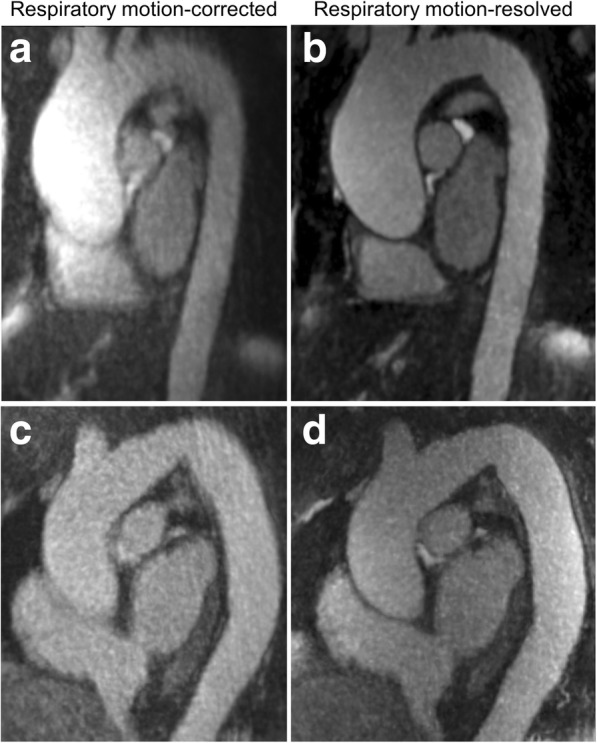
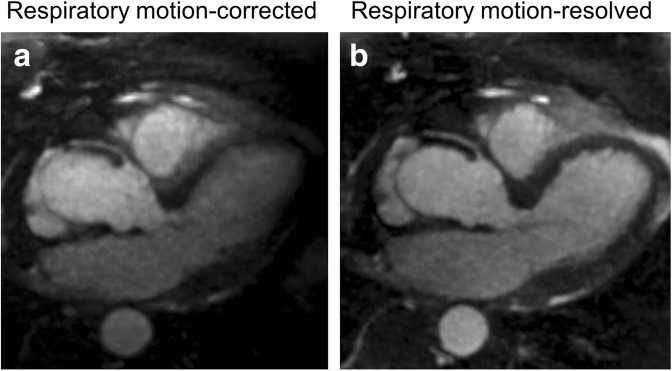
Background: Whole-heart magnetic resonance angiography (MRA) requires sophisticated methods accounting for respiratory motion. Our purpose was to evaluate the image quality of compressed sensing-based respiratory motion-resolved three-dimensional (3D) whole-heart MRA compared with self-navigated motion-corrected whole-heart MRA in patients with known thoracic aorta dilation.
Methods: Twenty-five patients were prospectively enrolled in this ethically approved study. Whole-heart 1.5-T MRA was acquired using a prototype 3D radial steady-state free-precession free-breathing sequence. The same data were reconstructed with a one-dimensional motion-correction algorithm (1D-MCA) and an extradimensional golden-angle radial sparse parallel reconstruction (XD-GRASP). Subjective image quality was scored and objective image quality was quantified (signal intensity ratio, SIR; vessel sharpness). Wilcoxon, McNemar, and paired t tests were used.
Results: Subjective image quality was significantly higher using XD-GRASP compared to 1D-MCA (median 4.5, interquartile range 4.5-5.0 versus 4.0 [2.25-4.75]; p < 0.001), as well as signal homogeneity (3.0 [3.0-3.0] versus 2.0 [2.0-3.0]; p = 0.003), and image sharpness (3.0 [2.0-3.0] vs 2.0 [1.25-3.0]; p < 0.001). SIR with the 1D-MCA and XD-GRASP was 6.1 ± 3.9 versus 7.4 ± 2.5, respectively (p < 0.001); while signal homogeneity was 274.2 ± 265.0 versus 199.8 ± 67.2 (p = 0.129). XD-GRASP provided a higher vessel sharpness (45.3 ± 10.7 versus 40.6 ± 101, p = 0.025).
Conclusions: XD-GRASP-based motion-resolved reconstruction of free-breathing 3D whole-heart MRA datasets provides improved image contrast, sharpness, and signal homogeneity and seems to be a promising technique that overcomes some of the limitations of motion correction or respiratory navigator gating.
Keywords: Aorta; Dilatation; Image processing (computer–assisted); Magnetic resonance angiography; Motion.
Conflict of interest statement
U. Joseph Schoepf is a consultant for and/or receives research support from Astellas, Bayer, Elucid Bioimaging, GE, Guerbet, HeartFlow Inc., and Siemens. Davide Piccini is an employee of Siemens. John Heerfordt’s doctoral studies are financially supported by Siemens. Akos Varga-Szemes receives institutional research support and travel support from Siemens and is a consultant for Elucid Bioimaging. The other authors declare that they have no competing interests.
Figures
References
Publication types
MeSH terms
LinkOut - more resources
Full Text Sources