


Fixed versus flexible combination of GLP-1 receptor agonists with basal insulin in type 2 diabetes: A retrospective multicentre comparative effectiveness study
- PMID: 31364233
- PMCID: PMC6852173
- DOI: 10.1111/dom.13840
Fixed versus flexible combination of GLP-1 receptor agonists with basal insulin in type 2 diabetes: A retrospective multicentre comparative effectiveness study
Abstract
Background and aims: The combination of basal insulin (BI) and GLP-1 receptor agonists (GLP-1RAs) is a rational and effective therapy for patients with uncontrolled type 2 diabetes (T2D). We compared the effectiveness of fixed and flexible BI/GLP-1RA combinations using routinely accumulated clinical data.
Methods: This was a retrospective, multicentre, real-world study concerning T2D patients initiating a fixed or flexible BI/GLP-1RA combination (NCT03959865). The primary endpoint was change in HbA1c. Secondary endpoints were changes in body weight, fasting plasma glucose (FPG) and systolic blood pressure (SBP). Confounding was addressed by propensity score matching (PSM) or multivariable adjustment (MVA).
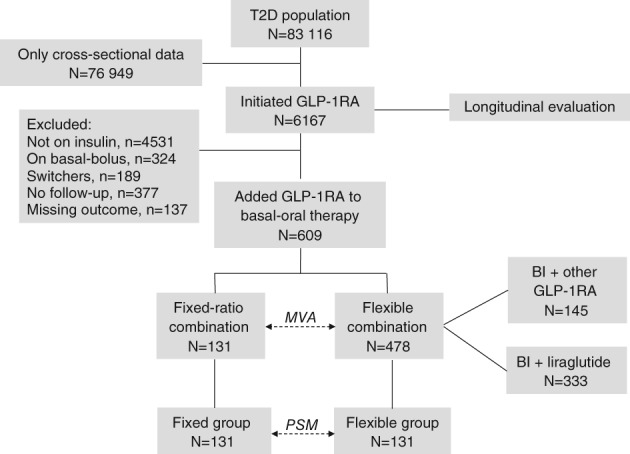
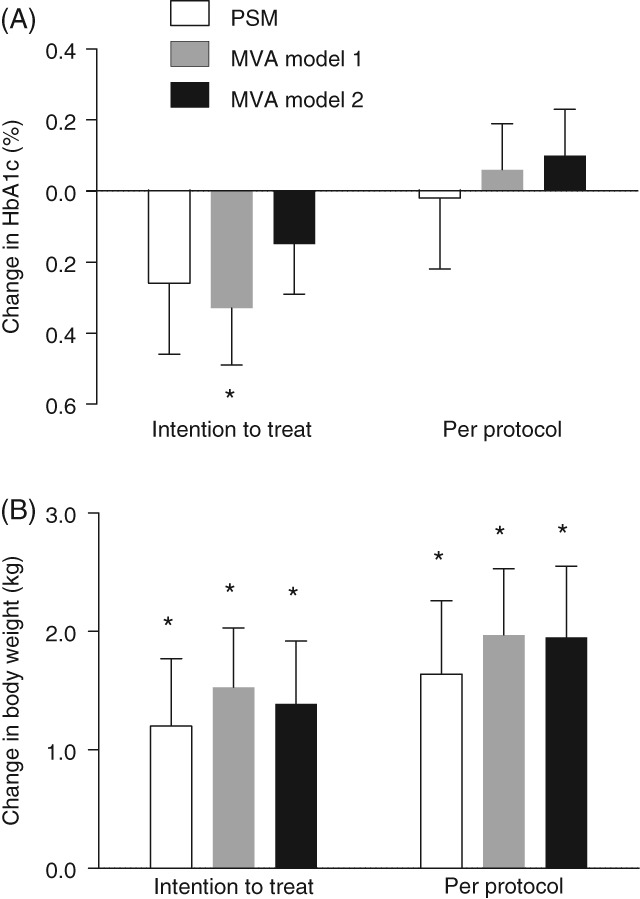
Results: A total of 609 patients were included in the study, 131 in the fixed group and 478 in the flexible group. The two groups differed in terms of diabetes duration, body weight and concomitant medications. After 5.7 months, observed HbA1c reductions were 0.6% and 0.8%, and body weight reductions were 2.8 kg and 1.2 kg in the flexible and fixed groups, respectively. Following PSM, HbA1c declined similarly in the two groups, whereas reduction in body weight was significantly in favour of the flexible combination. Findings were robust in sensitivity analyses, with the exception that, with MVA, a significantly higher reduction in HbA1c was detected in the fixed group. Final doses of BI were higher in the fixed group, whereas those of GLP-1RA were higher in the flexible group.
Conclusions: In routine specialist care, initiation of the fixed or flexible BI/GLP-1RA combination allowed similar improvement in glycaemic control, but greater weight loss was observed with the flexible combination. This difference reflected dosages of BI and GLP-1RAs.
Keywords: GLP-1 analogue; basal insulin; observational study; type 2 diabetes.
© 2019 The Authors. Diabetes, Obesity and Metabolism published by John Wiley & Sons Ltd.
Conflict of interest statement
M. R. received lecture and advisory board fees from AstraZeneca, Boehringer‐Ingelheim, Novo Nordisk and Sanofi Aventis. V. F. served as a consultant for Novo Nordisk. N. S. received lecture or consultancy fees from Astra‐Zeneca, Boehringer‐Lilly, Novartis, Novo Nordisk, Sanofi‐Aventis, Takeda, Merck Sharp & Dohme and Abbott and received research support from Novo Nordisk. A. L. received grant support and lecture or advisory board fees from Novo Nordisk, Sanofi, Abbott and Eli Lilly. A. A. received research grants and lecture or advisory board fees from Merck Sharp & Dome, AstraZeneca, Novartis, Boeringher‐Ingelheim, Sanofi, Mediolanum, Janssen and Novo Nordisk. G. P. F. received grant support and lecture or advisory board fees from AstraZeneca, Boehringer‐Ingelheim, Eli Lilly, Mundipharma, Novo Nordisk, Sanofi, Genzyme, Abbott, Novartis and Merck Sharp & Dohme. M. L. M., F. T. and M. D. A. declare no conflict of interest.
Figures
References
-
- Abd El Aziz MS, Kahle M, Meier JJ, Nauck MA. A meta‐analysis comparing clinical effects of short‐ or long‐acting GLP‐1 receptor agonists versus insulin treatment from head‐to‐head studies in type 2 diabetic patients. Diabetes Obes Metab. 2017;19:216‐227. - PubMed
-
- Htike ZZ, Zaccardi F, Papamargaritis D, Webb DR, Khunti K, Davies MJ. Efficacy and safety of glucagon‐like peptide‐1 receptor agonists in type 2 diabetes: a systematic review and mixed‐treatment comparison analysis. Diabetes Obes Metab. 2017;19:524‐536. - PubMed
Publication types
MeSH terms
Substances
Associated data
LinkOut - more resources
Full Text Sources
Medical
Miscellaneous
