Review
. 2019 Sep;49(9):990-1002.
doi: 10.1111/hepr.13417. Epub 2019 Aug 22.

Countermeasures against viral hepatitis B and C in Japan: An epidemiological point of view

Affiliations
Review

Countermeasures against viral hepatitis B and C in Japan: An epidemiological point of view

Junko Tanaka et al. Hepatol Res. 2019 Sep.

Abstract

Although the mortality rate due to hepatocellular carcinoma (HCC) has been gradually decreasing in Japan, approximately 30 000 people died of HCC in 2016. In 2007, the dominant etiology was persistent hepatitis C virus (HCV) infection, which accounted for 65% of total HCC deaths, and 15% of cases were due to chronic hepatitis B virus (HBV) infection. In managing chronic HBV and HCV infection, it is critically important to know the exact number of infected individuals in a particular country, which then assists in evaluating medical and financial needs in the foreseeable future. Therefore, from an epidemiological perspective, we estimated the numbers of HBV and HCV carriers in four categories: (i) undiagnosed carriers; (ii) carriers who were already hospitalized as patients or were receiving outpatient medical attention; (iii) diagnosed carriers who had not consulted any medical facility, or had discontinued consultation; and (iv) newly infected carriers. From these estimates we determined the current HBV and HCV burden and then reviewed the existing countermeasures for their prevention and control in Japan. While continuing the surveillance on the dynamics of hepatitis virus infections linked with preventive measures against hepatitis virus infection, it is crucially important to promote appropriate measures for each of the four groups of hepatitis virus carriers in society.

Keywords: Japan; countermeasure; epidemiology; hepatitis B virus; hepatitis C virus.


Figures

Figure 1
Figure 1
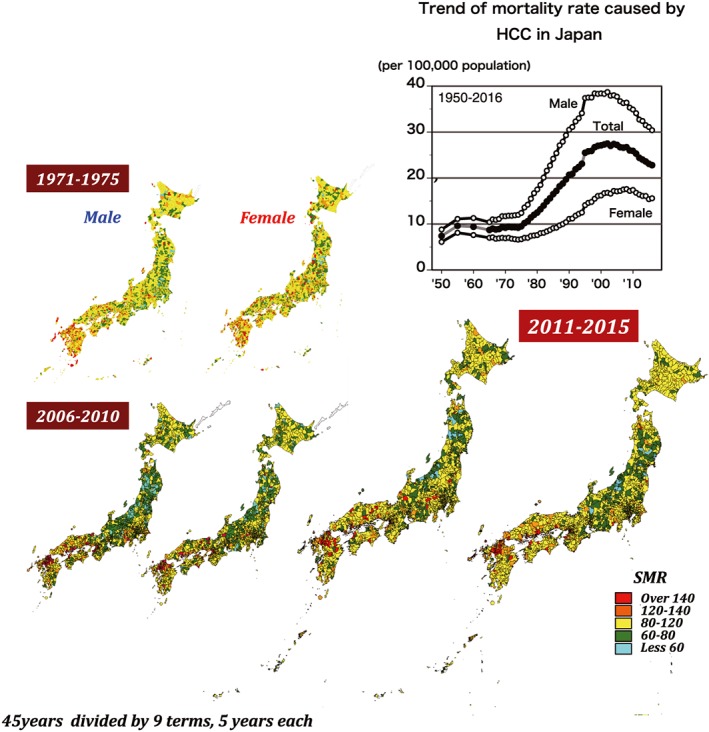
Area‐specific 5‐year standard mortality ratios of hepatocellular carcinoma in Japan. Each figure represents the area‐specific standard mortality ratio of hepatocellular carcinoma divided by eight jurisdictions of Japan during 1971–1975 (top left figures), 2006–2010 (bottom left figures), and 2011–2015 (bottom right figures). In each pair, the left map represents male individuals and the right map represents female individuals. Each color spot represents the mortality rate by their level of severity, from blue for standard mortality ratio (SMR) <60 to red for SMR >140. [Color figure can be viewed at http://wileyonlinelibrary.com]
Figure 2
Figure 2
Flow diagram showing the development of the system of countermeasures for hepatitis virus control in Japan. The long history of countermeasures against hepatitis B virus (HBV) and hepatitis C virus (HCV) infection in Japan is indicated by the establishment of strategic plans and gradual modification of the system in each year, together with particular milestones during the system's development. DAA, direct‐acting antiviral; HBsAg, hepatitis B surface antigen; IFN, interferon; JRC, Japanese Red Cross; NA, nucleos(t)ide analogue; NAT, nucleic acid amplification test. [Color figure can be viewed at http://wileyonlinelibrary.com]
Figure 3
Figure 3
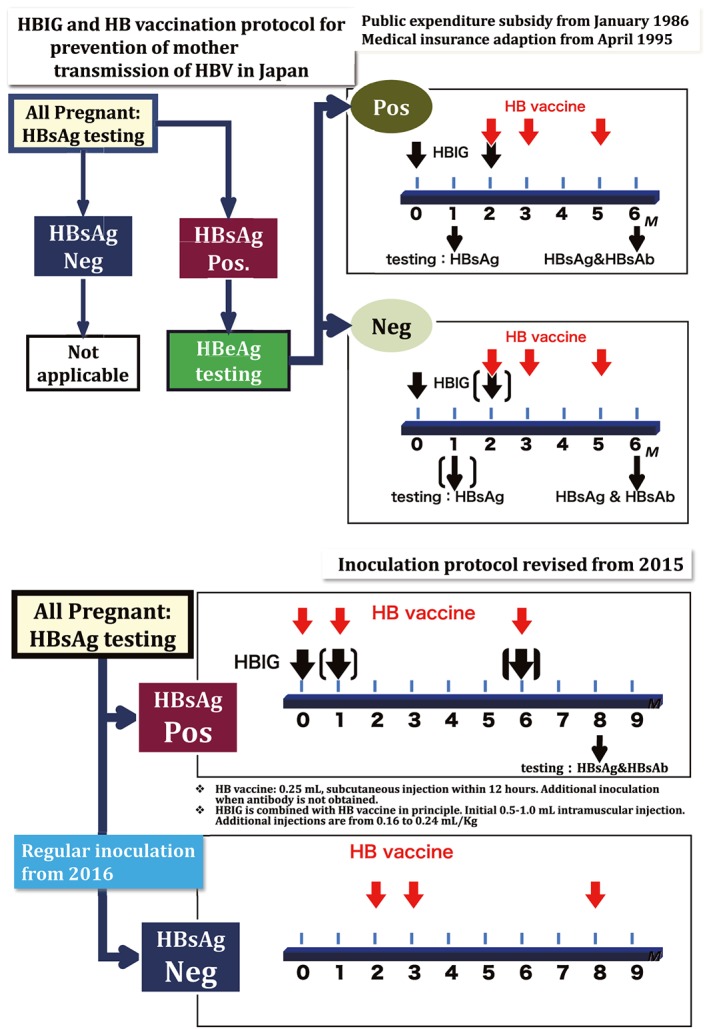
Algorithm for prevention of mother‐to‐child transmission of hepatitis B virus (HBV) in Japan (since 1986), which was incorporated with the universal HB vaccination in 2016. The top figure shows the procedure for prevention of mother‐to‐child transmission of HBV since 1986. Protocol 1 was for those children born to both hepatitis B surface antigen (HBsAg)‐ and hepatitis B envelope antigen (HBeAg)‐positive (Pos.) women; protocol 2 was for those children born to only HBsAg‐positive pregnant women. The bottom figure shows the procedure for the national program on prevention of mother‐to‐child transmission of HBV that was modified in 2015 with the addition of a three‐dose HB vaccine to the standard national immunization schedule in 2016. HBIG, hepatitis B immunoglobulin; Neg., negative. [Color figure can be viewed at http://wileyonlinelibrary.com]
Figure 4
Figure 4
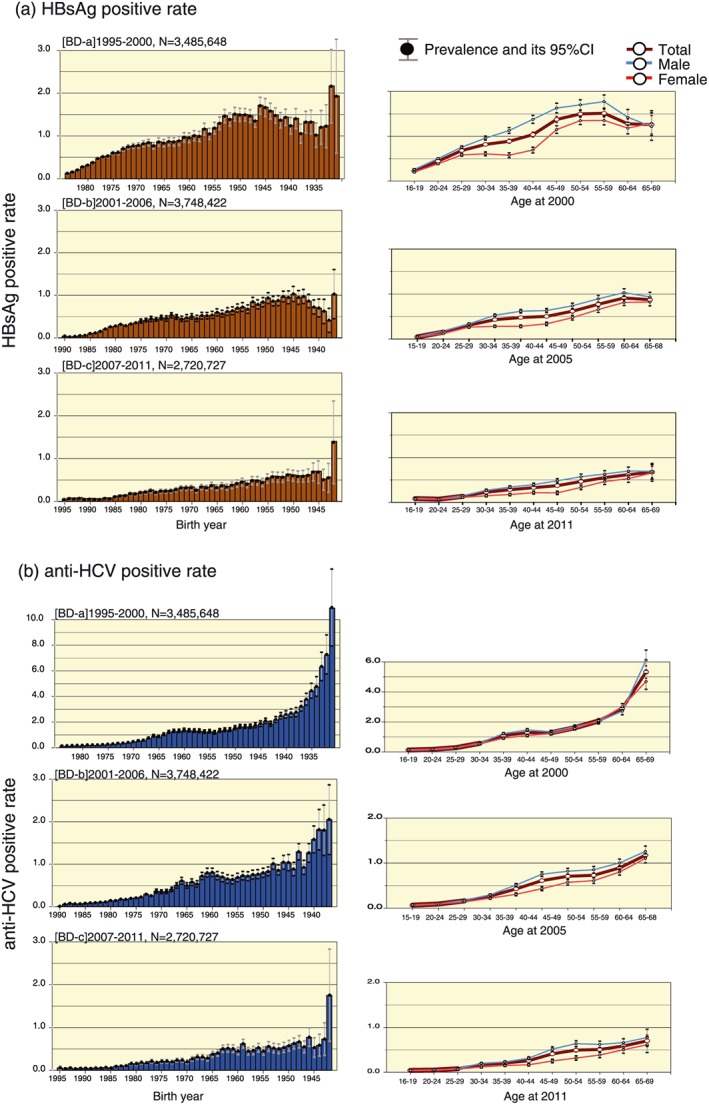
Trend of age‐ and sex‐specific hepatitis B virus (HBV) and hepatitis C virus (HCV) prevalence among first‐time blood donors in Japan from 1995 to 2011. (a) The hepatitis B surface antigen (HBsAg)‐positive rate is shown by each age group and birth year as a percentage of the total, and according to sex. (b) Anti‐HCV prevalence is shown in the same manner as in (a). Blue line, male cases; red line, female cases; brown line, total prevalence of the particular infection. Prevalence is shown by the particular period of observation in 5‐year intervals: (a) 1995–2000; (b) 2001–2006; and (c) 2007–2011. BD, Blood donors; CI, confidence interval. [Color figure can be viewed at http://wileyonlinelibrary.com]
Figure 5
Figure 5
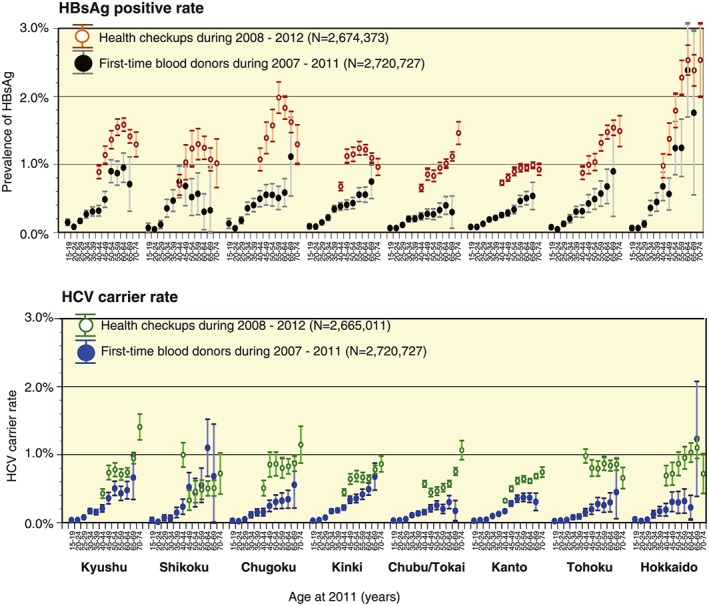
Trends of region‐specific hepatitis B virus (HBV) and hepatitis C virus (HCV) prevalence as indicated by two large‐scale nationwide surveys in Japan. The rates of hepatitis B surface antigen (HBsAg) and anti‐HCV positivity among first‐time blood donors during 2007–2011, as well as employees as revealed by health check‐ups during 2008–2012, are shown by each municipal region (n = 8). This region‐specific prevalence was further subdivided by age group for each particular infection with 95% confidence interval. Each color represents the respective group of people screened for HBV and HCV infection. [Color figure can be viewed at http://wileyonlinelibrary.com]

References

    1. World Health Organization . Hepatitis B Fact Sheet World Health Organization 2017. Available at: [https://www.who.int/en/news-room/fact-sheets/detail/hepatitis-b]. Accessed [October 11, 2018].
    1. World Health Organization . Hepatitis C fact Sheet World Health Organization 2017. Available at: [https://www.who.int/en/news-room/fact-sheets/detail/hepatitis-c]. Accessed [October 11, 2018].
    1. National Cancer Center Japan . Center for cancer control and information services. National Cancer Center Japan, 2017. Available at: [https://www.ncc.go.jp/en/cis/index.html]. Accessed [October 11, 2018]
    1. Editorial board of cancer statistics in Japan . Cancer Statistics in Japan 2017: Tokyo: Foundation for Promotion of Cancer Research; Available at: [https://ganjoho.jp/en/professional/statistics/brochure/2017_en.html]. Accessed [October 11, 2018].
    1. Perz JF, Armstrong GL, Farrington LA, Hutin YJF, Bell BP. The contributions of hepatitis B virus and hepatitis C virus infections to cirrhosis and primary liver cancer worldwide. J Hepatol 2006; 45: 529–538. - PubMed