. 2019 Oct;13(10):328-333.
doi: 10.5489/cuaj.5703.

Depression and helplessness impact interstitial cystitis/bladder pain syndrome pain over time

Affiliations

Depression and helplessness impact interstitial cystitis/bladder pain syndrome pain over time

Alison Crawford et al. Can Urol Assoc J. 2019 Oct.

Abstract

Introduction: Interstitial cystitis/bladder pain syndrome (IC/BPS) is a devastating urological chronic pelvic pain condition with an unknown etiology. Evidence-based psychological strategies are becoming more successful for symptom management as we learn more about the targets for intervention. Previous research has established an indirect relationship between depression and pain through catastrophizing, but there have yet to be studies examining the emerging role of emotion regulation in this relationship.

Methods: Women with IC/BPS were recruited from tertiary care clinics in Canada and the U.S. between 2013 and 2018. Patients completed questionnaires, including demographics and scores for pain, depression, catastrophizing, and difficulties in emotion regulation at baseline, six months, and one year. Serial mediation was used to test models of pain, catastrophizing, and depression.

Results: A total of 135 women with IC/BPS completed all three time points. The only significant indirect path was from baseline depression to catastrophizing at six months to pain at one year (b=0.10; confidence interval [CI] 0.0049-0.2520). A followup analysis demonstrated that helplessness was the key factor of catastrophizing driving this relationship (b=0.17; CI 0.0282-0.3826).

Conclusions: Reducing feelings of helplessness and increasing patient feelings of control are important ways to limit the effect of low mood on patient pain experience. De-catastrophizing interventions should be part of the referral strategy for IC/BPS symptom management.


Conflict of interest statement

Competing interests: Dr. Nickel has been a consultant for Astellas, Auxillium, Eli Lilly, Farr Labs, Ferring, GSK, Pfizer, Redleaf Pharma, Taris Biomedical, Tribute, and Trillium Therapeutics; a lecturer for Astellas and Eli Lilly; and has participated in clinical trials supported by Eli Lilly, GSK, J&J, Pfizer, and Taris Biomedical. Dr. Carr has been an advisory board member for Allergan, Astellas, Ferring, and Pfizer; and has participated in clinical trials supported by Allergan, Astellas, Aquinox, and Cook. Dr. Moldwin has been an advisory board member for Aquinox, Ipsen, Teva, and Urigen; has received honoraria from Aquinox, Ipsen, and Teva; and has participated in clinical trials supported by Aquinox and Urigen. The remaining authors report no competing personal or financial interests related to this work.

Figures

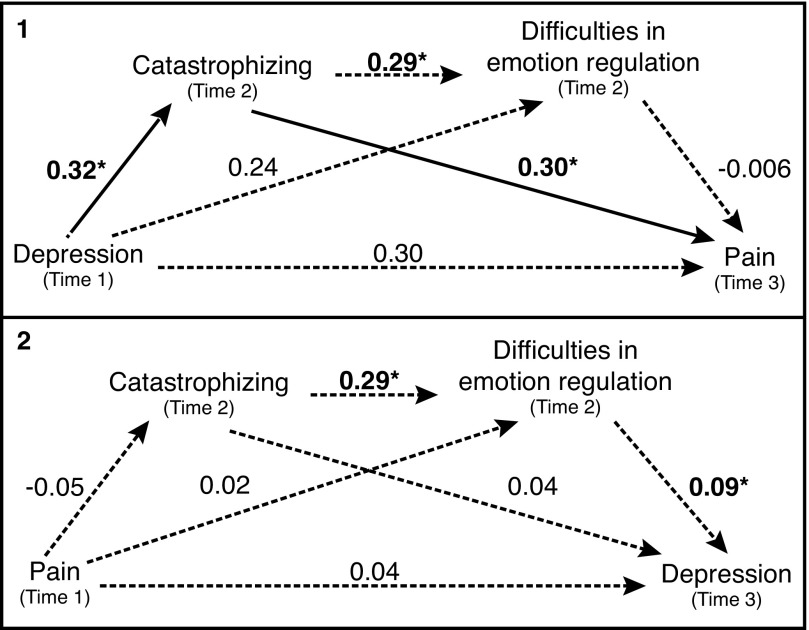
Fig. 1
Fig. 1
Path coefficients of models. Note: Significant coefficients are in bold (*p≤0.05). The significant indirect path is highlighted using solid lines.
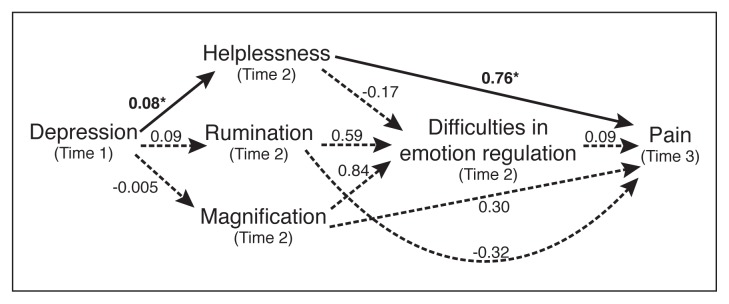
Fig. 2
Fig. 2
Followup mediation of model 1. Note: In this model, pain, total catastrophizing, and difficulties in emotion regulation at baseline were included as covariates. Significant coefficients are in bold (*p≤0.05). The significant indirect path is highlighted using solid lines.

References

    1. Nickel JC, Shoskes D, Irvine-Bird K. Clinical phenotyping of women with interstitial cystitis/painful bladder syndrome: A key to classification and potentially improved management. J Urol. 2009;182:155–60. doi: 10.1016/j.juro.2009.02.122. - DOI - PubMed
    1. Suskind AM, Berry SH, Suttorp MJ, et al. Symptom persistence in a community cohort of women with interstitial cystitis/bladder pain syndrome (IC/BPS): 3-, 6-, 9-, and 12-month followup from the RICE cohort. Int Urogynecol J. 2014;25:1639–43. doi: 10.1007/s00192-014-2420-z. - DOI - PMC - PubMed
    1. Clemens JQ, Brown SO, Calhoun EA. Mental health diagnoses in patients with interstitial cystitis/painful bladder syndrome and chronic prostatitis/chronic pelvic pain syndrome: A case/control study. J Urol. 2008;180:1378–82. doi: 10.1016/j.juro.2008.06.032. - DOI - PMC - PubMed
    1. Tripp DA, Nickel JC, Wong J, et al. Mapping of pain phenotypes in female patients with bladder pain syndrome/interstitial cystitis and controls. Eur Urol. 2012;62:1188–94. doi: 10.1016/j.eururo.2012.05.023. - DOI - PubMed
    1. Naliboff BD, Stephens AJ, Lai HH, et al. Clinical and psychosocial predictors of urological chronic pelvic pain symptom change in 1 year: A prospective study from the MAPP Research Network. J Urol. 2017;198:848–57. doi: 10.1016/j.juro.2017.05.065. - DOI - PMC - PubMed

LinkOut - more resources