. 2019 Aug 28;141(34):13468-13478.
doi: 10.1021/jacs.9b04823. Epub 2019 Aug 14.

Role of the Carboxylate in Enzyme-Catalyzed Decarboxylation of Orotidine 5'-Monophosphate: Transition State Stabilization Dominates Over Ground State Destabilization

Affiliations

Role of the Carboxylate in Enzyme-Catalyzed Decarboxylation of Orotidine 5'-Monophosphate: Transition State Stabilization Dominates Over Ground State Destabilization

Bogdana Goryanova et al. J Am Chem Soc. .

Abstract

Kinetic parameters kex (s-1) and kex/Kd (M-1 s-1) are reported for exchange for deuterium in D2O of the C-6 hydrogen of 5-fluororotidine 5'-monophosphate (FUMP) catalyzed by the Q215A, Y217F, and Q215A/Y217F variants of yeast orotidine 5'-monophosphate decarboxylase (ScOMPDC) at pD 8.1, and by the Q215A variant at pD 7.1-9.3. The pD rate profiles for wildtype ScOMPDC and the Q215A variant are identical, except for a 2.5 log unit downward displacement in the profile for the Q215A variant. The Q215A, Y217F and Q215A/Y217F substitutions cause 1.3-2.0 kcal/mol larger increases in the activation barrier for wildtype ScOMPDC-catalyzed deuterium exchange compared with decarboxylation, because of the stronger apparent side chain interaction with the transition state for the deuterium exchange reaction. The stabilization of the transition state for the OMPDC-catalyzed deuterium exchange reaction of FUMP is ca. 19 kcal/mol smaller than the transition state for decarboxylation of OMP, and ca. 8 kcal/mol smaller than for OMPDC-catalyzed deprotonation of FUMP to form the vinyl carbanion intermediate common to OMPDC-catalyzed reactions OMP/FOMP and UMP/FUMP. We propose that ScOMPDC shows similar stabilizing interactions with the common portions of decarboxylation and deprotonation transition states that lead to formation of this vinyl carbanion intermediate, and that there is a large ca. (19-8) = 11 kcal/mol stabilization of the former transition state from interactions with the nascent CO2 of product. The effects of Q215A and Y217F substitutions on kcat/Km for decarboxylation of OMP are expressed mainly as an increase in Km for the reactions catalyzed by the variant enzymes, while the effects on kex/Kd for deuterium exchange are expressed mainly as an increase in kex. This shows that the Q215 and Y217 side chains stabilize the Michaelis complex to OMP for the decarboxylation reaction, compared with the complex to FUMP for the deuterium exchange reaction. These results provide strong support for the conclusion that interactions which stabilize the transition state for ScOMPDC-catalyzed decarboxylation at a nonpolar enzyme active site dominate over interactions that destabilize the ground-state Michaelis complex.


Conflict of interest statement

The authors declare no competing financial interest.

Figures
Scheme 1
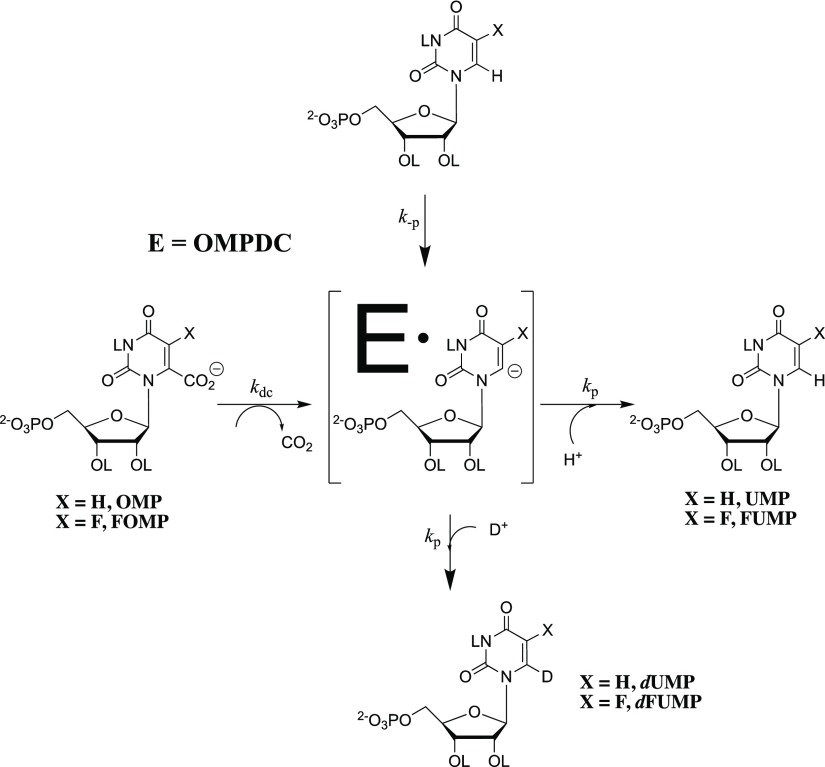
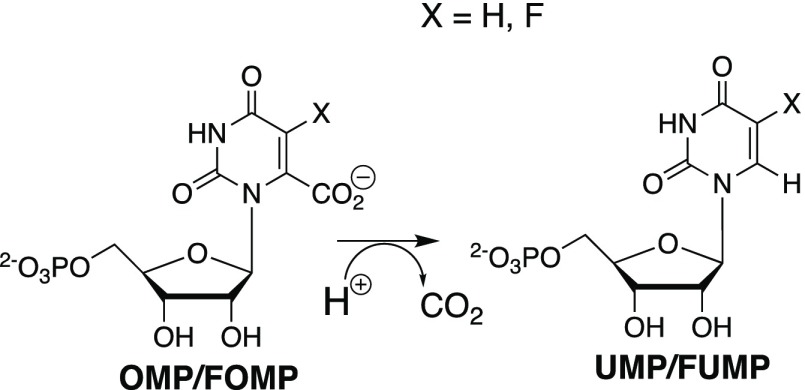
Scheme 1. Decarboxylation Reactions Catalyzed by OMPDC
Figure 1
Figure 1
OMPDC-catalyzed decarboxylation of OMP and FOMP, and deuterium exchange reactions of UMP and FUMP, through common UMP or FUMP vinyl carbanion intermediates.
Figure 2
Figure 2
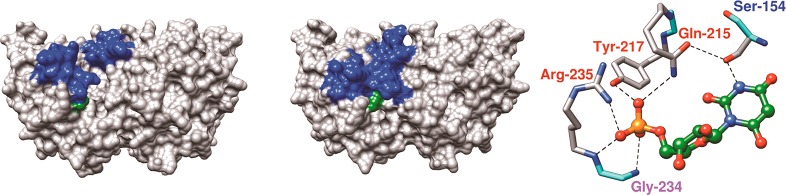
Representations of the X-ray crystal structures of ScOMPDC from Saccharomyces cerevisiae (ScOMPDC). The left-hand and middle surface structures show, respectively, the open unliganded form of ScOMPDC (PDB entry 1DQW) and the closed form with 6-hydroxyuridine 5′-monophosphate bound (PDB entry 1DQX). The phosphodianion gripper (residues 202–220) and pyrimidine umbrella loops (residues 151–165) are shaded blue, and the side chain from R235 is shaded green in both structures. The right-hand structure (PDB entry 1DQX) shows the interactions of Q215, Y217, and R235 with the phosphodianion of 6-hydroxyuridine 5′-monophosphate, and the clamping interaction between the Q215 side chain and the S154 side chain from the phosphodianion gripper and the pyrimidine umbrella loops.
Scheme 2
Scheme 2. Kinetic Mechanism for OMPDC-Catalyzed Deuterium Exchange
Figure 3
Figure 3
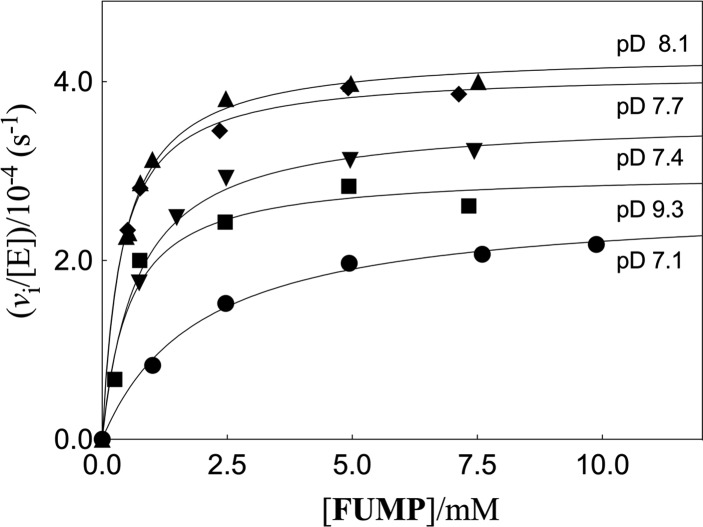
Dependence of vi/[E] on [FUMP] for Q215A variant ScOMPDC-catalyzed deuterium exchange reactions at I = 0.1 (NaCl). Key: (●), pD 7.1 (50 mM imidazole buffer); (▼), pD 7.4 (50 mM MOPS buffer); (⧫), pD 7.7 (50 mM MOPS buffer); (▲), pD 8.1 (50 mM GlyGly buffer); (■) pD 9.3 (50 mM GlyGly buffer).
Figure 4
Figure 4
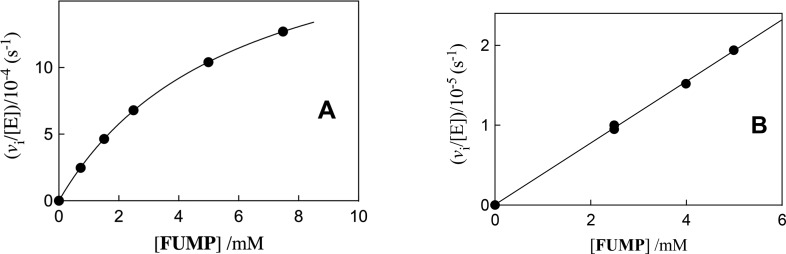
Dependence of vi/[E] on [FUMP] for ScOMPDC-catalyzed deuterium exchange reactions at pD 8.1 (50 mM GlyGly) and I = 0.1 (NaCl). (A) Y217F variant; (B) Q215A/Y217A variant.
Figure 5
Figure 5
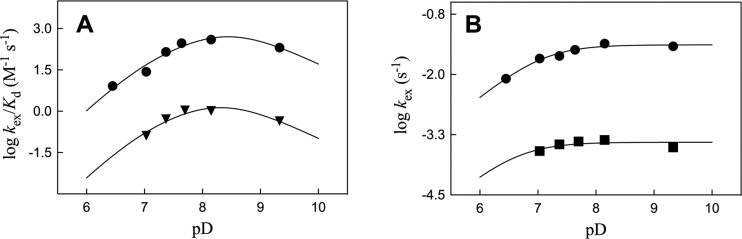
Logarithmic rate profiles of kinetic parameters for ScOMPDC-catalyzed exchange for deuterium of the C-6 proton of FUMP in D2O at 25 °C and I = 0.1 (NaCl). (A) Second-order rate constants kex/Kd (M–1 s–1) for reactions catalyzed by wild type ScOMPDC (●) and the Q215A variant (▼). (B) First order rate constants kex (s–1) for reactions catalyzed by wild type ScOMPDC (●) and the Q215A variant (■). The solid lines show that fits of these data to the kinetic Scheme described previously for the reaction catalyzed by wild type OMPDC.
Figure 6
Figure 6
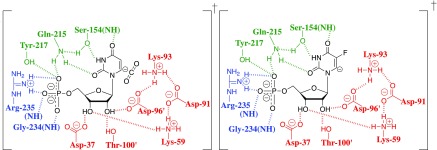
Diagram which illustrates the hypothetical interactions between ScOMPDC and late vinyl carbanion-like transition states for decarboxylation of OMP and deprotonation of FUMP. These diagrams were constructed using X-ray crystallographic data for the complex to the 6-hydroxyuridine 5′-monophosphate (BMP) transition state analog (PDB entry 1DQX), and assuming similar contacts for the stable ligand and hypothetical transition states. Not shown is stabilization of nascent CO2 by interactions with hydrophobic amino acid side chains (see below).
Figure 7
Figure 7
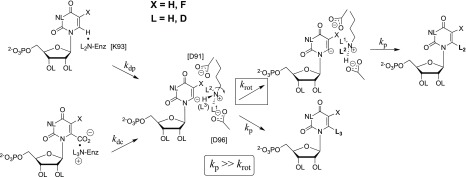
Stepwise OMPDC-catalyzed decarboxylation of OMP (X= H, bottom reaction) and the exchange reaction of -H from FUMP for -D from solvent D2O (X = F, top reaction). The inequality kpkrot for partitioning of the vinyl carbanion intermediate between proton transfer and bond rotation at the K93 side chain ensures that the deuterium enrichment of product of OMPDC-catalyzed decarboxylation of OMP is equal to the initial 50% enrichment of the mixed H2O/D2O solvent,, and that the barrier to the deprotonation of FUMPGdp) is smaller than the overall barrier for the deuterium exchange reaction.
Figure 8
Figure 8
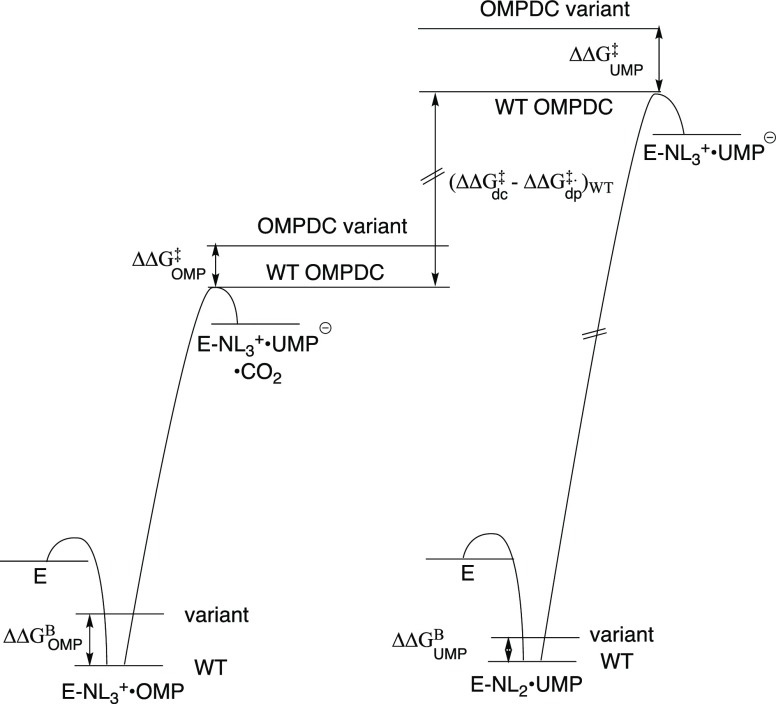
Hypothetical free-energy profiles for wild type and protein variants of ScOMPDC-catalyzed decarboxylation of OMP and deprotonation of UMP to form UMP vinyl carbanion intermediates UMP-, which are drawn to show the difference in the stabilization of the respective transition states by interactions with the protein catalyst. These profiles were constructed using kinetic data from Table 1, and assuming that the changes in protein structure effect similar changes in the barriers for ScOMPDC-catalyzed deprotonation of FUMP and UMP. The diagrams show: (1) The ca. 11 kcal/mol difference in the stabilization of the transition states for wildtype ScOMPDC-catalyzed decarboxylation of OMP (ΔΔG)dc and deprotonation of UMP (ΔΔG)dp [(ΔΔG)dc – (ΔΔG)dp = 11 kcal/mol, Figure 7], that we propose is due to stabilization of the former transition state by interactions with the nascent CO2 product. (2) The difference between the effects of Q215A or Y217F substitutions on ΔΔGUMP (relatively large) and ΔΔGOMP [smaller, Table 3]. (3) The larger effect of amino acid substitutions on the stability of the Michaelis complexes to OMP (ΔΔGOMPB) compared with UMP/FUMP (ΔΔGFUMPB). The ca 8 kcal/mol barrier to krot, which is required for the deuterium exchange reaction of UMP (kex) but not for decarboxylation of OMP (kdc) or deprotonation of UMP (kdp), is not shown. The barriers to the two enzymatic reactions have not been scaled to show the thermodynamic driving force to decarboxylation of OMP to form UMP, because this driving force is not known.
Figure 9
Figure 9
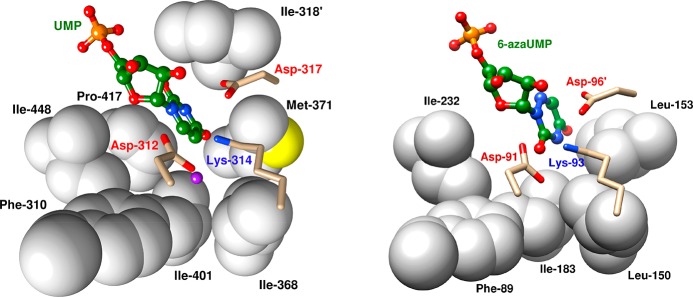
Representation, on the left, of the X-ray crystal structure for HsOMPDC liganded by UMP (PDB entry 2QCD) and, on the right, for ScOMPDC liganded by 6-azaUMP (PDB entry 3GDL). There is good superposition between the active site residues D312, K314, and D317 at HsOMPDC with D91, K93, and D96 at ScOMPDC, and of the hydrophobic side chains F310, I401, and I448 at the CO2 binding pocket with F89, I183 and I232.

References

    1. Richard J. P.; Amyes T. L.; Reyes A. C. Orotidine 5′-Monophosphate Decarboxylase: Probing the Limits of the Possible for Enzyme Catalysis. Acc. Chem. Res. 2018, 51, 960–969. 10.1021/acs.accounts.8b00059. - DOI - PMC - PubMed
    1. Miller B. G.; Wolfenden R. Catalytic proficiency: the unusual case of OMP decarboxylase. Annu. Rev. Biochem. 2002, 71, 847–885. 10.1146/annurev.biochem.71.110601.135446. - DOI - PubMed
    1. Callahan B. P.; Miller B. G. OMP decarboxylase - An enigma persists. Bioorg. Chem. 2007, 35, 465–469. 10.1016/j.bioorg.2007.07.004. - DOI - PubMed
    1. Fujihashi M.; Mnpotra J. S.; Mishra R. K.; Pai E. F.; Kotra L. P. Orotidine Monophosphate Decarboxylase - A Fascinating Workhorse Enzyme with Therapeutic Potential. J. Genet. Genomics 2015, 42, 221–234. 10.1016/j.jgg.2015.04.005. - DOI - PubMed
    1. Radzicka A.; Wolfenden R. A proficient enzyme. Science 1995, 267, 90–93. 10.1126/science.7809611. - DOI - PubMed

Publication types

MeSH terms

LinkOut - more resources