. 2019 Sep;9(9):977-985.
doi: 10.1002/alr.22357. Epub 2019 Jul 31.

Olfactory dysfunction persists after smoking cessation and signals increased cardiovascular risk

Affiliations

Olfactory dysfunction persists after smoking cessation and signals increased cardiovascular risk

Jesse K Siegel et al. Int Forum Allergy Rhinol. 2019 Sep.

Abstract

Background: Olfaction plays a critical role in health and function in older adults, and impaired sense of smell is a strong predictor of morbidity and mortality. Smoking cigarettes causes olfactory impairment, but the mechanism of damage and ability to recover after cessation are unknown. We investigated the relationship between time since quitting and olfactory dysfunction in order to elucidate the mechanism(s) by which smoking damages the olfactory system and to inform patient counseling.

Methods: Using longitudinal data from the National Social Life Health and Aging Project (n = 3528 older adults, including 1526 former smokers), we analyzed the association between odor identification performance and time since smoking cessation using multivariate ordinal logistic regression, adjusting for cognition and demographic variables. To test whether vascular disease plays a role, we also assessed the relationship between olfactory decline and incidence of heart attack and heart disease.

Results: Former smokers who quit ≤15 years before testing had significantly impaired olfaction compared to never smokers (p = 0.04), but those who quit >15 years prior did not. Olfactory decline over 5 years showed modest evidence toward predicting increased incidence of heart attack or heart disease (p = 0.08).

Conclusion: Olfactory impairment in smokers persists 15 years after quitting, which is consistent with a vascular mechanism of impairment. Indeed, olfactory decline is a predictor of the development of cardiovascular disease. Taken together, these data suggest that olfactory loss may be a useful sign of underlying vascular pathology. Further investigation of olfactory loss as an early biomarker for cardiovascular disease is warranted.

Keywords: aging; atherosclerosis; heart disease; myocardial infarction; smell; smoking cessation; tobacco.


Conflict of interest statement

Financial disclosures/conflicts of interest:

None

Figures
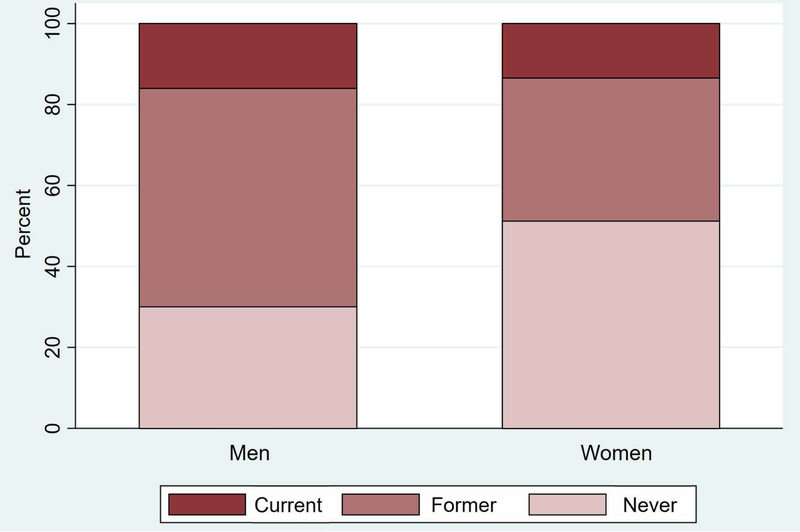
Figure 1
Figure 1. Smoking status of respondents at baseline (n=3,528).
Smoking status self-reported by respondents at baseline. Men were more likely to report being former smokers and less likely to report being never smokers (p<.001) than women.
Figure 2
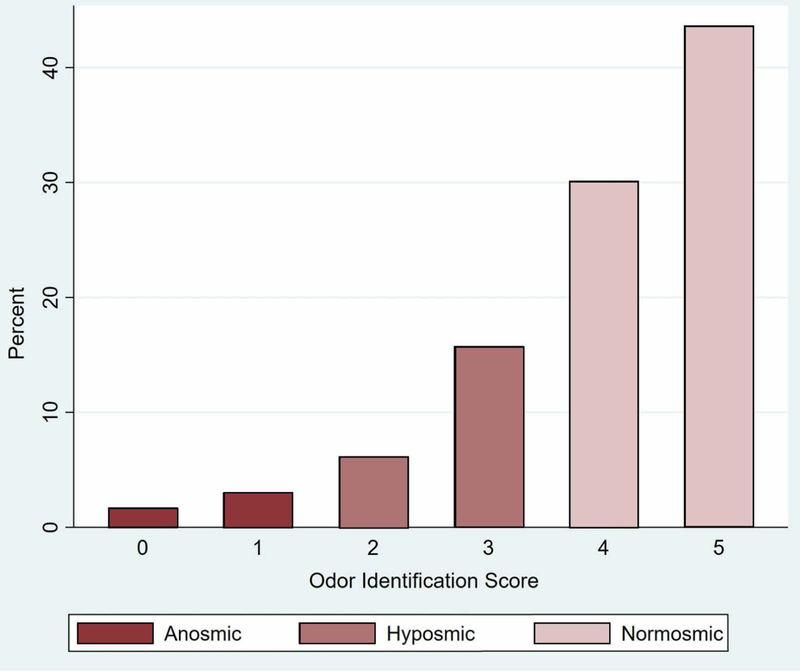
Figure 2. Odor identification scores at baseline (n=3,528).
Odor identification score is the number of odors out of 5 that respondent was able to correctly identify. 4–5 correct = normosmic, 2–3 correct = hyposmic, 0–1 correct = anosmic.
Figure 3
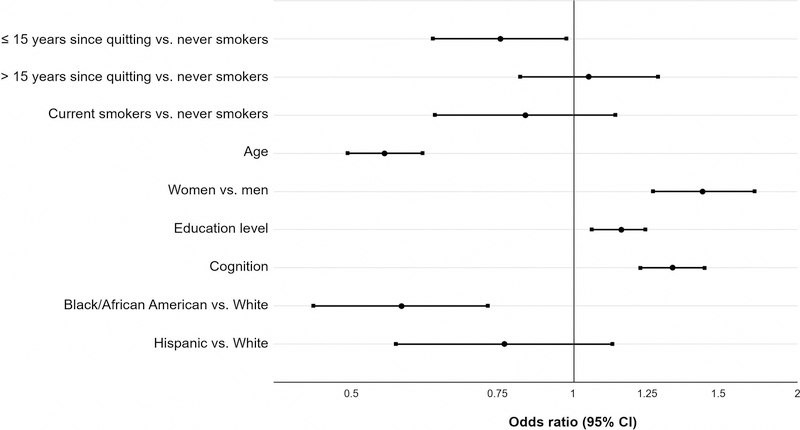
Figure 3. Former smokers who quit ≤ 15 years ago, but not those who quit >15 years ago, have worse odor identification scores than never smokers.
n=3528. Ordinal logistic regression with survey weights. Odds ratios for higher score on odor identification test. The effect of age is per decade increase. Education treated as a continuous measure with integer scores for education level (higher scores = more education). Cognition measured using z-scores for performance on SPMSQ or MoCA-SA.
Figure 4
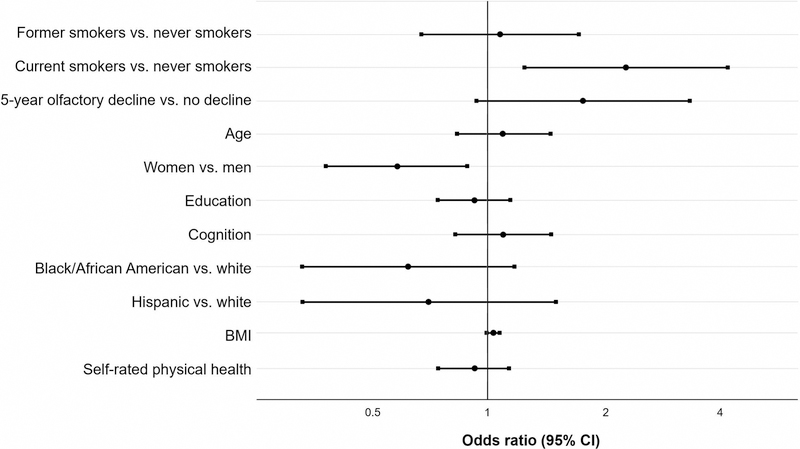
Figure 4. Olfactory decline at 5-year follow-up predicts new cardiac events at 10-year follow-up, independent of smoking status.
Multivariate logistic regression, n=935. Odds ratios for 10-year incidence of new cardiac events. Reference groups are never smokers, men, and white. Respondents with new cardiac events are those who reported no history of heart attack or heart disease at baseline and history of heart attack and/or heart disease at 10-year follow-up. Olfactory decline at 5-year follow-up is defined by a decrease of 2 or more points in odor identification score. The effect of age is per decade increase. Education treated as a continuous measure with integer scores for education level (higher scores = more education). Cognition measured using z-scores for performance on SPMSQ or MoCA-SA. BMI calculated from direct measurements of height and weight and the effect of BMI is per 1 kg/m2 increase.

References

    1. Sivam A, Wroblewski KE, Alkorta-Aranburu G, et al. Olfactory Dysfunction in Older Adults is Associated with Feelings of Depression and Loneliness. Chem Senses 2016;41(4):293–299. 10.1093/chemse/bjv088 - DOI - PMC - PubMed
    1. McSorley VE, Pinto J, Schumm LP, et al. Sleep and Olfaction among Older Adults. Neuroepidemiology 2017;48(3–4):147–154. 10.1159/000479066 - DOI - PMC - PubMed
    1. Adams DR, Kern DW, Wroblewski KE, McClintock MK, Dale W, Pinto JM. Olfactory Dysfunction Predicts Subsequent Dementia in Older U.S. Adults. J Am Geriatr Soc 2018;66(1):140–144. 10.1111/jgs.15048 - DOI - PMC - PubMed
    1. Pinto JM, Wroblewski KE, Kern DW, Schumm LP, McClintock MK. Olfactory Dysfunction Predicts 5-Year Mortality in Older Adults. PLOS ONE 2014;9(10):e107541 10.1371/journal.pone.0107541 - DOI - PMC - PubMed
    1. Ajmani GS, Suh HH, Wroblewski KE, Pinto JM. Smoking and olfactory dysfunction: A systematic literature review and meta-analysis. The Laryngoscope 2017;127(8):1753–1761. 10.1002/lary.26558 - DOI - PMC - PubMed

Publication types