


The Transcriptional Roles of ALK Fusion Proteins in Tumorigenesis
- PMID: 31366041
- PMCID: PMC6721376
- DOI: 10.3390/cancers11081074
The Transcriptional Roles of ALK Fusion Proteins in Tumorigenesis
Abstract
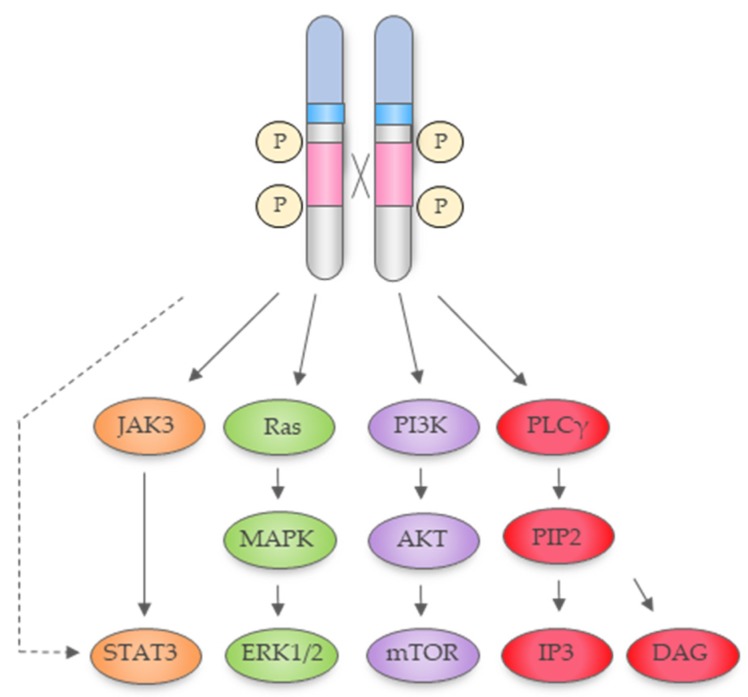
Anaplastic lymphoma kinase (ALK) is a tyrosine kinase involved in neuronal and gut development. Initially discovered in T cell lymphoma, ALK is frequently affected in diverse cancers by oncogenic translocations. These translocations involve different fusion partners that facilitate multimerisation and autophosphorylation of ALK, resulting in a constitutively active tyrosine kinase with oncogenic potential. ALK fusion proteins are involved in diverse cellular signalling pathways, such as Ras/extracellular signal-regulated kinase (ERK), phosphatidylinositol 3-kinase (PI3K)/Akt and Janus protein tyrosine kinase (JAK)/STAT. Furthermore, ALK is implicated in epigenetic regulation, including DNA methylation and miRNA expression, and an interaction with nuclear proteins has been described. Through these mechanisms, ALK fusion proteins enable a transcriptional programme that drives the pathogenesis of a range of ALK-related malignancies.
Keywords: ALCL; ALK; ALK-translocation proteins; EML4-ALK; NPM-ALK; NSCLC; epigenetics.
Conflict of interest statement
The authors declare no conflict of interest.
Figures


References
-
- Colleoni G.W.B., Bridge J.A., Garicochea B., Liu J., Filippa D.A., Ladanyi M. ATIC-ALK: A novel variant ALK gene fusion in anaplastic large cell lymphoma resulting from the recurrent cryptic chromosomal inversion, inv(2)(p23q35) Am. J. Pathol. 2000;156:781–789. doi: 10.1016/S0002-9440(10)64945-0. - DOI - PMC - PubMed
Publication types
LinkOut - more resources
Full Text Sources
Molecular Biology Databases
Miscellaneous
