


PTEN Tumor-Suppressor: The Dam of Stemness in Cancer
- PMID: 31366089
- PMCID: PMC6721423
- DOI: 10.3390/cancers11081076
PTEN Tumor-Suppressor: The Dam of Stemness in Cancer
Abstract
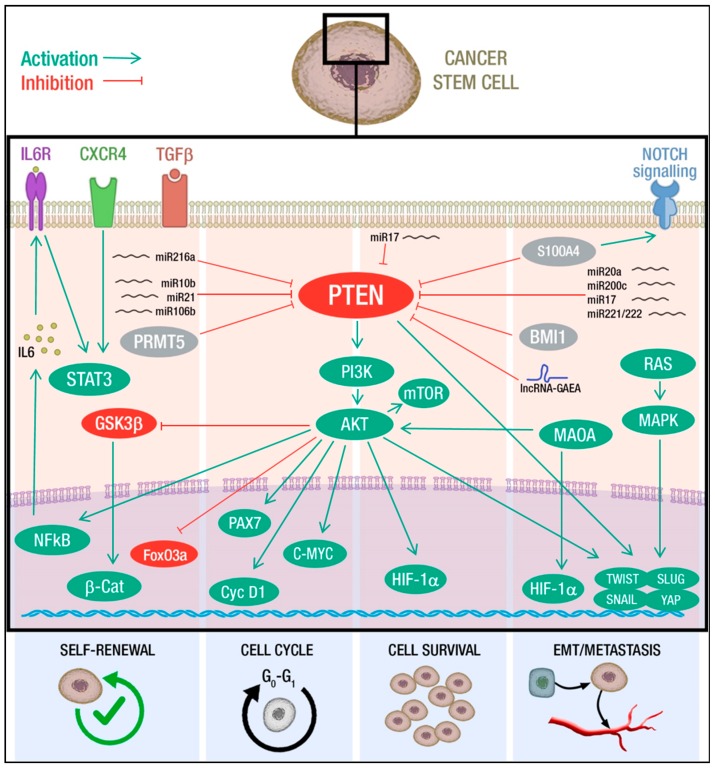
PTEN is one of the most frequently inactivated tumor suppressor genes in cancer. Loss or variation in PTEN gene/protein levels is commonly observed in a broad spectrum of human cancers, while germline PTEN mutations cause inherited syndromes that lead to increased risk of tumors. PTEN restrains tumorigenesis through different mechanisms ranging from phosphatase-dependent and independent activities, subcellular localization and protein interaction, modulating a broad array of cellular functions including growth, proliferation, survival, DNA repair, and cell motility. The main target of PTEN phosphatase activity is one of the most significant cell growth and pro-survival signaling pathway in cancer: PI3K/AKT/mTOR. Several shreds of evidence shed light on the critical role of PTEN in normal and cancer stem cells (CSCs) homeostasis, with its loss fostering the CSC compartment in both solid and hematologic malignancies. CSCs are responsible for tumor propagation, metastatic spread, resistance to therapy, and relapse. Thus, understanding how alterations of PTEN levels affect CSC hallmarks could be crucial for the development of successful therapeutic approaches. Here, we discuss the most significant findings on PTEN-mediated control of CSC state. We aim to unravel the role of PTEN in the regulation of key mechanisms specific for CSCs, such as self-renewal, quiescence/cell cycle, Epithelial-to-Mesenchymal-Transition (EMT), with a particular focus on PTEN-based therapy resistance mechanisms and their exploitation for novel therapeutic approaches in cancer treatment.
Keywords: PTEN; cancer stem cells; targeted therapy; therapy resistance.
Conflict of interest statement
The authors declare that they have no competing interests.
Figures
References
-
- Li D.M., Sun H. TEP1, encoded by a candidate tumor suppressor locus, is a novel protein tyrosine phosphatase regulated by transforming growth factor beta. Cancer Res. 1997;57:2124–2129. - PubMed
-
- Steck P.A., Pershouse M.A., Jasser S.A., Yung W.K., Lin H., Ligon A.H., Langford L.A., Baumgard M.L., Hattier T., Davis T., et al. Identification of a candidate tumour suppressor gene, MMAC1, at chromosome 10q23.3 that is mutated in multiple advanced cancers. Nat. Genet. 1997;15:356–362. doi: 10.1038/ng0497-356. - DOI - PubMed
Publication types
Grants and funding
LinkOut - more resources
Full Text Sources
Research Materials
Miscellaneous
