Review
. 2019 Jul 30;8(8):796.
doi: 10.3390/cells8080796.

How to Choose the Right Inducible Gene Expression System for Mammalian Studies?

Affiliations
Review

How to Choose the Right Inducible Gene Expression System for Mammalian Studies?

Tuula Kallunki et al. Cells. .

Abstract

Inducible gene expression systems are favored over stable expression systems in a wide variety of basic and applied research areas, including functional genomics, gene therapy, tissue engineering, biopharmaceutical protein production and drug discovery. This is because they are mostly reversible and thus more flexible to use. Furthermore, compared to constitutive expression, they generally exhibit a higher efficiency and have fewer side effects, such as cell death and delayed growth or development. Empowered by decades of development of inducible gene expression systems, researchers can now efficiently activate or suppress any gene, temporarily and quantitively at will, depending on experimental requirements and designs. Here, we review a number of most commonly used mammalian inducible expression systems and provide basic standards and criteria for the selection of the most suitable one.

Keywords: cumate 2; light-switchable 3; tamoxifen 4; tetracycline 1.


Conflict of interest statement

The authors declare no conflict of interest.

Figures
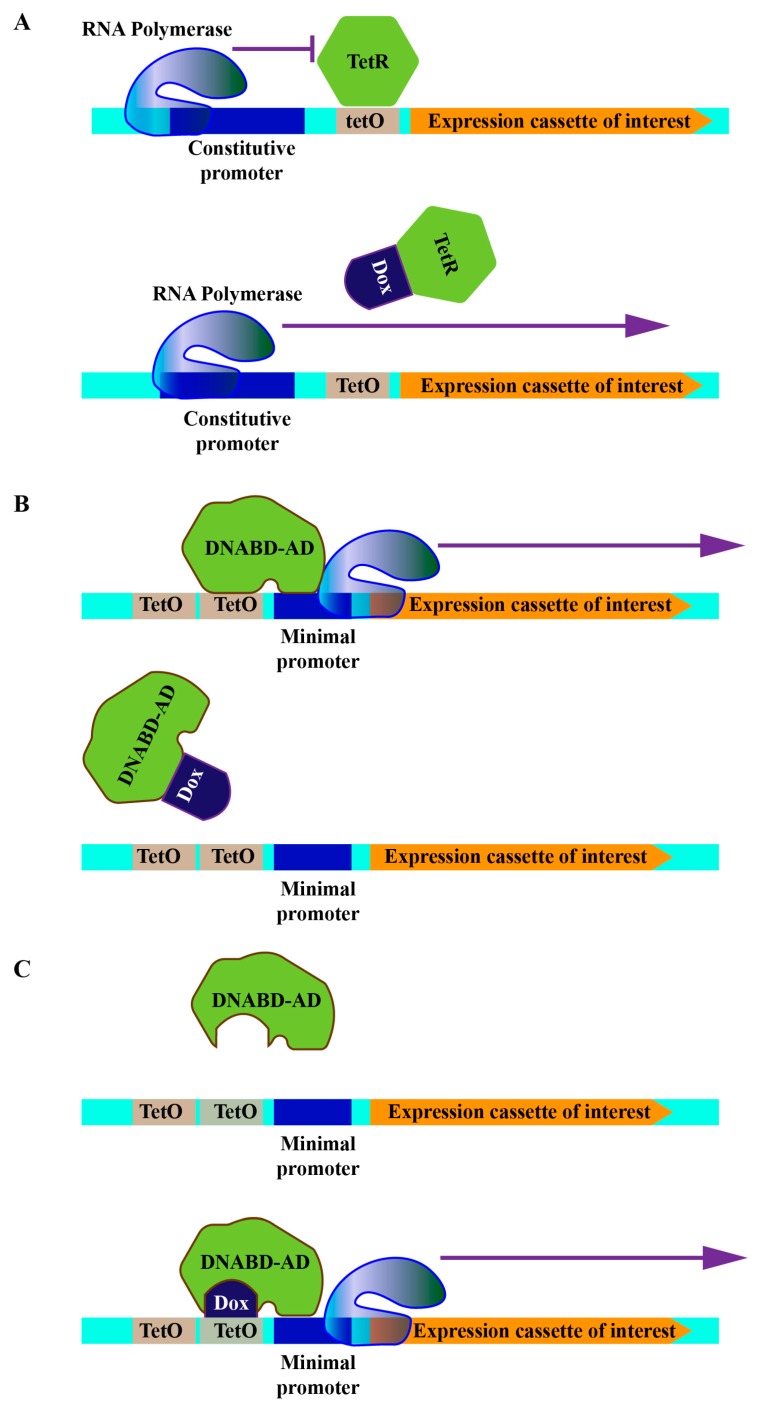
Figure 1
Figure 1
Schematic representations of tetracycline-controled operator systems. (A) Repression based configuration. (B) Tet-off configuration. (C) Tet-on configuration. DNABD: DNA binding domain, AD: activating domain, TetO: tetracycline operator, Dox: doxycycline, TetR: tet repressor.
Figure 2
Figure 2
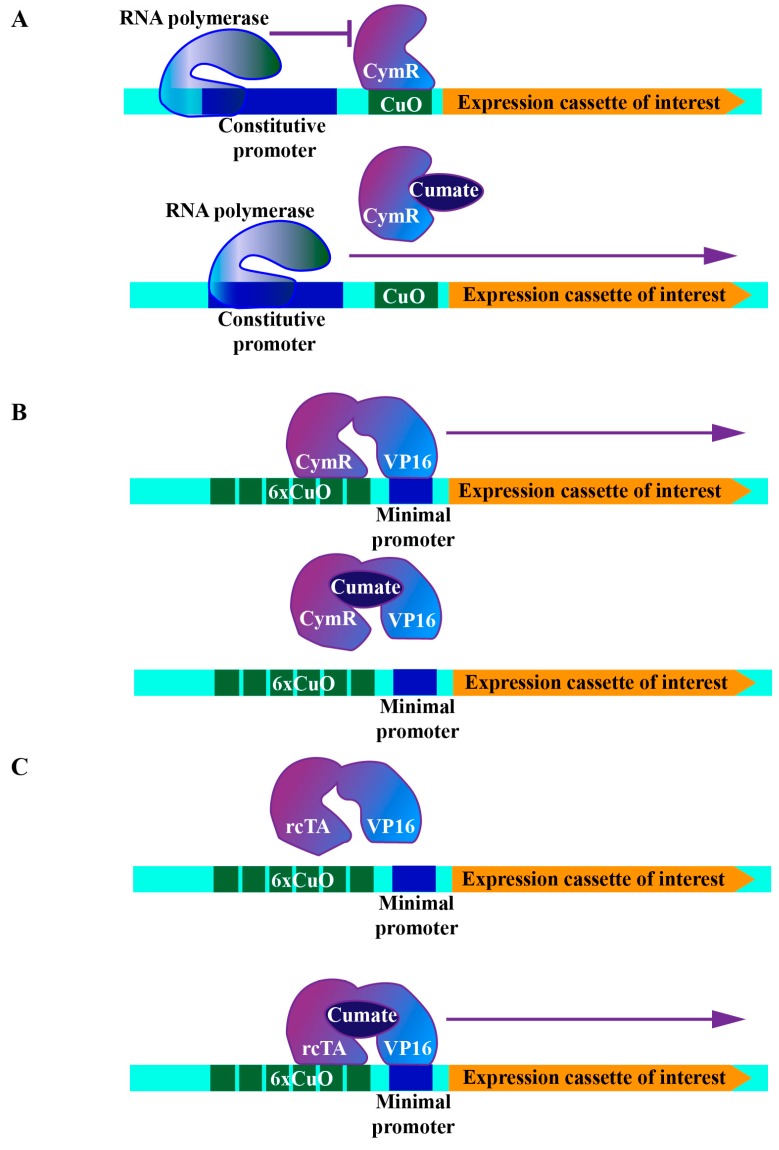
Schematic representations of cumate-controlled operator systems. (A) Repression configuration. (B) Activator configuration. (C) Reverse activator configuration. CymR: cumate repressor, CuO: cumate operator, rcTA: reverse chimeric transactivator.
Figure 3
Figure 3
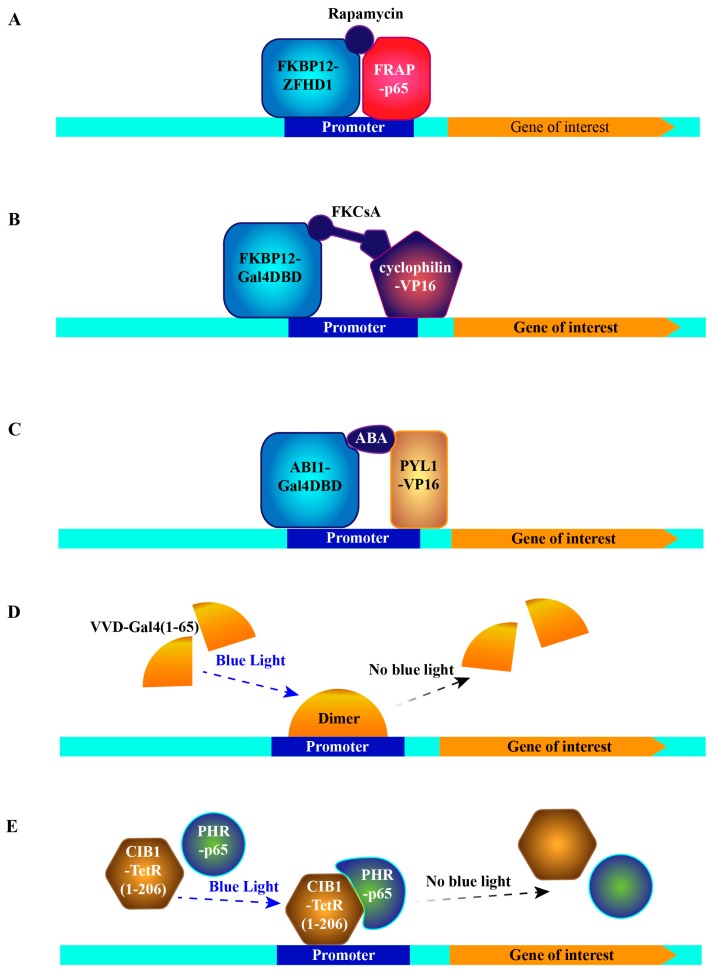
Schematic representations of protein–protein interaction based systems. (A) Inducible system dependent on rapamycin induced interaction between FKBP12 and FRAP. (B) Inducible system dependent on FKCsA induced interaction between FKBP12 and cyclophilin. (C) Inducible system dependent on ABA induced interaction between PYL1 and ABI1. (D) Inducible system dependent on blue light induced VVD dimer formation. (E) Photoactivatable-Tet-OFF/ON system dependent on blue light induced interaction between Cry2 and CIB1. Gal4DBD: Gal4 DNA binding domain, ABA: abscisic acid, TetR: tet repressor.

References

    1. Heitman J., Movva N.R., Hall M.N. Targets for cell cycle arrest by the immunosuppressant rapamycin in yeast. Science. 1991;253:905–909. doi: 10.1126/science.1715094. - DOI - PubMed
    1. Kunz J., Henriquez R., Schneider U., Deuter-Reinhard M., Movva N.R., Hall M.N. Target of rapamycin in yeast, TOR2, is an essential phosphatidylinositol kinase homolog required for G1 progression. Cell. 1993;73:585–596. doi: 10.1016/0092-8674(93)90144-F. - DOI - PubMed
    1. Yuan J.Y., Horvitz H.R. The Caenorhabditis elegans genes ced-3 and ced-4 act cell autonomously to cause programmed cell death. Dev. Biol. 1990;138:33–41. doi: 10.1016/0012-1606(90)90174-H. - DOI - PubMed
    1. Tsukada M., Ohsumi Y. Isolation and characterization of autophagy-defective mutants of Saccharomyces cerevisiae. FEBS Lett. 1993;333:169–174. doi: 10.1016/0014-5793(93)80398-E. - DOI - PubMed
    1. Harvey K.F., Pfleger C.M., Hariharan I.K. The Drosophila Mst ortholog, hippo, restricts growth and cell proliferation and promotes apoptosis. Cell. 2003;114:457–467. doi: 10.1016/S0092-8674(03)00557-9. - DOI - PubMed

Publication types

LinkOut - more resources