Review
. 2019 Jul 30;11(8):1083.
doi: 10.3390/cancers11081083.

The Role of Intra-Tumoral Heterogeneity and Its Clinical Relevance in Epithelial Ovarian Cancer Recurrence and Metastasis

Affiliations
Review

The Role of Intra-Tumoral Heterogeneity and Its Clinical Relevance in Epithelial Ovarian Cancer Recurrence and Metastasis

Cai M Roberts et al. Cancers (Basel). .

Abstract

Epithelial ovarian cancer is the deadliest gynecologic cancer, due in large part to recurrent tumors. Recurrences tend to have metastasized, mainly in the peritoneal cavity and developed resistance to the first line chemotherapy. Key to the progression and ultimate lethality of ovarian cancer is the existence of extensive intra-tumoral heterogeneity (ITH). In this review, we describe the genetic and epigenetic changes that have been reported to give rise to different cell populations in ovarian cancer. We also describe at length the contributions made to heterogeneity by both linear and parallel models of clonal evolution and the existence of cancer stem cells. We dissect the key biological signals from the tumor microenvironment, both directly from other cell types in the vicinity and soluble or circulating factors. Finally, we discuss the impact of tumor heterogeneity on the choice of therapeutic approaches in the clinic. Variability in ovarian tumors remains a major barrier to effective therapy, but by leveraging future research into tumor heterogeneity, we may be able to overcome this barrier and provide more effective, personalized therapy to patients.

Keywords: cancer stem cells; clonal evolution; intratumoral heterogeneity; ovarian cancer; tumor microenvironment.


Conflict of interest statement

The authors declare they have no conflict of interest that would impact the impartiality of this review.

Figures
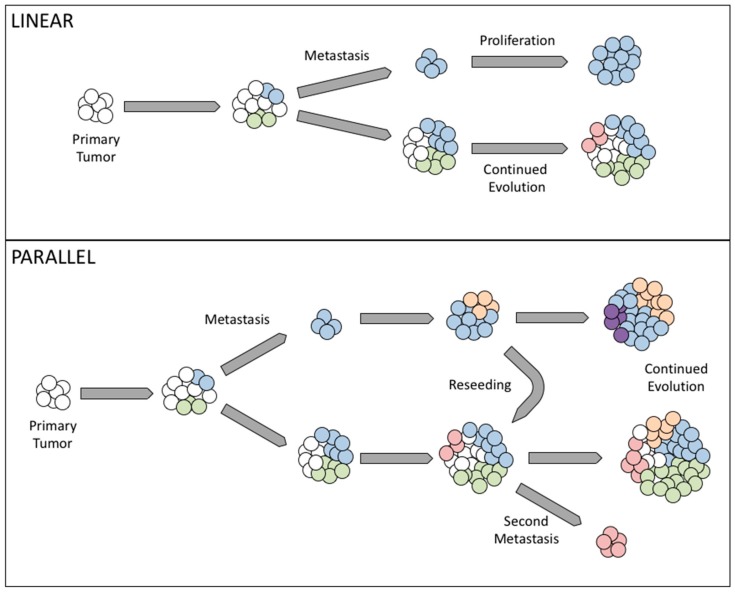
Figure 1
Figure 1
Comparison of linear and parallel forms of clonal evolution. Upper panel: In linear evolution, distinct populations of cells arise in the primary tumor (blue, green). Cells capable of metastasis break off and form monoclonal tumors in secondary sites (top blue clone). The primary tumor continues to evolve new populations (red). Lower panel: In parallel evolution, Multiple populations capable of metastasis arise at different places and times (blue, red). Both primary tumors and metastases continue to evolve, with new populations from metastases (orange, purple) arising and even reseeding the primary site (orange).
Figure 2
Figure 2
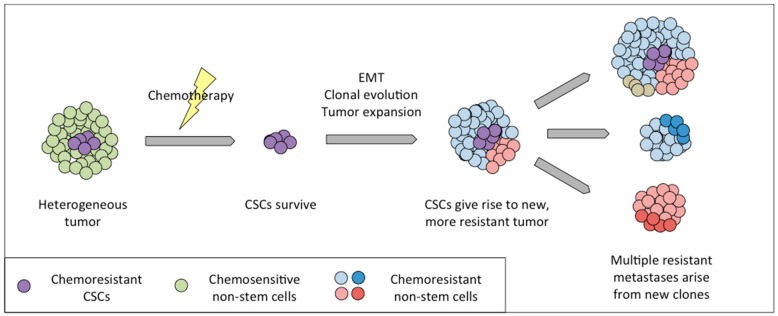
Contribution of cancer stem cells (CSCs) to recurrence and metastasis. A tumor with populations of CSCs (purple) and non-stem bulk tumor cells (green) treated with chemotherapy may eliminate all fast dividing cells, leaving resistant CSCs behind. CSCs will expand and differentiate, undergoing epithelial to mesenchymal transition to give rise to recurrence. Recurrent tumors (red, blue) tend to be resistant to first line chemotherapy, metastasize widely, and continue to evolve (dark red, dark blue), ultimately leading to lethality to the patient.
Figure 3
Figure 3
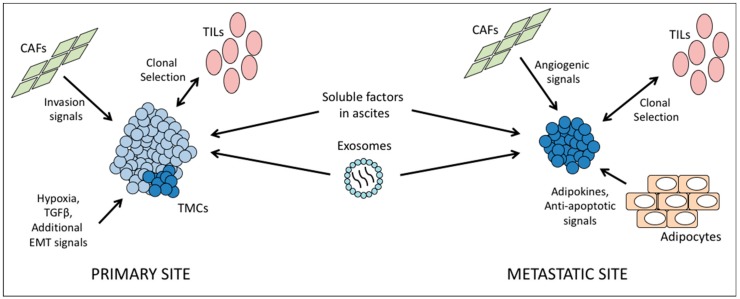
Tumor microenvironment influences tumor cell heterogeneity. Left, at the primary site, hypoxia and epithelial to mesenchymal transition (EMT) signals lead to differentiation of transitional mesenchymal cells (TMCs), a metastatic population. Local fibroblasts regulate adherence and invasiveness of cell populations. Tumor infiltrating lymphocytes (TILs) select clonal populations, while tumor diversity opposes immune action. Center, circulating exosomes and a wide variety of soluble signals from ascites fluid can affect tumors throughout the body and tumor cells in transit. Right, at the metastatic niche such as the omentum, cancer-associated fibroblasts (CAFs) can provide angiogenic signals and prepare a niche for tumor cells. Adipocytes signal to tumor cells and help colonizing cells resist programmed cell death.

References

    1. Siegel R.L., Miller K.D., Jemal A. Cancer statistics, 2019. CA Can. J. Clin. 2019;69:7–34. doi: 10.3322/caac.21551. - DOI - PubMed
    1. Torre L.A., Trabert B., DeSantis C.E., Miller K.D., Samimi G., Runowicz C.D., Gaudet M.M., Jemal A., Siegel R.L. Ovarian cancer statistics, 2018. CA Can. J. Clin. 2018;68:284–296. doi: 10.3322/caac.21456. - DOI - PMC - PubMed
    1. Fidler I.J. Tumor Heterogeneity and the Biology of Cancer Invasion and Metastasis. Can. Res. 1978;38:2651–2660. doi: 10.1158/0008-5472.CAN-16-1330. - DOI - PubMed
    1. Hallou A., Jennings J., Kabla Alexandre J. Tumour heterogeneity promotes collective invasion and cancer metastatic dissemination. R. Soc. Open Sci. 2017;4:161007. doi: 10.1098/rsos.161007. - DOI - PMC - PubMed
    1. Abelson S., Shamai Y., Berger L., Skorecki K., Tzukerman M. Niche-dependent gene expression profile of intratumoral heterogeneous ovarian cancer stem cell populations. PLoS ONE. 2013;8:e83651. doi: 10.1371/journal.pone.0083651. - DOI - PMC - PubMed

LinkOut - more resources