


How unmeasured confounding in a competing risks setting can affect treatment effect estimates in observational studies
- PMID: 31366331
- PMCID: PMC6668192
- DOI: 10.1186/s12874-019-0808-7
How unmeasured confounding in a competing risks setting can affect treatment effect estimates in observational studies
Abstract
Background: Analysis of competing risks is commonly achieved through a cause specific or a subdistribution framework using Cox or Fine & Gray models, respectively. The estimation of treatment effects in observational data is prone to unmeasured confounding which causes bias. There has been limited research into such biases in a competing risks framework.
Methods: We designed simulations to examine bias in the estimated treatment effect under Cox and Fine & Gray models with unmeasured confounding present. We varied the strength of the unmeasured confounding (i.e. the unmeasured variable's effect on the probability of treatment and both outcome events) in different scenarios.
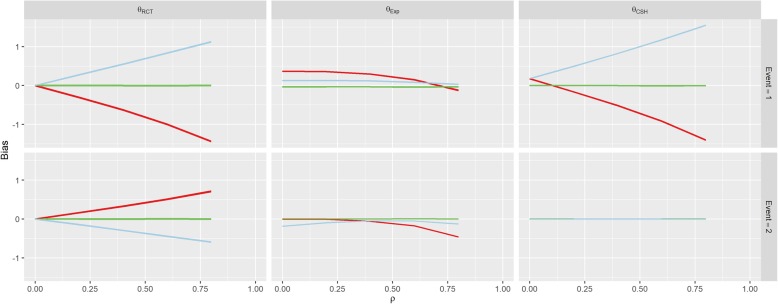
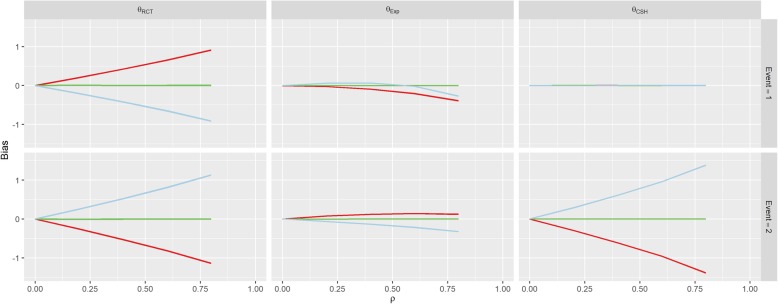
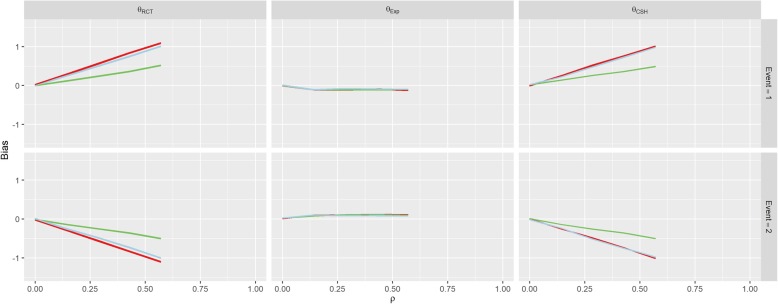
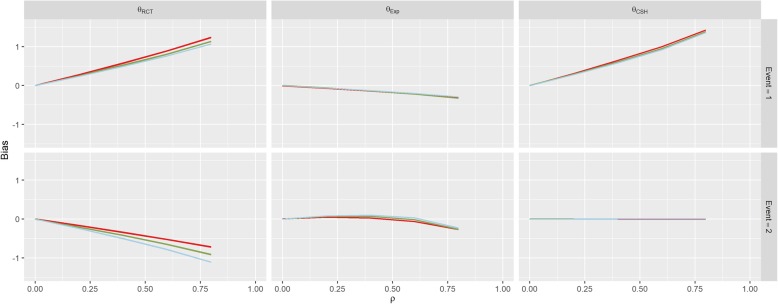
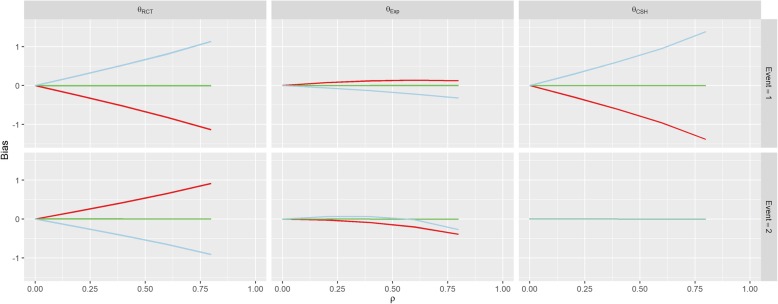
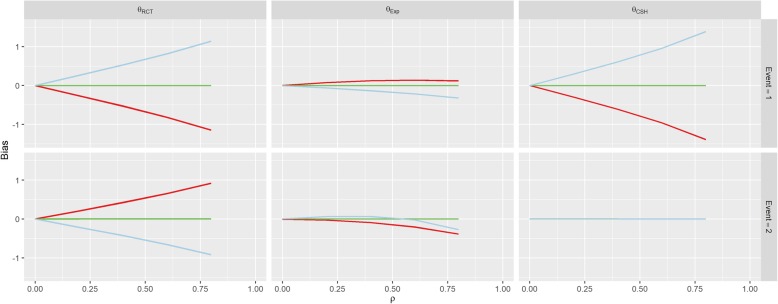
Results: In both the Cox and Fine & Gray models, correlation between the unmeasured confounder and the probability of treatment created biases in the same direction (upward/downward) as the effect of the unmeasured confounder on the event-of-interest. The association between correlation and bias is reversed if the unmeasured confounder affects the competing event. These effects are reversed for the bias on the treatment effect of the competing event and are amplified when there are uneven treatment arms.
Conclusion: The effect of unmeasured confounding on an event-of-interest or a competing event should not be overlooked in observational studies as strong correlations can lead to bias in treatment effect estimates and therefore cause inaccurate results to lead to false conclusions. This is true for cause specific perspective, but moreso for a subdistribution perspective. This can have ramifications if real-world treatment decisions rely on conclusions from these biased results. Graphical visualisation to aid in understanding the systems involved and potential confounders/events leading to sensitivity analyses that assumes unmeasured confounders exists should be performed to assess the robustness of results.
Keywords: Competing risks; Observation studies; Simulation study; Unmeasured confounding.
Conflict of interest statement
The authors declare that they have no competing interests.
Figures








References
-
- K. J. Jager, V. S. Stel, C. Wanner, C. Zoccali, and F. W. Dekker, “The valuable contribution of observational studies to nephrology.,” Kidney Int., vol. 72, no. June, pp. 671–675, 2007. - PubMed
Publication types
MeSH terms
LinkOut - more resources
Full Text Sources
