Review
. 2019 Jul 31;83(3):e00074-18.
doi: 10.1128/MMBR.00074-18. Print 2019 Aug 21.

Physiology and Distribution of Archaeal Methanotrophs That Couple Anaerobic Oxidation of Methane with Sulfate Reduction

Affiliations
Review

Physiology and Distribution of Archaeal Methanotrophs That Couple Anaerobic Oxidation of Methane with Sulfate Reduction

S Bhattarai et al. Microbiol Mol Biol Rev. .

Abstract

In marine anaerobic environments, methane is oxidized where sulfate-rich seawater meets biogenic or thermogenic methane. In those niches, a few phylogenetically distinct microbial types, i.e., anaerobic methanotrophs (ANME), are able to grow through anaerobic oxidation of methane (AOM). Due to the relevance of methane in the global carbon cycle, ANME have drawn the attention of a broad scientific community for 4 decades. This review presents and discusses the microbiology and physiology of ANME up to the recent discoveries, revealing novel physiological types of anaerobic methane oxidizers which challenge the view of obligate syntrophy for AOM. An overview of the drivers shaping the distribution of ANME in different marine habitats, from cold seep sediments to hydrothermal vents, is given. Multivariate analyses of the abundance of ANME in various habitats identify a distribution of distinct ANME types driven by the mode of methane transport. Intriguingly, ANME have not yet been cultivated in pure culture, despite intense attempts. Further advances in understanding this microbial process are hampered by insufficient amounts of enriched cultures. This review discusses the advantages, limitations, and potential improvements for ANME laboratory-based cultivation systems.

Keywords: anaerobic oxidation of methane; anerobic methanotrophs.


Figures

FIG 1
FIG 1
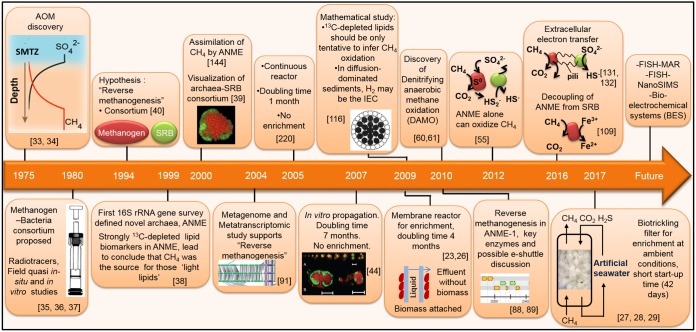
Time line of relevant research on and discoveries about anaerobic methane oxidation with sulfate as an electron acceptor. The major milestones achieved are depicted in their respective years along with some future possibilities in AOM studies. IEC, interspecies electron carrier; MAR, microautoradiography; NanoSIMS, nanometer-scale secondary ion mass spectrometry.
FIG 2
FIG 2
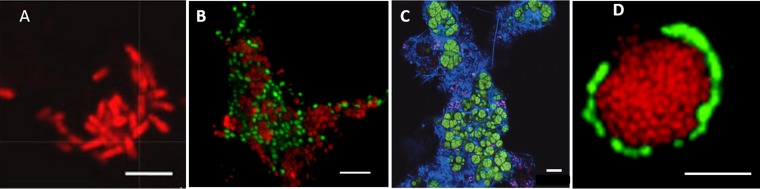
Fluorescence in situ hybridization images from different ANME types. (A) ANME-1 cells in elongated rectangular shape (red) that inhabit the Guaymas Basin hydrothermal vent as a monospecific clade. Republished from reference with permission from Springer Nature. (B) Aggregate of coccus-shaped ANME-2 (red) and Desulfosarcina/Desulfococcus (green) bacteria, an enrichment sample after 8 years from the Isis Mud Volcano in the Mediterranean Sea. The image was taken from http://www.mpg.de/6619070/marine-methane-oxidation and is republished with permission from Jana Milucka and the Max Planck Institute for Marine Microbiology. (C) Aggregate of large, densely clustered ANME-2d (green) and other (blue) bacteria obtained from a bioreactor enrichment. Republished from reference with permission from Springer Nature. (D) Aggregate of coccus-shaped ANME-3 (red) and Desulfobulbaceae (green) bacteria inhabiting the Haakon Mosby Mud Volcano. Republished from reference with permission. Scale bars, 10 μm.
FIG 3
FIG 3
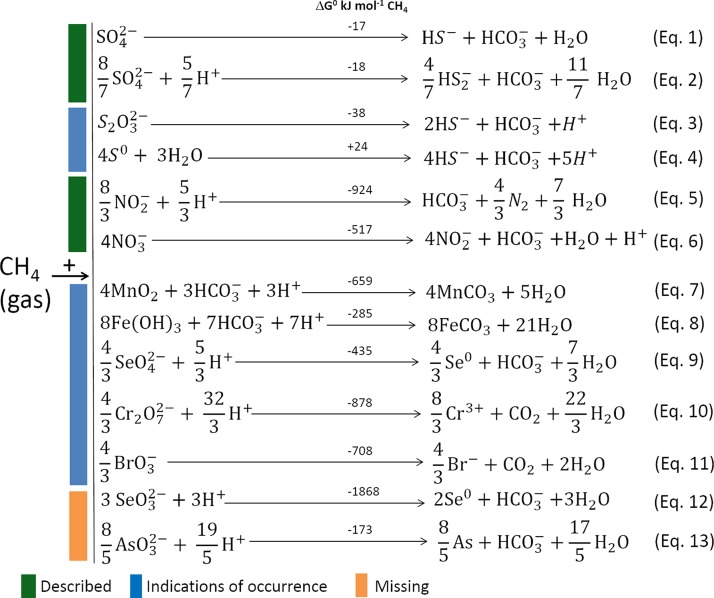
Described and possible AOM processes with different terminal electron acceptors. AOM with sulfate, nitrate, or nitrite as the electron acceptor is well described, along with the microbes involved (indicated by green bars), whereas AOM with manganese and iron has been shown, but the microbes involved need to be characterized (indicated by blue bars). Other possible electrons are indicated in the bottom part of the figure according to the thermodynamic calculation of the chemical reaction (indicated by an orange bar).
FIG 4
FIG 4
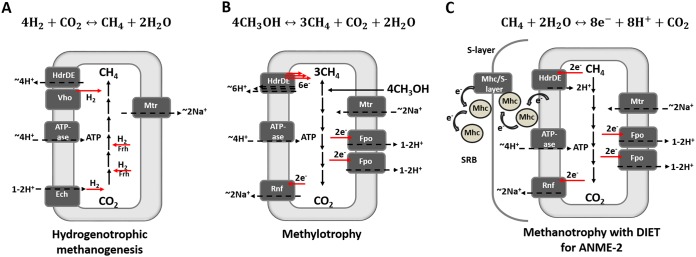
Diverse physiology in methane-producing and methane-consuming archaea. (A) Hydrogenotrophic methanogenesis by Methanosarcina barkeri; (B) methylotrophy by M. acetivorans; (C) methanotrophy by ANME-2 with direct interspecies electron exchange (DIET). Red arrows indicate electron transfer, and dashed black arrows represent ion translocation steps for energy conservation. Enzyme abbreviations: Frh, F420-reducing hydrogenase; Ech, ferredoxin-dependent hydrogenase; Vho, methanophenazine-reducing hydrogenase; Fpo/Fqo, F420H2:phenazine/quinone oxidoreductase; HdrDE, heterodisulfide reductase; Mhc, multiheme cytochrome; Rnf, Na+-translocating ferredoxin:NAD oxidoreductase; Mtr, Na+-translocating methyl-H4MPT:coenzyme M methyltransferase. The figure is based on reports from McGlynn (108), Timmers et al. (92), Thauer et al. (204), and references therein.
FIG 5
FIG 5
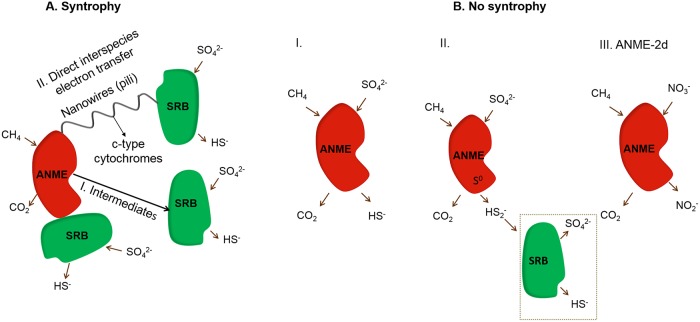
Syntrophic and nonsyntrophic anaerobic methanotrophs (ANME) using sulfate as an electron acceptor. (A) In a syntrophic association, ANME can transfer electrons to a sulfate-reducing bacterium (SRB) via different mechanisms: electron transfer via possible intermediate compounds such as formate, acetate, or hydrogen (I) and direct interspecies electron transfer between ANME and SRB mediated by c-type cytochromes, e.g., as in ANME-2 (131), or via nanowires and cytochromes acting, e.g., as in thermophilic ANME-1 (132) (II). (B) In a nonsyntrophic association, ANME can possibly perform the complete AOM process alone without a sulfate-reducing partner by using insoluble iron oxides as external electron acceptors (109) (I), by producing carbon dioxide and disulfide (HS2) with S0 as an intermediate (the HS2 can be disproportionated by SRB) (55) (II), or by ANME-2d performing DAMO (III).
FIG 6
FIG 6
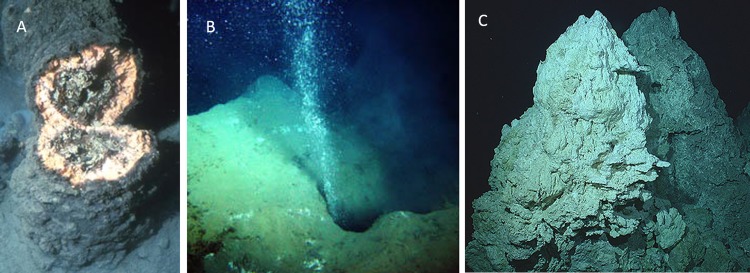
In situ pictures of some of the well-studied ANME habitats. (A) Black and pink microbial mats covering a carbonate chimney in the Black Sea. Republished from reference with permission from AAAS. (B) Methane seeping from the Haakon Mosby Mud Volcano. Republished from reference (image copyright IFREMER, Brest, and Alfred Wegener Institute [AWI] for Polar and Marine Research, Bremerhaven, Germany). (C) Carbonate chimney from the Lost City hydrothermal vent. Republished from reference with permission.
FIG 7
FIG 7
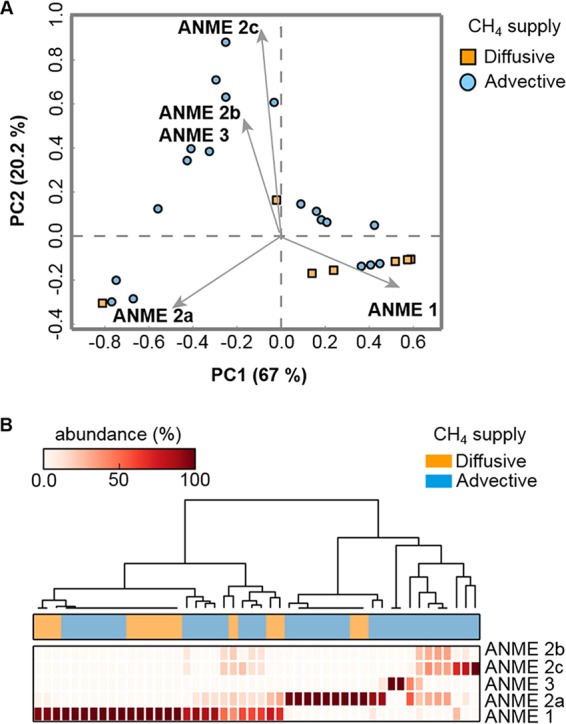
Multivariate (A) and cluster (B) analyses of the mode of CH4 transport, illustrating that it is one of the drivers for the distribution of ANME types in the environment and showing that ANME-2 is dominant mostly in CH4-advective sites. The heat map was generated using the heatmap.2 function in R. Hierarchical clustering was performed using complete linkage.
FIG 8
FIG 8
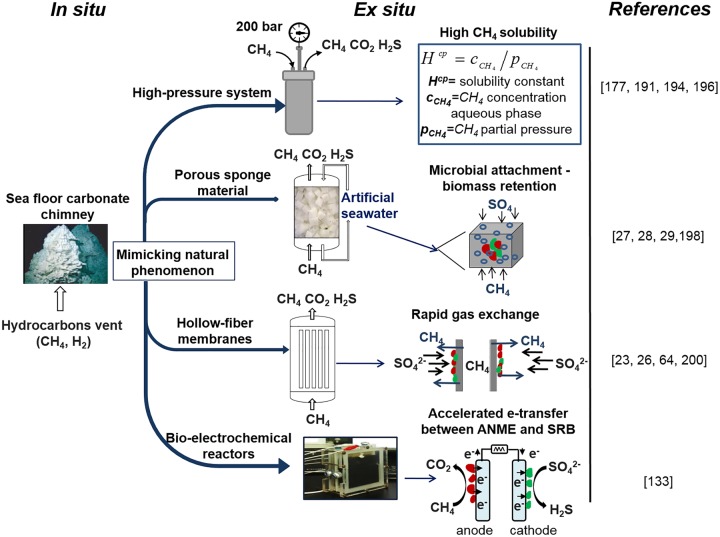
Different bioreactor configurations to enhance ex situ growth of ANME mediating AOM-SR mimicking different characteristics of the growth modes of ANME in natural habitats.

References

    1. Thauer RK, Shima S. 2008. Methane as fuel for anaerobic microorganisms. Ann N Y Acad Sci 1125:158–170. doi: 10.1196/annals.1419.000. - DOI - PubMed
    1. Ciais P, Sabine C, Bala G, Bopp L, Brovkin V, Canadell J, Chhabra A, DeFries R, Galloway J, Heimann M. 2014. Carbon and other biogeochemical cycles, p 465–570. In IPCC 2013: climate change 2013. Contribution of Working Group I to the Fifth Assessment Report of the Intergovernmental Panel on Climate Change. Cambridge University Press, Cambridge, England.
    1. Degelmann DM, Borken W, Drake HL, Kolb S. 2010. Different atmospheric methane-oxidizing communities in European beech and Norway spruce soils. Appl Environ Microbiol 76:3228–3235. doi: 10.1128/AEM.02730-09. - DOI - PMC - PubMed
    1. Maxfield P, Hornibrook E, Evershed R. 2006. Estimating high-affinity methanotrophic bacterial biomass, growth, and turnover in soil by phospholipid fatty acid 13C labeling. Appl Environ Microbiol 72:3901–3907. doi: 10.1128/AEM.02779-05. - DOI - PMC - PubMed
    1. Kirschke S, Bousquet P, Ciais P, Saunois M, Canadell JG, Dlugokencky EJ, Bergamaschi P, Bergmann D, Blake DR, Bruhwiler L, Cameron-Smith P, Castaldi S, Chevallier F, Feng L, Fraser A, Heimann M, Hodson EL, Houweling S, Josse B, Fraser PJ, Krummel PB, Lamarque J-F, Langenfelds RL, Le Quere C, Naik V, O'Doherty S, Palmer PI, Pison I, Plummer D, Poulter B, Prinn RG, Rigby M, Ringeval B, Santini M, Schmidt M, Shindell DT, Simpson IJ, Spahni R, Steele LP, Strode SA, Sudo K, Szopa S, van der Werf GR, Voulgarakis A, van Weele M, Weiss RF, Williams JE, Zeng G. 2013. Three decades of global methane sources and sinks. Nat Geosci 6:813–823. doi: 10.1038/ngeo1955. - DOI

Publication types

LinkOut - more resources