Review
. 2019 Jul 31;32(4):e00019-19.
doi: 10.1128/CMR.00019-19. Print 2019 Sep 18.

Plasmodium Genomics and Genetics: New Insights into Malaria Pathogenesis, Drug Resistance, Epidemiology, and Evolution

Affiliations
Review

Plasmodium Genomics and Genetics: New Insights into Malaria Pathogenesis, Drug Resistance, Epidemiology, and Evolution

Xin-Zhuan Su et al. Clin Microbiol Rev. .

Abstract

Protozoan Plasmodium parasites are the causative agents of malaria, a deadly disease that continues to afflict hundreds of millions of people every year. Infections with malaria parasites can be asymptomatic, with mild or severe symptoms, or fatal, depending on many factors such as parasite virulence and host immune status. Malaria can be treated with various drugs, with artemisinin-based combination therapies (ACTs) being the first-line choice. Recent advances in genetics and genomics of malaria parasites have contributed greatly to our understanding of parasite population dynamics, transmission, drug responses, and pathogenesis. However, knowledge gaps in parasite biology and host-parasite interactions still remain. Parasites resistant to multiple antimalarial drugs have emerged, while advanced clinical trials have shown partial efficacy for one available vaccine. Here we discuss genetic and genomic studies of Plasmodium biology, host-parasite interactions, population structures, mosquito infectivity, antigenic variation, and targets for treatment and immunization. Knowledge from these studies will advance our understanding of malaria pathogenesis, epidemiology, and evolution and will support work to discover and develop new medicines and vaccines.

Keywords: association studies; evolutionary selection; genetic mapping; genome diversity; population structure.


Figures

FIG 1
FIG 1
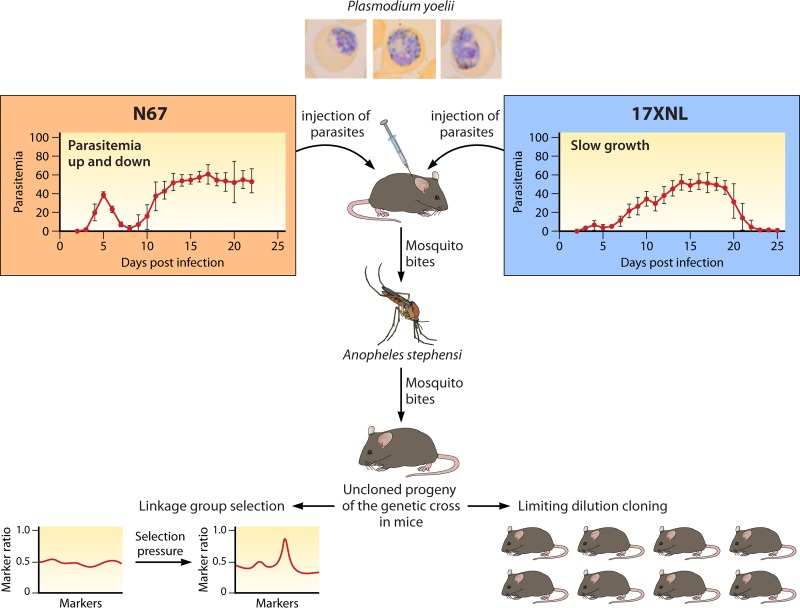
Diagram illustrating the principle of a malaria genetic cross of rodent malaria parasites. A cross starts with an intravenous or intraperitoneal injection of blood samples containing gametocytes from two parasite strains (in this case, Plasmodium yoelii subsp. nigeriensis N67 and P. yoelii subsp. yoelii 17XNL, that have different growth characteristics and virulence in mice). Mice infected with mixtures of gametocytes are anesthetized and fed to Anopheles stephensi mosquitoes. Approximately 15 to 17 days after feeding, the infected mosquitoes with salivary gland sporozoites are allowed to feed on new mice. Daily blood smears are made to monitor parasitemia. The resulting parasites are cloned through limiting dilution by injecting a single parasite into a mouse or are frozen in liquid nitrogen for future studies. The parasite mixtures can be also used for linkage group selection (LGS) after applying selection pressure such as drugs.
FIG 2
FIG 2
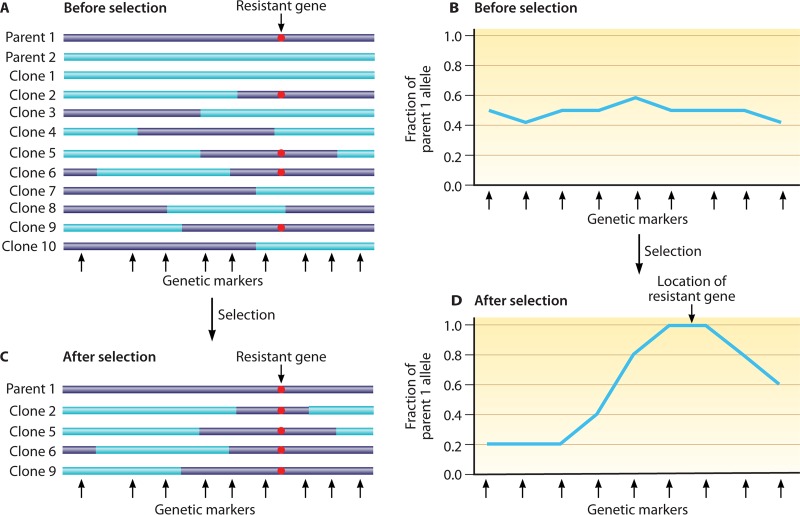
Diagram illustrating the principle of genetic recombination and linkage group selection. (A) Genetic recombination between parental lines (purple and blue) results in progenies harboring various combinations of the parental chromosomal segments. The bars represent chromosomal segments with a putative resistance marker from parent 1 (red dot) distributed among the progenies. Black arrows at the bottom denote positions of polymorphic genetic markers between the two parents. (B) Ratios of resistant alleles from parent 1, showing approximately 50% of allele ratios of the parents before selection. (C) After selection, only the parasites carrying the resistant allele (red dot) survive. (D) A plot of the ratios of resistant alleles shows increased frequency (to 100%) at one locus of the chromosome segment, suggesting at least one genetic determinant contributing to parasite survival or resistance to selection pressure in the locus. Fine-mapping with additional recombinant progenies and genetic markers may identify the gene(s) conferring the resistance.
FIG 3
FIG 3
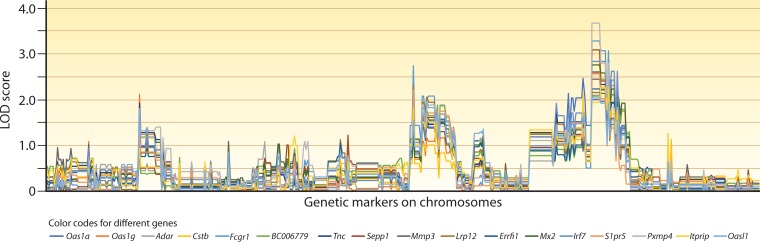
Plots of host genes based on genome-wide patterns of LOD scores. This figure is based on data published in reference . In the study, mice were individually infected with 24 progenies from a genetic cross of Plasmodium yoelii subsp. yoelii 17XNL and Plasmodium yoelii subsp. nigeriensis N67 parasites. mRNA samples from infected spleens were extracted at day 4 postinfection and were hybridized to a microarray representing ∼19,100 unique mouse genes. Transspecies expression quantitative trait locus (ts-eQTL) analysis was used to analyze genome-wide transcription data from the infections against 479 microsatellite (MS) markers typed on the corresponding progenies. This analysis provided a genome-wide pattern of LOD scores (GPLS) for each host gene. Genes with expression levels linked to at least one MS marker (out of 479) with a LOD score of ≥2.0 were chosen, and their GPLSs were clustered based on pattern similarity. This figure shows a group of genes with similar GPLSs including a major peak of LOD score on one end of the parasite chromosome 13. Genes in an individual cluster are often related through roles in the same host response pathways; examples shown in this figure include type I interferon (IFN-I)-stimulated genes (isg) or genes that likely regulate IFN-I responses (Oas1a, Oas1g, Adar, Mx2, Irf7, S1pr5, or Oasl1). The names of the genes in the cluster are indicated under the plot.
FIG 4
FIG 4
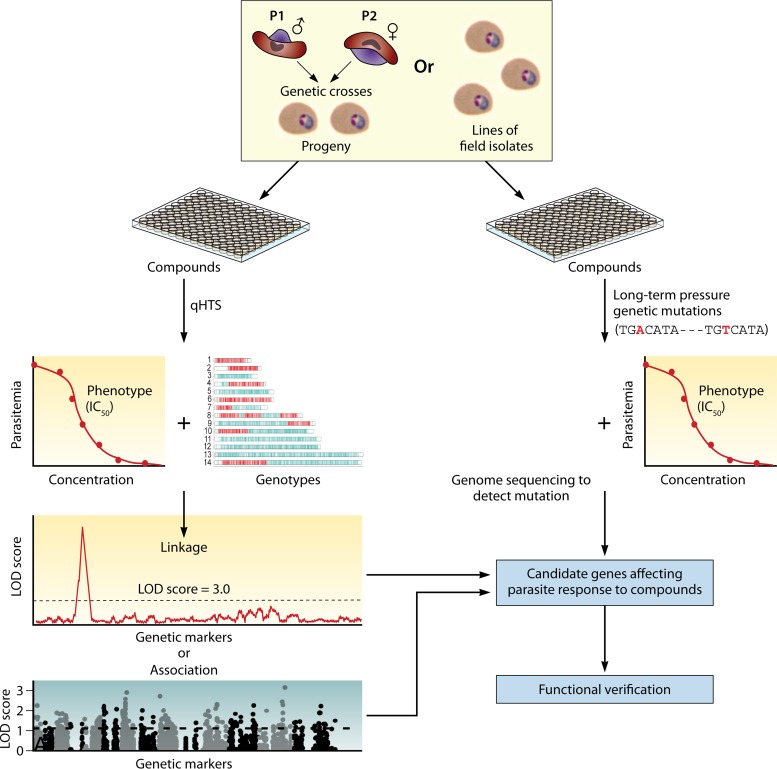
Chemical genomics approaches to identify interactions of small molecules (SMs) and parasite genes. Malaria parasites, either progenies from genetic crosses or field isolates, can be screened for response (half-maximal inhibitory concentration [IC50]) against libraries of SMs using quantitative high-throughput screening (qHTS). Parasites can also be placed under long-term SM pressure for mutations that may play a role in parasite survival. The parasites are genotyped with a large number of genetic markers or are genome sequenced to detect polymorphism or mutations under SM pressure. Linkage analysis, including LGS, or genome-wide association analysis (GWAS) can be performed to link SM and parasite genes playing roles in the SM responses. Genetic mutations and changes in gene expression can be detected after genome sequencing or microarray/RNA-seq from parasites before and after SM pressure. Candidate genes can be further verified using CRISPR/Cas9-based gene knockout, knock-in, or regulation of gene expression to confirm the potential SM target or genes in SM transport.
FIG 5
FIG 5
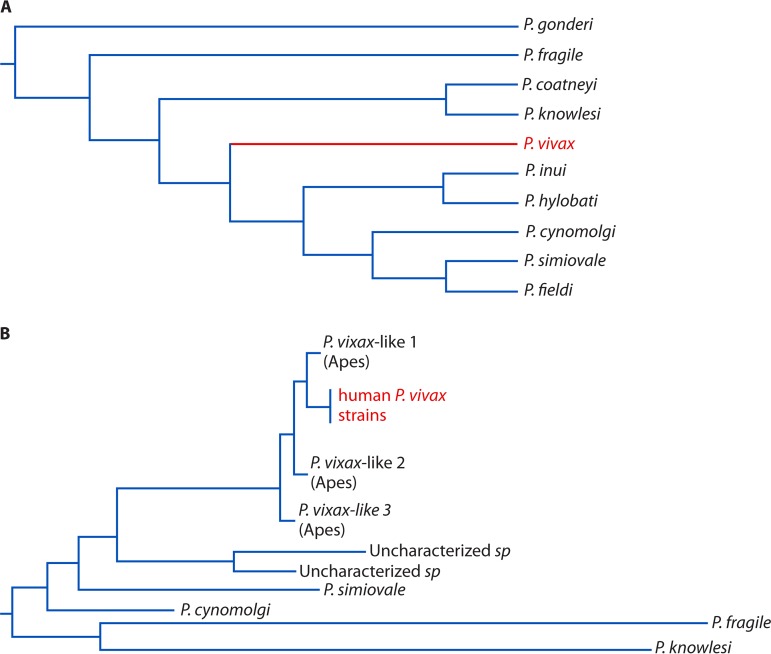
Molecular phylogenetic trees of Plasmodium vivax and other related nonhuman primate parasites. (A) A phylogenetic tree of P. vivax and related parasites based on sequences from two nuclear genes (β-tubulin and cell division cycle 2) and a plastid gene (the elongation factor Tu). The tree is adapted from Fig. 1B of reference with permission of the National Academy of Sciences. (B) A phylogenetic tree of P. vivax and P. vivax-like parasites from nonhuman primates, including apes. The tree is adapted (simplified) from Fig. 2 of reference with permission of Springer Nature/Macmillan Publishers Limited.

References

    1. Feachem RG, Phillips AA, Hwang J, Cotter C, Wielgosz B, Greenwood BM, Sabot O, Rodriguez MH, Abeyasinghe RR, Ghebreyesus TA, Snow RW. 2010. Shrinking the malaria map: progress and prospects. Lancet 376:1566–1578. doi: 10.1016/S0140-6736(10)61270-6. - DOI - PMC - PubMed
    1. Snow RW, Amratia P, Kabaria CW, Noor AM, Marsh K. 2012. The changing limits and incidence of malaria in Africa: 1939-2009. Adv Parasitol 78:169–262. doi: 10.1016/B978-0-12-394303-3.00010-4. - DOI - PMC - PubMed
    1. Noor AM, Kinyoki DK, Mundia CW, Kabaria CW, Mutua JW, Alegana VA, Fall IS, Snow RW. 2014. The changing risk of Plasmodium falciparum malaria infection in Africa: 2000-10: a spatial and temporal analysis of transmission intensity. Lancet 383:1739–1747. doi: 10.1016/S0140-6736(13)62566-0. - DOI - PMC - PubMed
    1. Bright AT, Tewhey R, Abeles S, Chuquiyauri R, Llanos-Cuentas A, Ferreira MU, Schork NJ, Vinetz JM, Winzeler EA. 2012. Whole genome sequencing analysis of Plasmodium vivax using whole genome capture. BMC Genomics 13:262. doi: 10.1186/1471-2164-13-262. - DOI - PMC - PubMed
    1. Carlton JM, Angiuoli SV, Suh BB, Kooij TW, Pertea M, Silva JC, Ermolaeva MD, Allen JE, Selengut JD, Koo HL, Peterson JD, Pop M, Kosack DS, Shumway MF, Bidwell SL, Shallom SJ, van Aken SE, Riedmuller SB, Feldblyum TV, Cho JK, Quackenbush J, Sedegah M, Shoaibi A, Cummings LM, Florens L, Yates JR, Raine JD, Sinden RE, Harris MA, Cunningham DA, Preiser PR, Bergman LW, Vaidya AB, van Lin LH, Janse CJ, Waters AP, Smith HO, White OR, Salzberg SL, Venter JC, Fraser CM, Hoffman SL, Gardner MJ, Carucci DJ. 2002. Genome sequence and comparative analysis of the model rodent malaria parasite Plasmodium yoelii yoelii. Nature 419:512–519. doi: 10.1038/nature01099. - DOI - PubMed

Publication types