


Acupuncture for chronic neck pain with sensitive points: study protocol for a multicentre randomised controlled trial
- PMID: 31366643
- PMCID: PMC6678032
- DOI: 10.1136/bmjopen-2018-026904
Acupuncture for chronic neck pain with sensitive points: study protocol for a multicentre randomised controlled trial
Erratum in
-
Correction: Acupuncture for chronic neck pain with sensitive points: study protocol for a multicentre randomised controlled trial.BMJ Open. 2019 Aug 18;9(8):e026904corr1. doi: 10.1136/bmjopen-2018-026904corr1. BMJ Open. 2019. PMID: 31427349 Free PMC article. No abstract available.
Abstract
Introduction: Chronic neck pain is a challenging condition to treat in clinical practice and has a considerable impact on quality of life and disability. According to the theory of traditional Chinese medicine, acupoints and tender points may become sensitised when the body is in a diseased state. Stimulation of such sensitive points may lead to disease improvement and improved clinical efficacy. This study aims to evaluate the efficacy and safety of needling at sensitive acupoints in providing pain relief, improvement of cervical vertebral function and quality of life in patients with chronic neck pain.
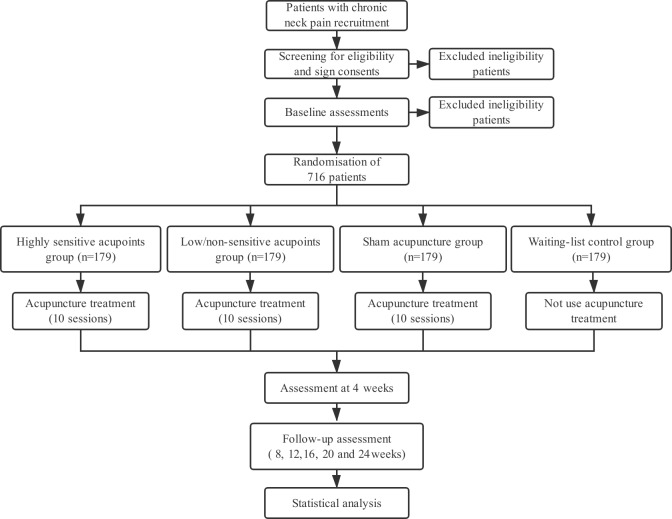
Methods and analysis: This multicentre, randomised controlled, explanatory and parallel clinical trial will include 716 patients with chronic neck pain. Study participants will be randomly assigned in a 1:1:1:1 ratio to four treatment groups: the highly sensitive acupoints group, low/non-sensitive acupoints group, sham acupuncture group and waiting-list control group. The primary outcome will be the change in the visual analogue scale score for neck pain from baseline to 4 weeks. Secondary outcomes will be the Northwick Park Neck Pain Questionnaire and McGill pain questionnaire, 12-item Short-Form health survey, Neck Disability Index, changes in the pressure pain threshold, range of cervical motion, Self-Rating Anxiety Scale, Self-Rating Depression Scale and adverse events before treatment, post-treatment, and at 4, 8, 12, 16 and 20 weeks post-treatment. The intention-to-treat approach will be used in the statistical analysis. Group comparisons will be undertaken using χ2 tests for categorical characteristics, and analysis of variance for continuous variables to analyse whether acupuncture in the highly sensitive acupoints group achieves better treatment outcomes than in each of the other three groups.
Ethics and dissemination: Ethical approval of this study has been granted by the local Institutional Review Board (ID: 2017 KL-038). The outcomes of the trial will be disseminated through peer-reviewed publications.
Trial registration number: ChiCTR1800016371; Pre-results.
Keywords: acupuncture; chronic neck pain; pressure pain threshold; sensitised points; study protocol.
© Author(s) (or their employer(s)) 2019. Re-use permitted under CC BY-NC. No commercial re-use. See rights and permissions. Published by BMJ.
Conflict of interest statement
Competing interests: None declared.
Figures
References
-
- Sari-Kouzel H, Cooper R. Managing pain from cervical spondylosis. Practitioner 1999;243:334–8. - PubMed
-
- Hoggjohnson S, Velde GVD, Carroll LJ, et al. . The burden and determinants of neck pain in the general population: results of the bone and joint decade 2000–2010 Task force on neck pain and its associated disorders. Best evidence on the burden and determinants of neck. European Spine Journal 2008;17:39–51. - PubMed
-
- Wang B, Duan YP, Zhang YC, et al. . [Epidemiologic research on the clinical features of patients with cervical spondylosis]. Zhong Nan Da Xue Xue Bao Yi Xue Ban 2004;29:472. - PubMed
Publication types
MeSH terms
Associated data
LinkOut - more resources
Full Text Sources
Medical
