


Evaluating the rancidity and quality of discarded oils in fast food restaurants
- PMID: 31367358
- PMCID: PMC6657716
- DOI: 10.1002/fsn3.1072
Evaluating the rancidity and quality of discarded oils in fast food restaurants
Abstract
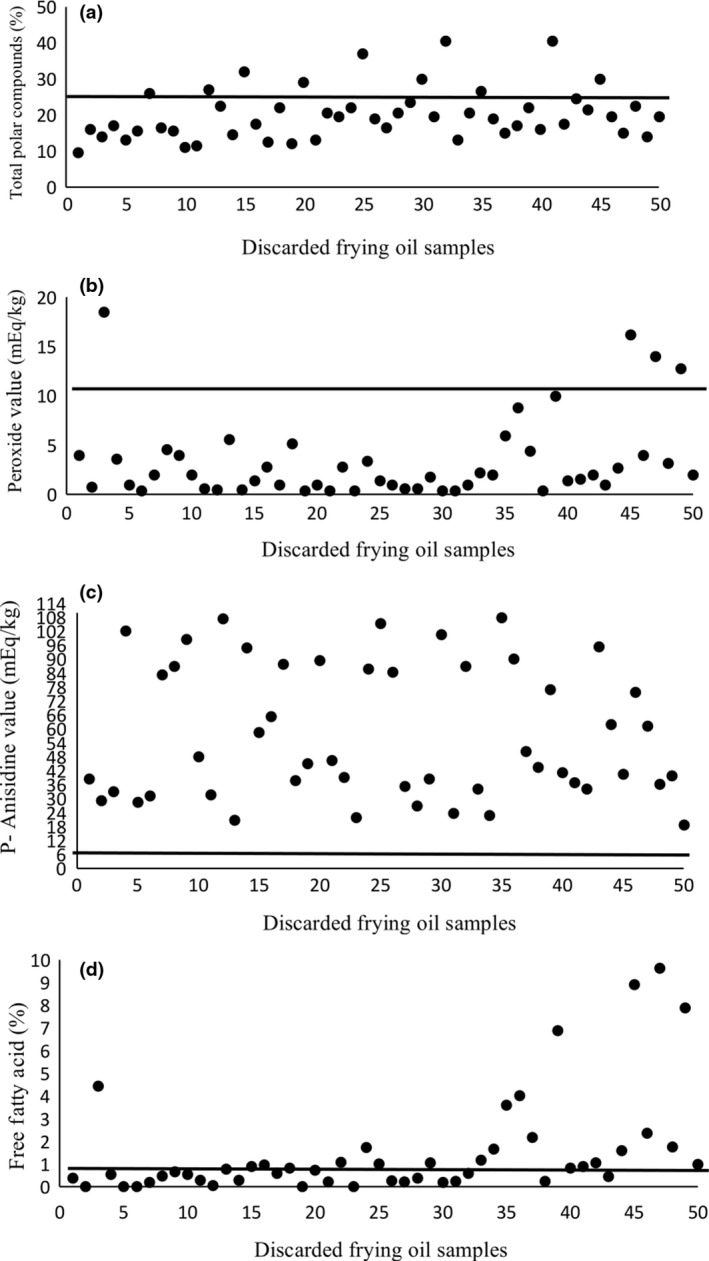
This cross-sectional study attempts to determine the rancidity and quality of discarded oils in fast food restaurants. Samples of the discarded frying oils were collected randomly from 50 fast food restaurants in Tehran, Iran. Their physicochemical properties were assessed and compared to the standard values. The means (±SD) of the physicochemical indicators of the rancidity in the discarded oils were as follows: peroxide value, 3.06 (0.51) (mEq/kg); free fatty acids content, 1.52 (2.26) (%); p-anisidine value, 57.63 (4.02) (mEq/kg); total oxidation value, 64.53 (4.15); total polar compounds (TPC), 20.19 (1.02) (%); viscosity, 107.87 (2.35) (cp); and red color, 9.64 (0.84). Positive correlations were found between the TPC, viscosity, and red color (p ≤ 0.01) of the oil samples. The majority of discarded oil from fast food restaurants were overdegraded containing hazardous secondary oxidative products, and also, the consumption of nonstandard frying oil has increased in fast food restaurants. Policymakers should develop guidelines to determine whether and when frying oils should be discarded and consider the consumption of overdegraded oils as a public health hazard.
Keywords: discarded oils; fast food restaurants; quality assessment; rancidity.
Conflict of interest statement
The authors declare that they have no conflicts of interest to disclose. This study received no specific grant from any funding sources (commercial or nonprofit sectors).
Figures
References
-
- (INSO), I. N. S. O. (1998). Animal and vegetable fats and oils – Determination of Lovibond colour, Vol. 5110.
-
- (INSO), I. N. S. O. (2016a). Animal and vegetable fats and oils‐Gas chromatography of fatty acid methyl esters – Part 2: Preparation of fatty acid methyl esters, Vol. 13126‐2.
-
- (INSO), I. N. S. O. (2016b). Edible fats & oils‐frying oil – Specifications and test methods, Vol. 4152.
-
- (INSO), I. N. S. O. (2018). Animal and vegetable fats and oils—Determination of peroxide value—Iodometric (visual) endpoint determination, Vol. 4179.
-
- Aalipour Hafshejani, F. , Mahdavi, F. , & Aalipour Hafshejani, E. (2015). Determination of peroxide value and visual color of Zoolbia and Bamieh oils in the holy Ramadan in Shahrekord. Journal of Shahrekord Uuniversity of Medical Sciences, 17(5), 74–82.
LinkOut - more resources
Full Text Sources
Miscellaneous
