


doi: 10.1016/j.nmni.2019.100585.
eCollection 2019 Sep.
Arcanobacterium ihumii sp. nov., Varibaculum vaginae sp. nov. and Tessaracoccus timonensis sp. nov., isolated from vaginal swabs from healthy Senegalese women
Affiliations
- PMID: 31367386
- PMCID: PMC6656688
- DOI: 10.1016/j.nmni.2019.100585
Item in Clipboard
Arcanobacterium ihumii sp. nov., Varibaculum vaginae sp. nov. and Tessaracoccus timonensis sp. nov., isolated from vaginal swabs from healthy Senegalese women
New Microbes New Infect.
.
Expression of concern in
-
Expression of Concern: Arcanobacterium ihumii sp. nov., Varibaculum vaginae sp. nov. and Tessaracoccus timonensis sp. nov., isolated from vaginal swabs from healthy Senegalese women.New Microbes New Infect. 2024 Mar 30;59:101259. doi: 10.1016/j.nmni.2024.101259. eCollection 2024 Jun. New Microbes New Infect. 2024. PMID: 38799966 Free PMC article. No abstract available.
Abstract
Culturomics studies the microbial variety of the human microbiome by combining diversified culture conditions, matrix-assisted laser desorption/ionization time-of-flight mass spectrometry and 16S rRNA gene identification. This study identifies three putative new bacterial species: Arcanobacterium ihumii sp. nov. strain Marseille-P5647T, Varibaculum vaginae sp. nov. strain Marseille-P5644T and Tessaracoccus timonensis sp. nov. strain Marseille-P5995T, which we describe according to the concept of taxonogenomics.
Keywords: Arcanobacterium ihumii sp. nov.; Tessaracoccus timonensis sp. nov.; Varibaculum vaginae sp. nov.; culturomics; vagina.
Figures

MALDI-TOF MS reference spectra of the three new species described. The reference spectra were generated by comparison of spectra from 12 individual colonies for each species.

Scanning electron microscopy (SEM) of the three new species. A colony was collected from agar and immersed into a 2.5% glutaraldehyde fixative solution. Then, a drop of the suspension was directly deposited on a poly-l -lysine-coated microscope slide for 5 minutes and treated with 1% phosphotungstic acid aqueous solution (pH 2.0) for 2 minutes to increase the SEM image contrast. The slide was gently washed in water; air-dried and examined in a tabletop SEM (Hitachi TM4000). Scales and acquisition settings are shown on figures.

Phylogenetic tree highlighting the position of all the new species relative to their most closely related type strains and validly published. GenBank Accession numbers of 16S rRNA are indicated in parentheses. Sequences were aligned using MUSCLE with default parameters, phylogenetic inferences were obtained using the maximum likelihood method and MEGA 7 software. Numbers at the nodes are percentages of bootstrap values obtained by repeating the analysis 1000 times to generate a majority consensus tree. The scale bar indicates a 5% nucleotide sequence divergence. Helcococcus kunzii DSM 10548 was used as outgroup.
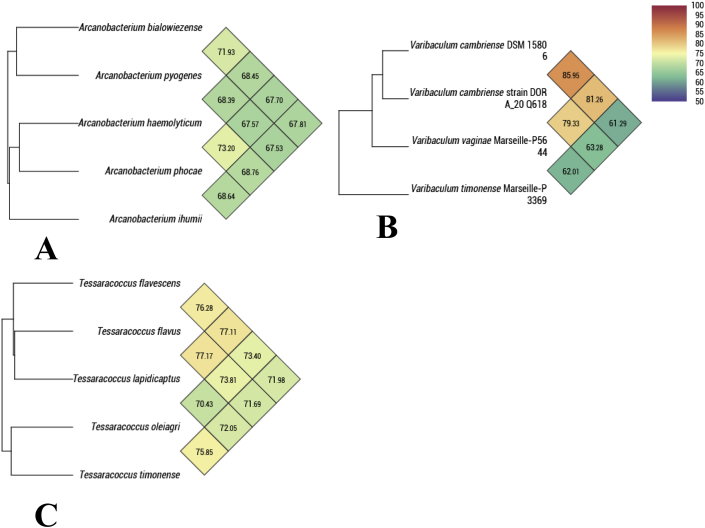
Heatmaps generated with OrthoANI values calculated using the OAT software for Arcanobacterium ihumii sp. nov. (a), Varibaculum vaginae sp. nov. (b) and Tessaracoccus timonense sp. nov. (c) with other closely related species with standing in nomenclature.
References
-
- De Vos P., Garrity G.M., Jones D., Krieg N.R., Ludwig W., Rainey F.A. The Firmicutes. In: Garrity G.M., editor. Bergey’s manual of systematic bacteriology. Springer; New York, NY: 2009. pp. 465–511.
-
- Fenollar F., Raoult D. Does bacterial vaginosis result from fecal transplantation? J Infect Dis. 2016;214:1784. - PubMed
LinkOut - more resources
Full Text Sources
Molecular Biology Databases