


Hepato-Renal protective Effects of Egyptian Purslane Extract against Experimental Cadmium Toxicity in Rats with Special Emphasis on the Functional and Histopathological Changes
- PMID: 31367527
- PMCID: PMC6650623
- DOI: 10.1016/j.toxrep.2019.06.013
Hepato-Renal protective Effects of Egyptian Purslane Extract against Experimental Cadmium Toxicity in Rats with Special Emphasis on the Functional and Histopathological Changes
Erratum in
-
Erratum regarding missing Declaration of Competing Interest statements in previously published articles.Toxicol Rep. 2020 Dec 22;8:28-29. doi: 10.1016/j.toxrep.2020.12.007. eCollection 2021. Toxicol Rep. 2020. PMID: 33384945 Free PMC article.
Abstract
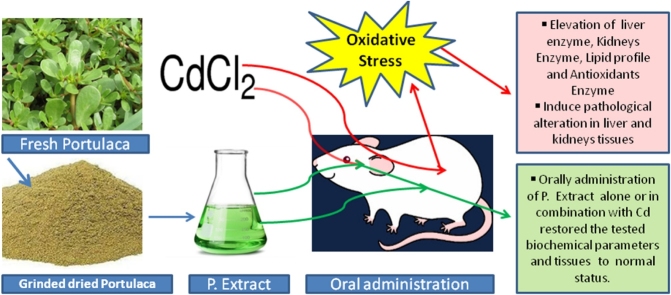
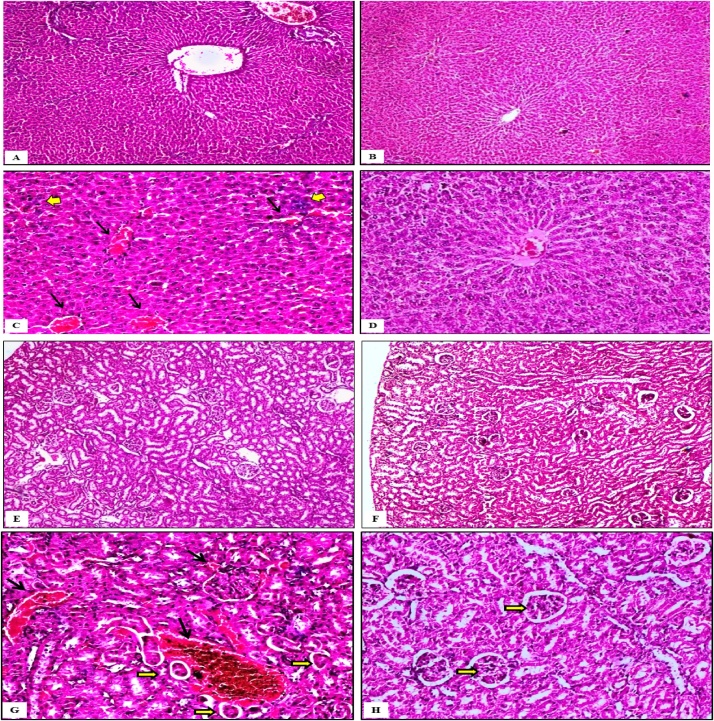
The study was designed to clarify the hapato-nephroprotective effects of purslane ethanolic extract (PEE) against cadmium toxicity. Cadmium (Cd) is a toxic heavy metal. Cd occurs as environmental and food/ feed contamination causing public and animals health hazards. Liver and kidney are the main target organs for acute and chronic cadmium toxicity. Portulaca oleracea is rich in several vitamins, minerals, antioxidant components, and omega-3 fatty acids mainly α-linolenic acid and eicosapentaenoic acid. Results showed significant elevation of the liver and kidney functions, lipid profile and lipid peroxidation. In contrast to the antioxidants enzymatic were greatly decreased. The hepatic and renal tissues showed severe degeneration and necrosis accompanied by severe congestion and multifocal hemorrhages in Cd intoxicated rats. All parameters and tissues showed no changes in rates-treated with both Cd and purslane extract as compared with the control rats. The administration of PEE provided a significantly protection against Cd-induced hepato-nephrotoxicity.
Keywords: Cadmium; Chemistry; Histopathology; Kidney; Liver; P. oleracea; Rat.
Figures
References
-
- Zhang W., Zhi J., Cui Y., Zhang F., Habyarimana A., Cambier C., Gustin P. Potentiated interaction between ineffective doses of budesonide and formoterol to control the inhaled cadmium-induced up-regulation of metalloproteinases and acute pulmonary inflammation in rats. PLoS One. 2014;9(10):e109–136. - PMC - PubMed
-
- Buha A., Antonijević B., Bulat Z., Jaćević V., Milovanović V., Matović V. The impact of prolonged cadmium exposure and co-exposure with polychlorinated biphenyls on thyroid function in rats. Toxicol. Lett. 2013;221(2):83–90. - PubMed
-
- Ihedioha J., Okoye C. Cadmium and lead levels in muscle and edible offal of cow reared in Nigeria. Bull. Environ. Contam. Toxicol. 2012;88(3):422–427. - PubMed
-
- Monsefi M., Fereydouni B. The effects of cadmium pollution on female rat reproductive system. J. Infertil. Reprod. Biol. 2013;1(1):1–6.
LinkOut - more resources
Full Text Sources
