Treatment of uncommon EGFR mutations in non-small cell lung cancer: new evidence and treatment
- PMID: 31367543
- PMCID: PMC6626855
- DOI: 10.21037/tlcr.2019.04.12
Treatment of uncommon EGFR mutations in non-small cell lung cancer: new evidence and treatment
Abstract
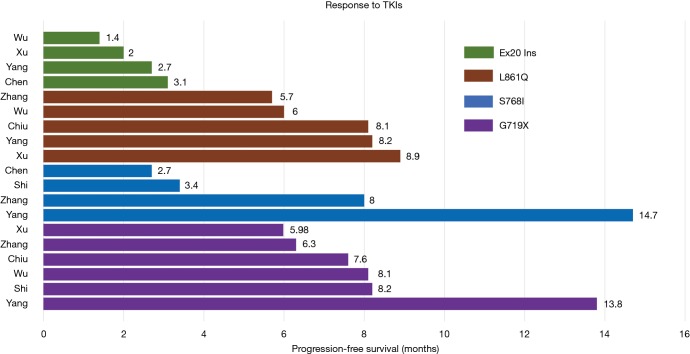
Sensitizing mutations in epidermal growth factor receptor (EGFR) are associated with positive responses to anti-EGFR-targeted therapy, leading to a new era of treatment for non-small cell lung cancer (NSCLC). Exon 19 deletions and exon 21 L858R substitutions are the most common mutations, accounting for approximately 90% mutations in NSCLC; these are termed classic mutations and result in high sensitivity to tyrosine kinase inhibitors (TKIs). Other EGFR mutations are termed uncommon EGFR mutations, of which G719X, S768I, L861Q, exon 20 insertions, and complex mutations are the most frequent. G719X, S768I, and L861Q are point mutations and those that exist with complex mutations are sensitive to first-generation TKIs. A prospective analysis demonstrated that afatinib, a second-generation TKI, led to a better prognosis in some patients with NSCLC compared to first-generation TKIs. Chemotherapy used to be the traditional choice for patients carrying exon 20 insertions; however, with the development of novel targeted drugs, the role of chemotherapy is changing. Tremendous progress has also been made in clinical trials on immunotherapy treatment of uncommon EGFR mutations. The treatment for patients with NSCLC harboring uncommon EGFR mutations remains a subject of debate and the sensitivity of uncommon EGFR mutations to TKIs is still unclear. Here, we summarized recent data in the literature and provide an overview of the clinical characteristics, incidence, and outcomes of patients harboring G719X, S768I, L861Q, exon 20 insertions, and complex mutations who were treated with TKIs, chemotherapy, or immunotherapy.
Keywords: Non-small cell lung cancer (NSCLC); immunotherapy; treatment; tyrosine kinase inhibitors (TKIs); uncommon epidermal growth factor receptor mutations (uncommon EGFR mutations).
Conflict of interest statement
Conflicts of Interest: The authors have no conflicts of interest to declare.
Figures
References
-
- Yang JC, Sequist LV, Geater SL, et al. Clinical activity of afatinib in patients with advanced non-small-cell lung cancer harbouring uncommon EGFR mutations: a combined post-hoc analysis of LUX-Lung 2, LUX-Lung 3, and LUX-Lung 6. Lancet Oncol 2015;16:830-8. 10.1016/S1470-2045(15)00026-1 - DOI - PubMed
Publication types
LinkOut - more resources
Full Text Sources
Other Literature Sources
Research Materials
Miscellaneous