. 2019 Sep;411(24):6435-6447.
doi: 10.1007/s00216-019-02024-5. Epub 2019 Aug 1.

Rapid breath analysis for acute respiratory distress syndrome diagnostics using a portable two-dimensional gas chromatography device

Affiliations

Rapid breath analysis for acute respiratory distress syndrome diagnostics using a portable two-dimensional gas chromatography device

Menglian Zhou et al. Anal Bioanal Chem. 2019 Sep.

Abstract

Acute respiratory distress syndrome (ARDS) is the most severe form of acute lung injury, responsible for high mortality and long-term morbidity. As a dynamic syndrome with multiple etiologies, its timely diagnosis is difficult as is tracking the course of the syndrome. Therefore, there is a significant need for early, rapid detection and diagnosis as well as clinical trajectory monitoring of ARDS. Here, we report our work on using human breath to differentiate ARDS and non-ARDS causes of respiratory failure. A fully automated portable 2-dimensional gas chromatography device with high peak capacity (> 200 at the resolution of 1), high sensitivity (sub-ppb), and rapid analysis capability (~ 30 min) was designed and made in-house for on-site analysis of patients' breath. A total of 85 breath samples from 48 ARDS patients and controls were collected. Ninety-seven elution peaks were separated and detected in 13 min. An algorithm based on machine learning, principal component analysis (PCA), and linear discriminant analysis (LDA) was developed. As compared to the adjudications done by physicians based on the Berlin criteria, our device and algorithm achieved an overall accuracy of 87.1% with 94.1% positive predictive value and 82.4% negative predictive value. The high overall accuracy and high positive predicative value suggest that the breath analysis method can accurately diagnose ARDS. The ability to continuously and non-invasively monitor exhaled breath for early diagnosis, disease trajectory tracking, and outcome prediction monitoring of ARDS may have a significant impact on changing practice and improving patient outcomes. Graphical abstract.

Keywords: 2D GC; Acute respiratory distress syndrome gas chromatography; Breath analysis; Machine learning.


Conflict of interest statement

Conflict of interest

The authors declare that there is no conflict of interest regarding the publication of this paper.

Figures
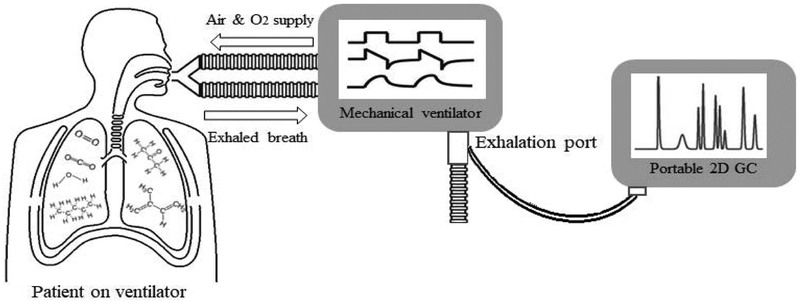
Fig. 1
Fig. 1
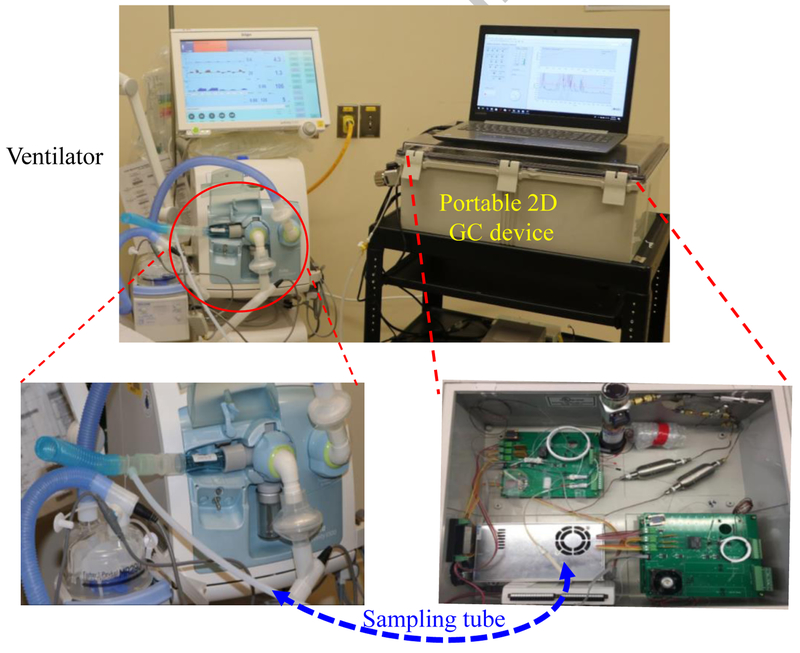
Conceptual illustration of using a portable GC device to analyze breath from a patient on a mechanical ventilator
Fig. 2
Fig. 2
Detailed description of the experimental setup. The portable GC was connected to the output of a ventilator via a 2 m long polytetrafluoroethylene (PTFE) tubing (0.64 cm i.d.). The portable GC weighed less than 5 kg. The patient breath was drawn into and captured by the thermal desorption tube in the GC device at a flow rate of 70 mL/min for 5 minutes. The total assay time was 33 minutes, which included 5 minutes of sample collection time, 5 minutes of desorption/transfer time, 13 minutes of separation time, and 10 minutes of cleaning time. For details of GC operation, see the ESM
Fig. 3
Fig. 3
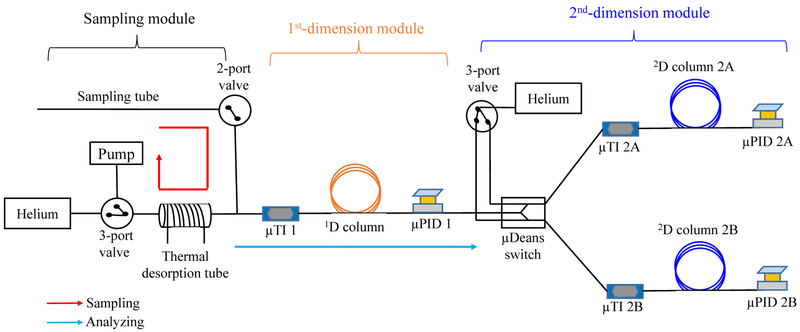
Layout of the portable 1×2-channel 2D GC device. It consisted of three detachable modules: sampling module, 1st-dimensional separation module, and 2nd-dimensional separation module. The 1st-dimensional module consisted of a micro-thermal injector (μTI), a non-polar column, and a micro-photoionization detector (μPID). The 2nd-dimensional module had two identical channels, each of which consisted of a μTI, a polar column, and a μPID. During operation, breath was collected via the sampling tube and captured by the thermal desorption tube. Then the analytes were transferred to μTI 1 and injected into the 1D column. The elution from the 1D column was detected by μPID 1. If 2nd-dimensional separation was needed, the 2nd-dimensional module was attached to the outlet of the 1D column and the elution from the 1D column was sliced and sent alternately to one of the two 1D columns via a micro-Deans switch. The portable GC can operate as 1D GC alone when the 2nd-dimensional module is disabled or detached, or as comprehensive 2D GC. Comprehensive 2D GC operation required additional 20 seconds compared to 1D GC operation alone, which was negligible considering the overall assay time of ~30 minutes. For details of GC operation and 2D GC chromatogram construction, see the ESM
Fig. 4
Fig. 4
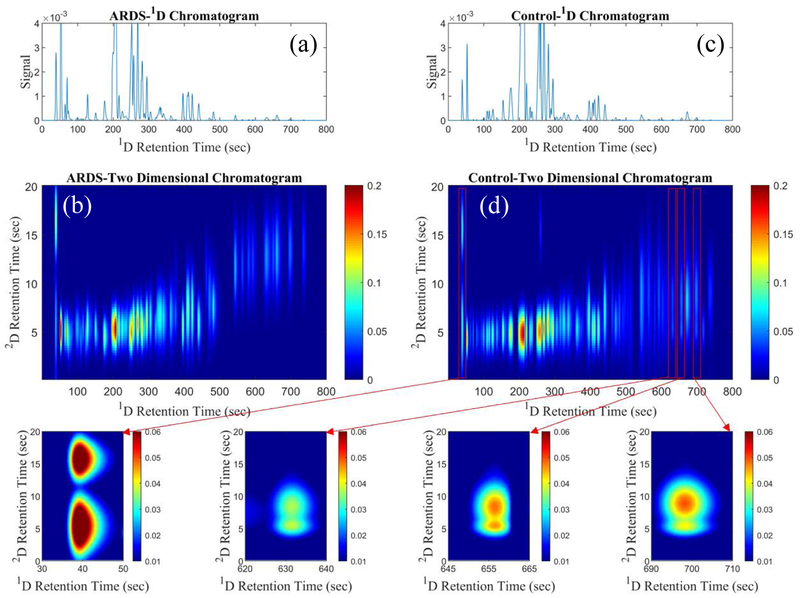
(a) and (b) Representative 1D chromatogram and 2D chromatogram for an ARDS patient, respectively. (c) and (d) Representative 1D chromatogram and 2D chromatogram for a non-ARDS (control) patient, respectively. In the zoomed-in 2D chromatogram for the control patient, four co-eluted 1D peaks are separated into eight peaks in the 2D chromatogram. Other zoomed-in portions of (b) and (d) can be found in ESM Fig. S1
Fig. 5
Fig. 5
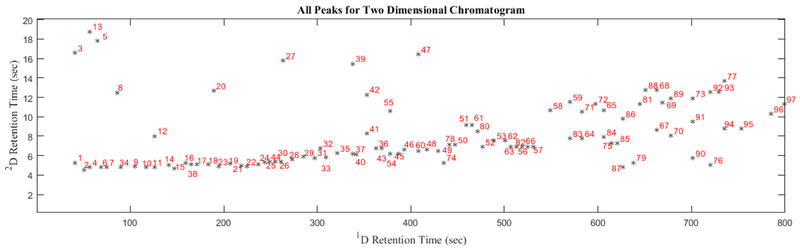
All 97 peaks found collectively in 85 breath samples from 48 patients plotted in a 2D chromatogram, among which 18 pairs (36 peaks) are co-eluted and approximately another 30 peaks are partially co-eluted (with doublets or triplets and separation of adjacent peaks is less than 2σ) from the 1D column. Each dot represents the center of a peak in the contour plot (see, for example, Fig. 4, for a peak contour plot). Note that not all 97 peaks appear in a 2D chromatogram for a particular patient
Fig. 6
Fig. 6
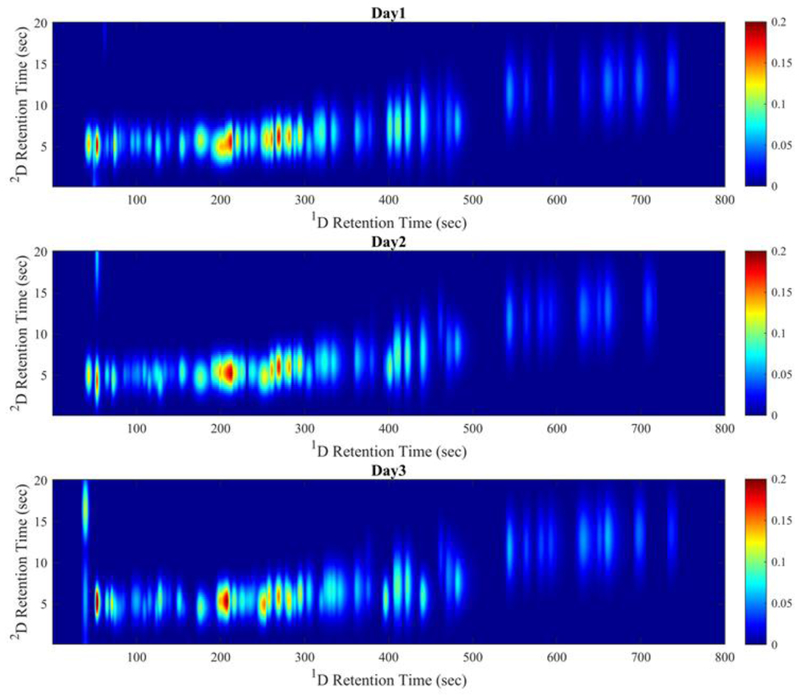
Evolution of the 2D chromatogram of an ARDS patient (Patient #11) during 3 days of monitoring
Fig. 7
Fig. 7
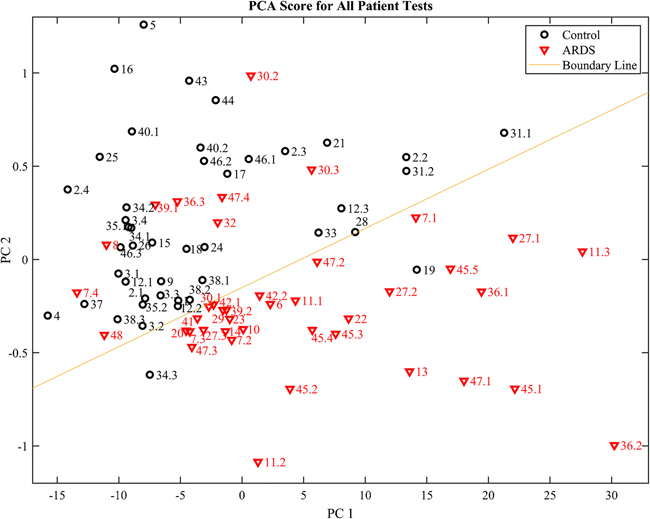
PCA plot of all recruited patients. X-axis (PC 1) is the 1st principal component and Y-axis (PC 2) is the 2nd principal component. The red and black symbols denote respectively the ARDS and non-ARDS patients adjudicated by physicians using the Berlin criteria. The patient numbers are given by the symbol. For example, “11.1” and “11.3” denote Patient #11, Day 1 and Day 3 results, respectively. The bottom/top zone below/above the boundary line represents respectively the ARDS/non-ARDS region using the breath analysis method. The corresponding Q-residuals for this PCA model are shown in ESM Fig. S5
Fig. 8
Fig. 8
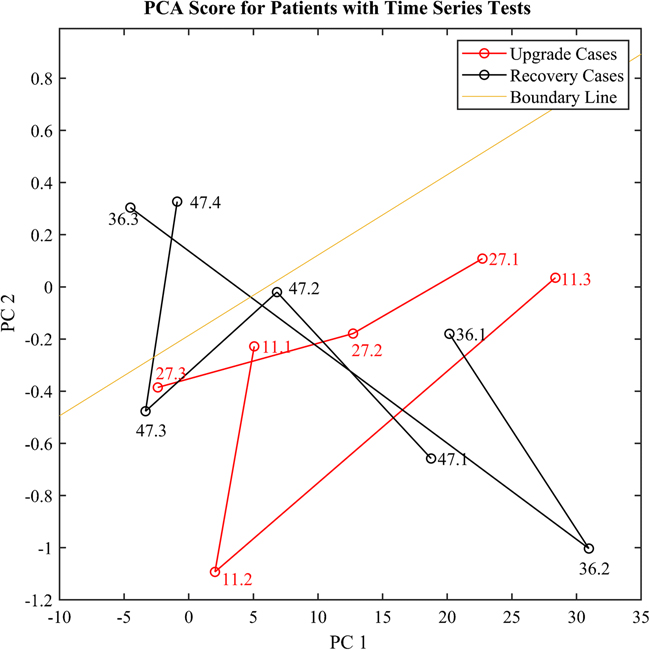
The trajectory on PCA plot for patient #11, #27, #36, and #47. #11 and #27 are the upgrade case (initially listed as potential ARDS on the first day) and #36 and #47 are recovery cases (extubated and discharged from ICU 24–48 hours after the last test). The bottom/top zone below/above the boundary line represents respectively the ARDS/non-ARDS region using the breath analysis method Note: If the breath test results do not match the clinical adjudication, we consider the test as “misclassification” when calculating the overall classification accuracy, even for the cases like #36.3 and #47.4 that suggest that the breath analysis was able to predict the trajectory of ARDS (i.e., earlier diagnosis).

References

    1. Rubenfeld GD, Caldwell E, Peabody E, Weaver J, Martin DP, Neff M, Stern EJ, Hudson LD. Incidence and outcomes of acute lung injury. N Engl J Med. 2005;353(16):1685–93. - PubMed
    1. Zambon M, Vincent J. L. Mortality rates for patients with acute lung injury/ARDS have decreased over time. Chest. 2008;133(5):1120–7. - PubMed
    1. Crader KM, Repine JJD, Repine JE. Breath Biomarkers and the Acute Respiratory Distress Syndrome J Pulmonar Respirat Med. 2012;2(1):111.
    1. Herridge MS, Tansey CM, Matte A, Tomlinson G, Diaz-Granados N, Cooper A, Guest CB, Mazer CD, Mehta S, Stewart TE, Kudlow P, Cook D, Slutsky AS, Cheung AM. Functional disability 5 years after acute respiratory distress syndrome. N Engl J Med. 2011;364(14):1293–304. - PubMed
    1. Mikkelsen ME, Christie JD, Lanken PN, Biester RC, Thompson BT, Bellamy SL, Localio AR, Demissie E, Hopkins RO, Angus DC. The adult respiratory distress syndrome cognitive outcomes study: long-term neuropsychological function in survivors of acute lung injury. Am J Respir Crit Care Med. 2012;185(12):1307–15. - PMC - PubMed