


Risk Factors of Obesity in Veterans of Recent Conflicts: Need for Diabetes Prevention
- PMID: 31368008
- PMCID: PMC7530827
- DOI: 10.1007/s11892-019-1191-9
Risk Factors of Obesity in Veterans of Recent Conflicts: Need for Diabetes Prevention
Abstract
Purpose of review: To identify factors associated with obesity in veterans of the recent, Operation Enduring Freedom (OEF), Operation Iraqi Freedom (OIF), and Operation New Dawn (OND) war conflicts.
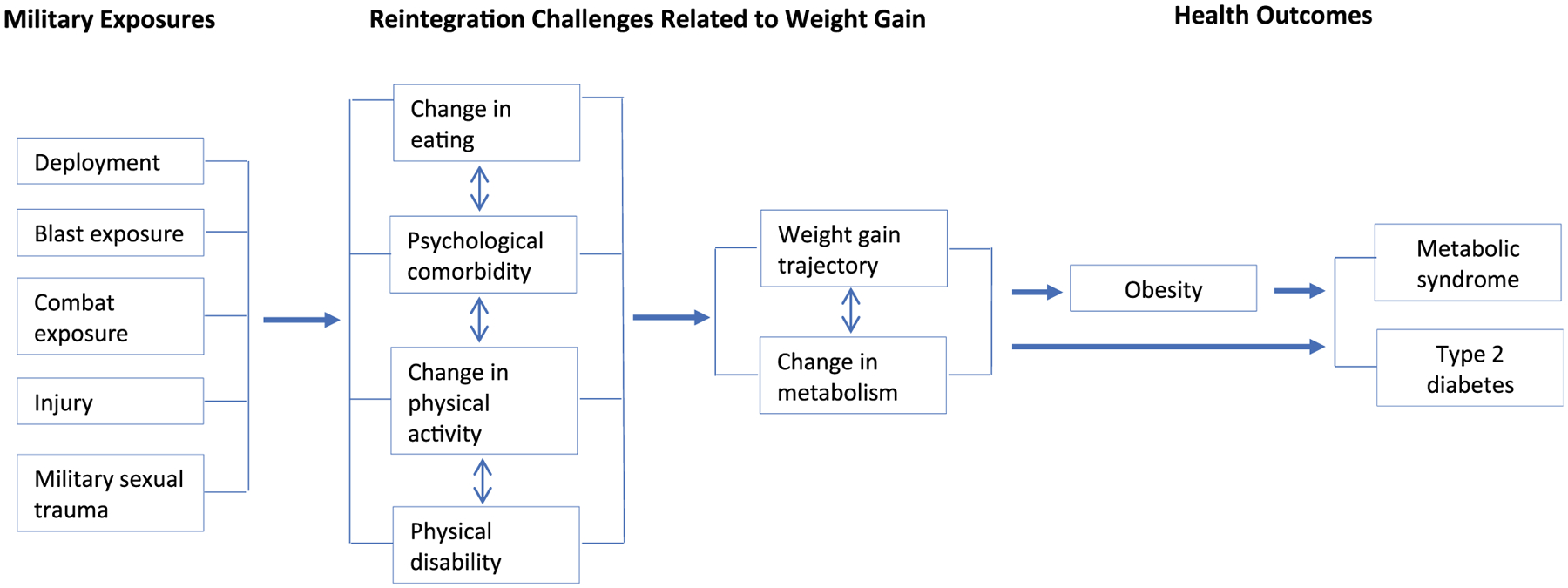
Recent findings: Over 44% OEF/OIF/OND veterans are obese (BMI > 30 kg/m2), which exceeds the national obesity prevalence rate of 39% in people younger than 45. Obesity increases morbidity, risk for type 2 diabetes (T2D), and mortality as well as decreases quality of life. A scoping review method was used to identify factors associated with obesity in young veterans. Military exposures, such as multiple deployments and exposure to combat, contribute to challenges in re-integration to civilian life in all veterans. Factors that contribute to increased risk for obesity include changes in eating patterns/eating disorders, changes in physical activity, physical disability, and psychological comorbidity. These conditions can contribute to a rapid weight gain trajectory, changes in metabolism, and obesity. Young veterans face considerable challenges related to obesity risk. Further research is needed to better understand young veterans' experiences and health needs in order to adapt or expand existing programs and improve access, engagement, and metabolic outcomes in this vulnerable population.
Keywords: Mental health; OEF/OIF/OND; Obesity; Transition to civilian life; Young veterans.
Conflict of interest statement
Figures
References
-
- Dates and Names of Conflicts - Veterans Employment Toolkit. 2015; [updated 20150824. Available from: https://www.va.gov/vetsinworkplace/docs/em_datesNames.asp. Accessed 14 Jun 2019.
-
- Wenger JW, Wenger JW, O’Connell C, O’Connell C, Cottrell L, Cottrell L. Examination of Recent Deployment Experience Across the Services and Components. Santa Monica, CA: RAND Corporation; 2018. https://www.rand.org/pubs/research_reports/RR1928.html. Accessed 9 Jun 2019.
-
- US Department of Veterans Affairs VHA. VA Health Care Utilization by Recent Veterans - Public Health. 2019; [updated 20190226. Available from: https://www.publichealth.va.gov/epidemiology/reports/oefoifond/health-ca.... Accessed 17 Apr 2019.
-
- Cesur R, Sabia JJ, Tekin E. The psychological costs of war: military combat and mental health. J Health Econ. 2013;32(1):51–65. - PubMed
-
- Marmar CR. Mental health impact of Afghanistan and Iraq deployment: meeting the challenge of a new generation of veterans. Depress Anxiety. 2009;26(6):493–7. - PubMed
Publication types
MeSH terms
Grants and funding
LinkOut - more resources
Full Text Sources
Medical
Research Materials
