. 2020 Jan;44(1):81-90.
doi: 10.1111/aor.13534. Epub 2019 Aug 1.

The efficacy of HBOC-201 in ex situ gradual rewarming kidney perfusion in a rat model

Affiliations

The efficacy of HBOC-201 in ex situ gradual rewarming kidney perfusion in a rat model

Paria Mahboub et al. Artif Organs. 2020 Jan.

Abstract

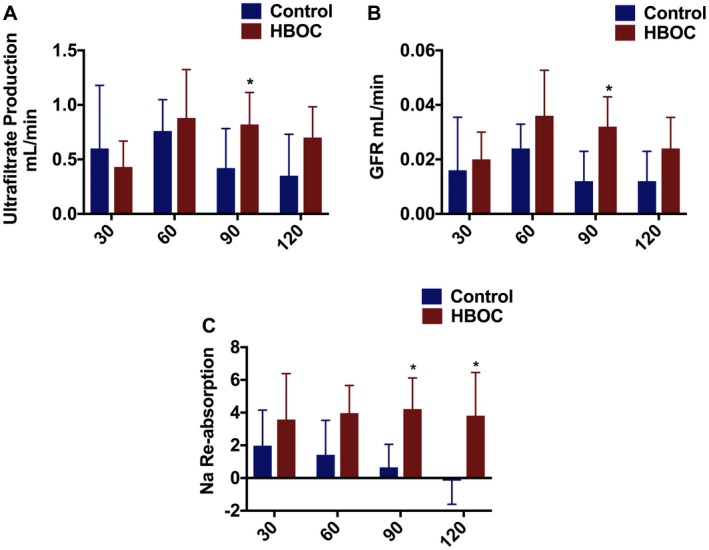
Gradual rewarming from hypothermic to normothermic is a novel perfusion modality with superior outcome to sudden rewarming to normothermic. However, the identification of an oxygen carrier that could function at a temperature range from 4 to 7°C or whether it is necessary to use oxygen carrier during kidney rewarming, remains unresolved. This study was designed to test the use of a hemoglobin-based oxygen carrier (HBOC) during gradual kidney rewarming as an alternative to simple dissolved oxygen. In this study, 10 rat kidneys were randomly divided into the control and the HBOC group. In the control group, no oxygen carrier was used during rewarming perfusion and the perfusion solution was oxygenated only by applying diffused carbogen flow. The protocol mimicked a donor after circulatory death (DCD) kidney transplantation, where after 30 minutes warm ischemia and 120 minutes cold storage in University of Wisconsin solution, the DCD kidneys underwent gradual rewarming from 10 to 37°C during 90 minutes with or without HBOC. This was followed by 30 minutes of warm ischemia in room temperature to mimic the anastomosis time and 120 minutes of reperfusion at 37°C to mimic the early post-transplant state of the graft. The HBOC group demonstrated superior kidney function which was highlighted by higher ultrafiltrate production, better glomerular filtration rate and improved sodium reabsorption. There was no significant difference between the 2 groups regarding the hemodynamics, tissue injury, and adenosine triphosphate levels. In conclusion, this study suggests better renal function recovery in DCD kidneys after rewarming with HBOC compared to rewarming without an oxygen carrier.

Keywords: donor after circulatory death kidney graft; hemoglobin-based oxygen carrier; oxygen carrier; perfusion; rewarming perfusion.


Conflict of interest statement

The authors of this manuscript have conflicts of interest to disclose: Dr. Uygun is inventor on pending patents relevant to this study. Dr. Uygun has a financial interest in Organ Solutions, a company focused on developing organ preservation technology. Dr. Uygun's interests are managed by the MGH and Partners HealthCare in accordance with their conflict of interest policies. Drs. Tessier and Uygun have several IP disclosures on extended organ preservation that may be relevant to this study. The HOBC‐201 used in this study was provided by HBO2 Therapeutics LLC.

Figures
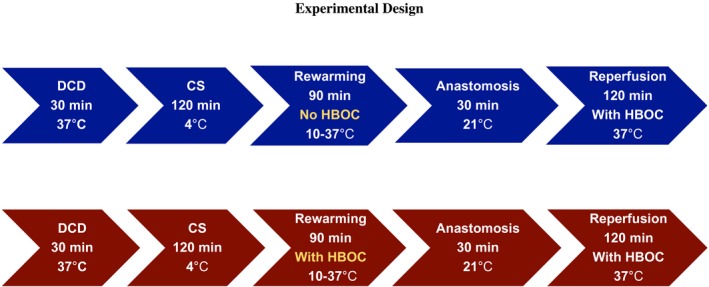
Figure 1
Figure 1
Experimental design. Illustrates the experimental design of the study and the duration in each section of the experiments [Color figure can be viewed at https://www.wileyonlinelibrary.com]
Figure 2
Figure 2
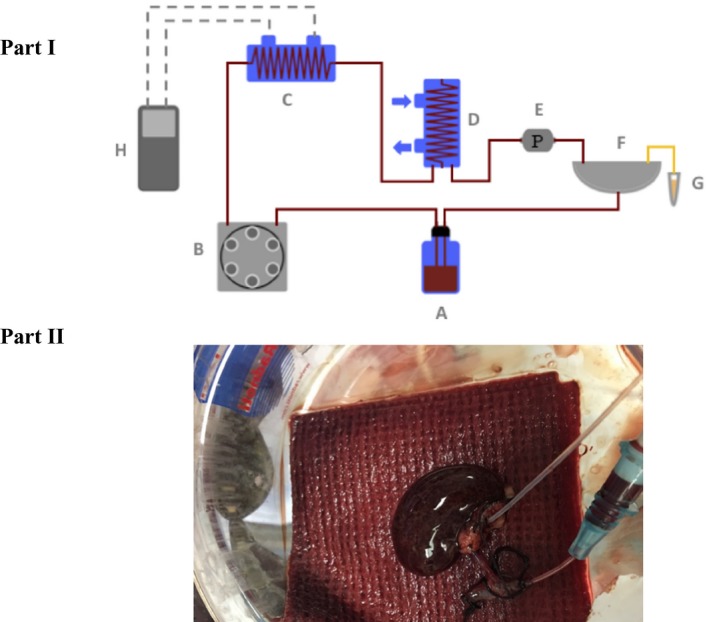
Graphic representation of the rodent kidney perfusion system. Part I: A, Solution reservoir; B, Roller pump; C, Heat exchanger and oxygenator containing silicone tubing and providing carbogen; D, Bubble trap; E, Pressure probe; F, Organ chamber; G, Urine Eppendorf; H, Thermostat which regulates the temperature. Part II: This picture shows a cannulated rat kidney during machine perfusion [Color figure can be viewed at https://www.wileyonlinelibrary.com]
Figure 3
Figure 3
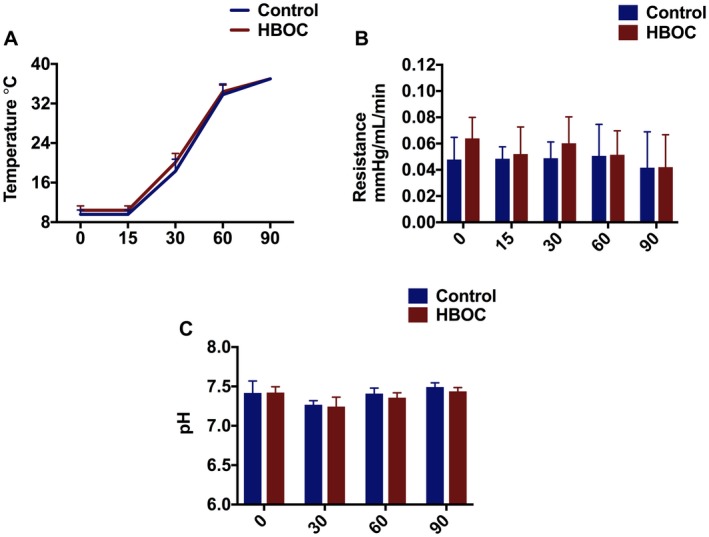
Kidney profile during gradual rewarming. A, Temperature. B, Renal Resistance, which slightly reduced during gradual rewarming in the both HBOC and control groups. C, pH was in the physiologic range during gradual rewarming. D, Oxygen consumption [Color figure can be viewed at https://www.wileyonlinelibrary.com]
Figure 4
Figure 4
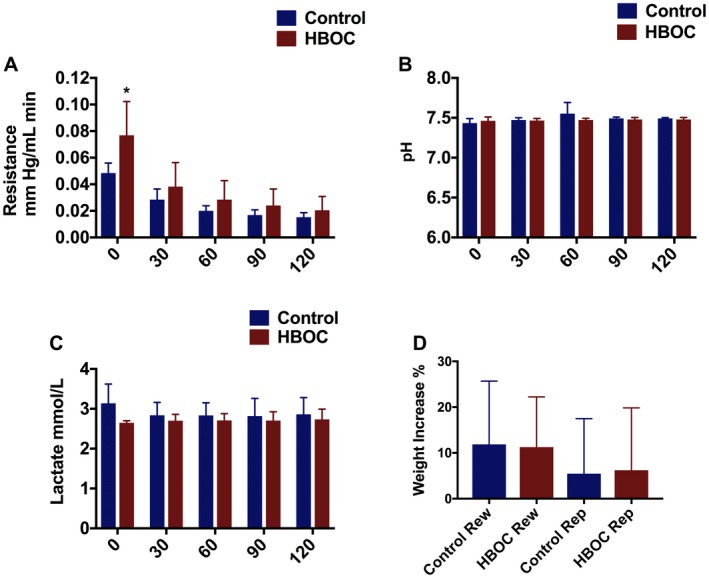
Kidney profile during reperfusion. A, Resistance was high in the both groups in the beginning of the reperfusion with significant difference, and then was reduced in both groups toward the end of reperfusion with no difference. B, pH was in normal range in the both groups with no significant difference. C, There was no significant difference in the lactate level between both groups. D, This graph indicates the weight gain during rewarming and reperfusion phase in both groups with no significant difference. *P ≤ 0.05 [Color figure can be viewed at https://www.wileyonlinelibrary.com]
Figure 5
Figure 5
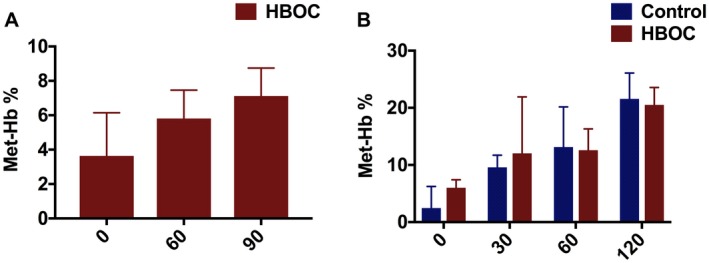
Kidney Met‐Hb during rewarming and reperfusion. A, Represents Met‐Hb level in the HBOC group during rewarming. B, Indicates a gradual increase in Met‐Hb level in the both HBOC and control groups during 120 minutes of reperfusion [Color figure can be viewed at https://www.wileyonlinelibrary.com]
Figure 6
Figure 6
Kidneys undergoing gradual rewarming show improved function and recovery compared to controls during reperfusion. A, The volume of ultrafiltrate production was measured every 30 minutes and was improved in the HBOC group and this was significant at t = 90. B, GFR was superior in the HBOC group with significant differences at t = 90. C, Fractional sodium re‐absorption was gradually increased in the HBOC group while it was decreased in the control group with significant differences at t = 90 and t = 120. *P ≤ 0.05 [Color figure can be viewed at https://www.wileyonlinelibrary.com]
Figure 7
Figure 7
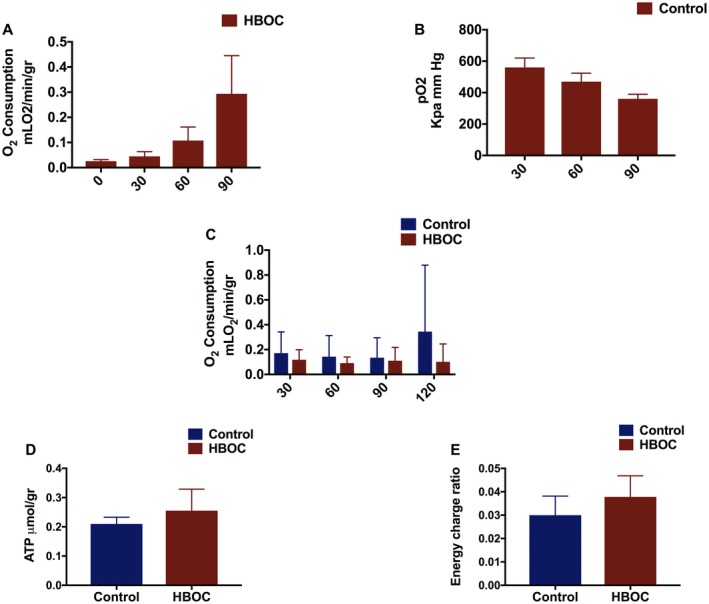
Graphical presentation of oxygen concentration, ATP level, and energy charge ratio in the rewarming and control groups. A, This graph demonstrates oxygen consumption during 90 minutes rewarming in the HBOC group. B, The difference between arterial pO2 and venous pO2 during rewarming phase in the control groups is shown in this graph. C, Oxygen consumption remained the same in the both groups during reperfusion. D, E, ATP and energy charge ratio trended higher in the HBOC group with no significant difference between the groups [Color figure can be viewed at https://www.wileyonlinelibrary.com]
Figure 8
Figure 8
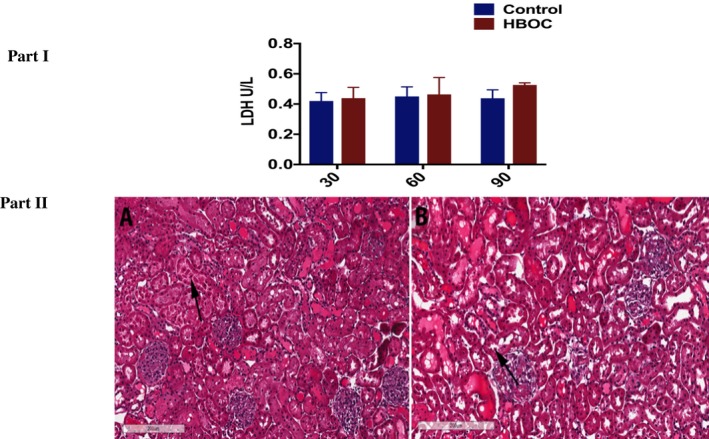
Renal Injury and H & E staining of kidney tissue from HBOC and control groups at the end of reperfusion. Part I: No difference was observed in LDH levels between the 2 groups. Part II: A, HBOC. B, Control. The arrow in the both groups shows slight epithelial shredding [Color figure can be viewed at https://www.wileyonlinelibrary.com]

References

    1. Mahboub P, Bozorgzadeh A, Martins PN. Potential approaches to improve the outcomes of donation after cardiac death liver grafts. World J Transplant. 2016;6:314–20. - PMC - PubMed
    1. Anderson PT, Aquil S, McLean K, McAlister VC, Sener A, Luke PP. First Canadian experience with donation after cardiac death simultaneous pancreas and kidney transplants. Can J Surg J Can Chir. 2017;60:323–8. - PMC - PubMed
    1. Op den Dries S, Karimian N, Porte RJ. Normothermic machine perfusion of discarded liver grafts. Am J Transplant Off J Am Soc Transplant Am Soc Transpl Surg. 2013;13:2504. - PubMed
    1. Mahboub P, Ottens P, Seelen M, ‘t Hart N, Van Goor H, Ploeg R, et al. Gradual rewarming with gradual increase in pressure during machine perfusion after cold static preservation reduces kidney ischemia reperfusion injury. PLoS One 2016;11:e0152006. - PMC - PubMed
    1. Westerkamp AC, Mahboub P, Meyer SL, Hottenrott M, Ottens PJ, Wiersema‐Buist J, et al. End‐ischemic machine perfusion reduces bile duct injury in donation after circulatory death rat donor livers independent of the machine perfusion temperature. Liver Transplant Off Publ Am Assoc Study Liver Dis Int Liver Transplant Soc. 2015;21:1300–11. - PubMed