Review
. 2020 Apr 1;32(10):659-676.
doi: 10.1089/ars.2019.7725. Epub 2019 Sep 9.

Redox Systems Biology: Harnessing the Sentinels of the Cysteine Redoxome

Affiliations
Review

Redox Systems Biology: Harnessing the Sentinels of the Cysteine Redoxome

Jason M Held. Antioxid Redox Signal. .

Abstract

Significance: Cellular redox processes are highly interconnected, yet not in equilibrium, and governed by a wide range of biochemical parameters. Technological advances continue refining how specific redox processes are regulated, but broad understanding of the dynamic interconnectivity between cellular redox modules remains limited. Systems biology investigates multiple components in complex environments and can provide integrative insights into the multifaceted cellular redox state. This review describes the state of the art in redox systems biology as well as provides an updated perspective and practical guide for harnessing thousands of cysteine sensors in the redoxome for multiparameter characterization of cellular redox networks. Recent Advances: Redox systems biology has been applied to genome-scale models and large public datasets, challenged common conceptions, and provided new insights that complement reductionist approaches. Advances in public knowledge and user-friendly tools for proteome-wide annotation of cysteine sentinels can now leverage cysteine redox proteomics datasets to provide spatial, functional, and protein structural information. Critical Issues: Careful consideration of available analytical approaches is needed to broadly characterize the systems-level properties of redox signaling networks and be experimentally feasible. The cysteine redoxome is an informative focal point since it integrates many aspects of redox biology. The mechanisms and redox modules governing cysteine redox regulation, cysteine oxidation assays, proteome-wide annotation of the biophysical and biochemical properties of individual cysteines, and their clinical application are discussed. Future Directions: Investigating the cysteine redoxome at a systems level will uncover new insights into the mechanisms of selectivity and context dependence of redox signaling networks.

Keywords: cysteines; mathematical modeling; oxidation; proteomics; redox; systems biology.


Figures
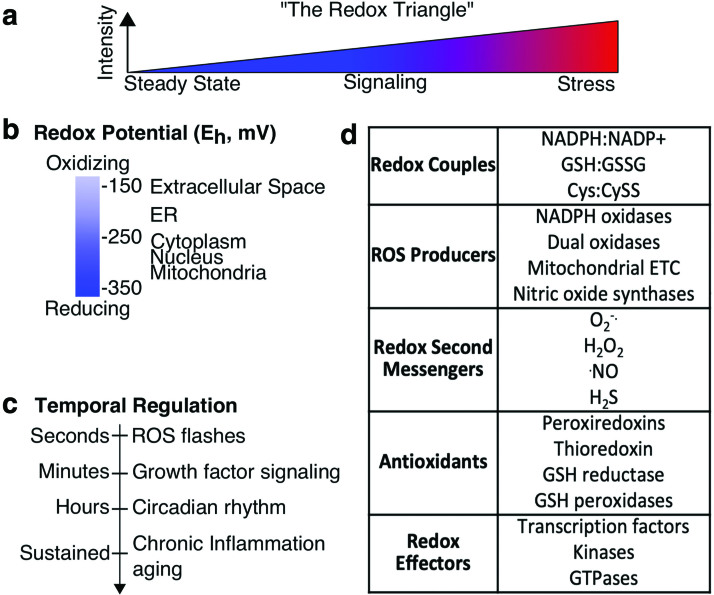
FIG. 1.
FIG. 1.
Redox systems biology: curse of dimensionality. (a) The redox triangle is a common representation of the cellular redox state, with the Y-axis generally vague as is typical. (b) Redox potentials (millivolts, mV) vary widely between organelles and (c) across temporal scales. (d) Cellular redox components include redox couples, ROS producers, redox active second messengers, antioxidants, and redox effectors. ROS, reactive oxygen species. Color images are available online.
FIG. 2.
FIG. 2.
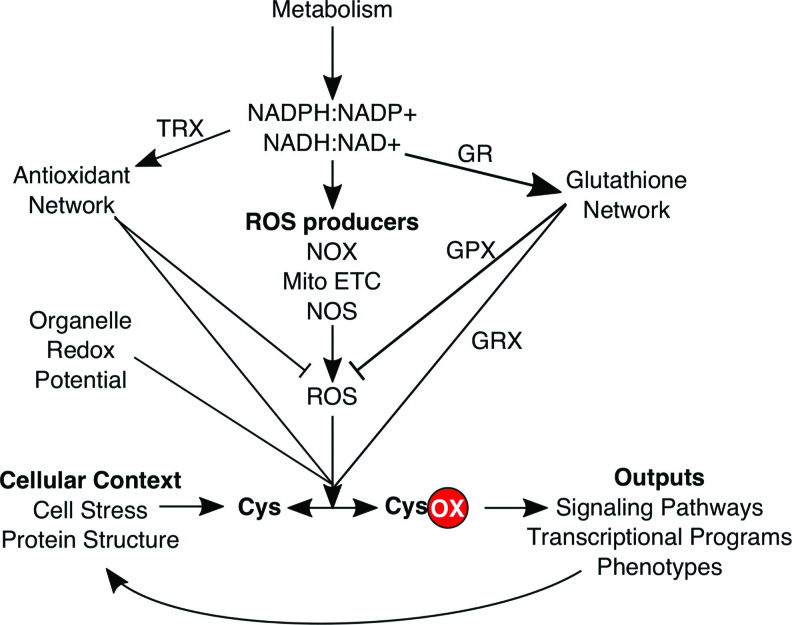
Cysteines as sentinels of multiple redox modules: ROS, redox couples, cellular location and context, and metabolism. Simplified network diagram of the redox and nonredox inputs and outputs tuned to redox regulation of the cysteine redoxome. Key proteins and molecules are indicated. mito, mitochondria; ox, oxidized. Color images are available online.
FIG. 3.
FIG. 3.
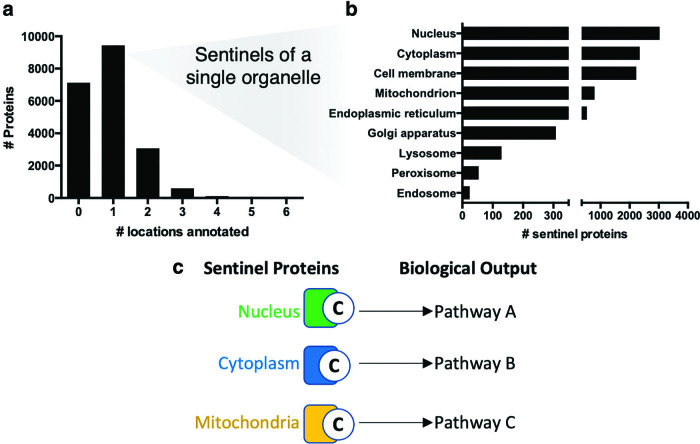
Protein sentinels of subcellular compartments. (a) Distribution of the number of organelles assigned by the COMPARTMENTS database (19) to each human protein using the locations in (b). (b) Subcellular localization of all single organelle-localized protein sentinels. (c) Cysteines in sentinel proteins can indicate localized redox regulation of specific regulatory pathways. Color images are available online.
FIG. 4.
FIG. 4.
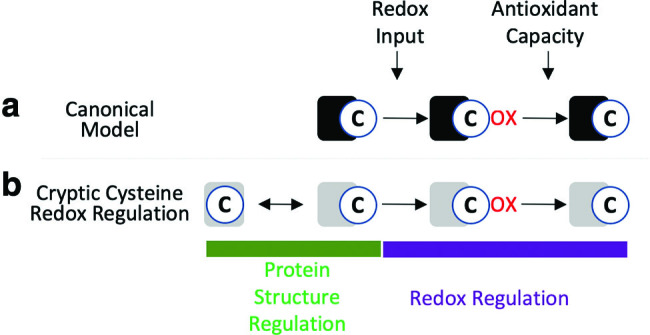
Protein structural changes specify context-dependent regulation of the cysteine redoxome and redox signaling networks. (a) Cysteines are the targets of oxidation and reduction, and in the canonical model cysteines that are solvent accessible can be redox regulated. (b) Recent studies (6, 15, 62) suggest that cryptic cysteines, those that become solvent exposed only upon a stimulus, can provide further context dependence of cysteine redox regulation via redox-independent changes in protein structure. Color images are available online.
FIG. 5.
FIG. 5.
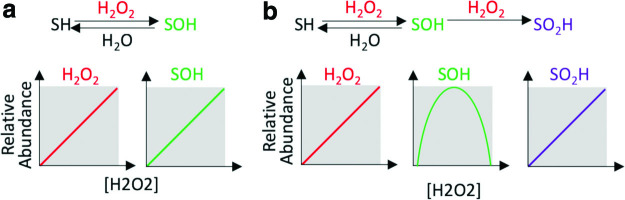
Nonintuitive, nonlinear redox regulation of cysteine sulfenation by H2O2. (a) In a kinetic model including only H2O2 and cysteine sulfenation (SOH), the concentrations of [H2O2] and [SOH] are directly related. While intuitive, this does not fit the empirical results in which H2O2 is biphasic, increasing [SOH] up to a point, beyond which [SOH] decreases. (b) Inclusion of cysteine sulfination (SO2H), the reaction product of SOH + H2O2, generates the observed biphasic relationship of [SOH] to [H2O2]. H2O2, hydrogen peroxide. Color images are available online.
FIG. 6.
FIG. 6.
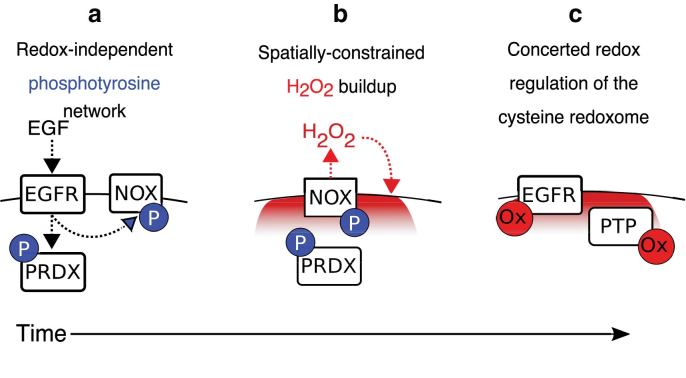
Temporal separation of redox-dependent and -independent events is a key design principle of the EGFR signaling network. (a) Redox-dependent signaling is delayed from redox-independent signaling after EGF stimulation. EGF initially stimulates local phosphotyrosine signaling cascades, an important activator of NOX and inhibitor of PRDX activity, (b) delaying ROS production and spatially constraining the H2O2 produced to the plasma membrane. (c) Cysteines in multiple proteins, including EGFR and PTPs, are concertedly redox regulated. EGF, epidermal growth factor; EGFR, epidermal growth factor receptor; NOX, NADPH oxidase; PRDX, peroxiredoxin; PTP, protein tyrosine phosphatase. Color images are available online.

References

    1. Abramczyk O, Rainey MA, Barnes R, Martin L, and Dalby KN. Expanding the repertoire of an ERK2 recruitment site: cysteine footprinting identifies the D-recruitment site as a mediator of Ets-1 binding. Biochemistry 46: 9174–9186, 2007 - PMC - PubMed
    1. Adimora NJ, Jones DP, and Kemp ML. A Model of redox kinetics implicates the thiol proteome in cellular hydrogen peroxide responses. Antioxid Redox Signal 13: 731–743, 2010 - PMC - PubMed
    1. Akavia UD, Litvin O, Kim J, Sanchez-Garcia F, Kotliar D, Causton HC, Pochanard P, Mozes E, Garraway LA, and Pe'Er D. An integrated approach to uncover drivers of cancer. Cell 143: 1005–1017, 2010 - PMC - PubMed
    1. Akter S, Fu L, Jung Y, Conte M Lo, Lawson JR, Lowther WT, Sun R, Liu K, Yang J, and Carroll KS. Chemical proteomics reveals new targets of cysteine sulfinic acid reductase. Nat Chem Biol 14: 995–1004, 2018 - PMC - PubMed
    1. Al-barakati HJ, McConnell EW, Hicks LM, Poole LB, Newman RH, and Kc DB. SVM-SulfoSite: a support vector machine based predictor for sulfenylation sites. Sci Rep 8: 11288, 2018 - PMC - PubMed

Publication types

LinkOut - more resources